Motor Insurance In India

Motor Insurance – Overview

Today, having your own vehicle and commuting using your own vehicle has become a necessity rather than a luxury. Short distance commute can be done easily by motorbikes and other two-wheelers whereas long-distance commute needs a four-wheeler. Travelling by a two-wheeler is advantageous in case of heavy traffic and it is also fun, especially for the younger generations; whereas commuting by a four-wheeler gives comfort.

However, several risk factors are associated when you are commuting either by motorbike or by a car on the Indian roads. So, it is necessary to ensure the protection of your vehicle against any such risk factors and this can be feasible by vehicle insurance or motor insurance.

Vehicle insurance or motor insurance is an agreement between the insurance provider and you for ensuring the protection of your vehicle in case of an unprecedented incident on the roads. Vehicle insurance is a mandate for all vehicles that are being used on the Indian roads. The main objective of vehicle insurance or motor insurance is to ensure the protection of your vehicle against any damage caused by natural or man-made calamities. With the recent amendments made to the Motor Vehicle Act, 2019 it has become extremely important to know about the different aspects associated with Motor Insurance.

Importance and benefits of buying a vehicle insurance policy:

So, why do you need motor insurance or vehicle insurance? Let us find out the major reasons and benefits of having vehicle insurance.

  1. Reduces liabilities

    Third-party liability insurance coverage is mandatory in India. In case of an accident caused by you, the third-party liability insurance will cover all the expenses incurred in the treatment or repair of the third party person or vehicle.

  2. Payment for damages

    The cost incurred in repairing vehicles i.e. a car or a motorbike is always high. There might be accidents and your vehicle will need repairs. In such a case, if you have vehicle insurance you will not have to pay the expenses from your pocket.

  3. Hospitalization expenses

    Some road accidents can be major incidents and can cause serious injuries. The treatment and hospitalization expenses incurred can be too high. If you have vehicle insurance or motor insurance and you have chosen the medical expenses add-on, you do not need to worry about these expenses and can focus on your treatment.

  4. Compensation for your family

    There can be some very serious road accidents in which the owner of the vehicle passes away. This would be a matter of financial emergency for the family members of the demised person. By vehicle insurance, the insurance provider can provide compensation to the family of the demised person.

  5. Online vehicleinsurance

    When you buy online vehicle insurance, then it is usually cheaper as there is no commission that needs to be paid to the distributors.

  6. Reduced stress level

    Vehicle insurance will reduce your levels of stress and you would be able to enjoy peace of mind.

Reasons to buy motor insurance with a number of road accidents

The deteriorating condition of the Indian roads, increase in the number of vehicles on the roads and the negligent attitude of the young drivers towards traffic rules are the major reasons for the increase in the number of accidents in India.

Due to these reasons, many insurance providers in India have included several benefits along with the motor insurance policy. Facilities like cashless claims at garages which are included in the network of the insurance company, towing facility, roadside assistance, invoice protection cover, accident cover; consumables cover, etc. are being offered as add-ons to vehicle owners for ensuring all-round protection of their vehicle.

According to a global report on the statistics of road accidents by WHO,

  1. The number of road accidents in India was 129,965.
  2. The number of road accidents in China was 80,500.
  3. The number of road accidents in the USA was 60,780.
  4. The number of road accidents in Russia was 40,890.
  5. The number of road accidents in the UK was 7689.

This data, when represented in the form of a pie-chart, shows that the highest percentage of road accidents occur in India. The need for road safety awareness and vehicle insurance is most required in India.
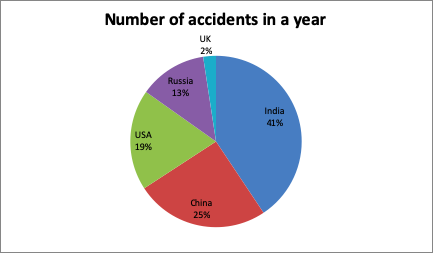
No of accidents in year

Different Types of Motor Insurance Policies in India:

Here is a list of different types of motorinsurance policies that are available in India:

  1. Third-Party Vehicle Insurance Policy

    Third-party vehicle insurance policy is mandated by the Government of India to ply the vehicles on the Indian roads as per the Motor Vehicles Act, 1988. A third-party liability only insurance policy provides coverage for the damages and the loss that has been incurred by a third-party person, property or vehicle by your vehicle.

    This is an insurance policy which saves the owner from all legal liabilities in case of an accident. The insurer bears the expenses arising out of the eventuality as long as the owner has a valid third-party motor insurance policy at the time of the accident.

    A third-party vehicle insurance policy covers any damage done to a third person’s property or vehicle or any bodily injury to a third-person resulting in death, disability or dismemberment or any legal liabilities arising from the same towards the owner.

  2. Comprehensive Vehicle Insurance Policy

    A comprehensive motor insurance policy provides for complete protection of the vehicle towards damages done for own vehicle along with third-party coverage. This complete coverage includes any damage that has been caused to the car which is insured, any third-party liabilities and personal accidents.

    The different types of comprehensive vehicle insurance policies are:

    1. Private Car Insurance

      Private Car insurance Policies will cover any damages caused to your own car or a third-party car because of accidents occurred. To obtain a good car insurance policy, you should compare car insurance policies online and select the best one.

    2. Two-wheeler Insurance

      Two-wheeler insurance provides coverage for any damages caused to scooters or motorbikes and its riders during accidents. It also covers any damage caused to two-wheelers due to natural calamities or man-made disasters like theft, riots, etc. Generally, there are two types of two-wheeler insurance policy i.e. Comprehensive two-wheeler insurance policy and liability-only two-wheeler insurance policy.

    3. Commercial Vehicle Insurance

      Those vehicles which are used for business purposes are known as Commercial vehicles. Commercial vehicle insurance is available for vehicles such as buses, taxis, ambulances and other vehicles like shovels, tractors, etc. By commercial vehicle insurance, coverage is provided by the insurance provider for damage caused to the vehicle due to accidents.

  3. Long term vehicle insurance policy

    A long term vehicle insurance policy is one that provides coverage for more than a year. In the case of two-wheeler insurance plans, long term comprehensive coverage is available for two or three continuous years. For car insurance plans, however, long term comprehensive coverage is not available.

    Moreover, for new vehicles, long term third party liability coverage is a must. This coverage should be availed as follows –

    • For new two-wheelers, long term third party liability cover for 5 years is mandatory
    • For new cars, long term third party liability cover for 3 years is mandatory 
  4. Bundled vehicle insurance policy

    A bundled vehicle insurance policy is one that offers long term third party coverage and annual comprehensive coverage. This type of policy is available for new vehicles. The different types of bundled plans available in the market are as follows –

    • Bundled two wheeler insurance plans wherein the third party coverage is offered for 5 years and own damage coverage is offered for 1 year
    • Bundled car insurance plans wherein the third party coverage is offered for 3 years and own damage coverage is offered for 1 year
  5. Pay-as-you-drive motor insurance plans

    Launched under the Sandbox initiative of the IRDAI, pay-as-you-drive motor insurance plans are flexible policies that allow you to insure your vehicle only when you use it. Coverage is allowed for both third party and own damage liabilities. Premium depends on the usage of the vehicle that you declare when buying the plan. Since the coverage is usage based, the premiums are quite low. Presently, only a handful of insurance companies are offering this type of policy.

Inclusions of Motor Insurance Plans in India:

Let us know about the damages which are covered under motor insurance or vehicle insurance.

  • Any damage caused to the vehicle due to natural calamities like earthquakes, storms, cyclones, floods, lightning, landslide, etc. are covered
  • Any damage caused to the insured vehicle due to man-made calamities like fire, self-explosion, riots, malicious acts, strikes, etc. are covered 
  • The loss or theft of the vehicle that has been insured is covered under vehicle insurance.
  • Any third party liabilities incurred by the third party person or vehicle during an accident is covered under vehicle insurance. Such liabilities might arise if any third party is physically injured, killed or if any third party property is damaged by the insured vehicle. 
  • Damages suffered when the vehicle is being transported from one location to another through air, water, or land.
  • Vehicle insurance also offers personal accident cover for the insured vehicle’s driver/owner. This coverage allows additional benefits payable in the case of accidental death or permanent disablement. The sum insured is INR 15 lakhs. The personal accident cover, however, is not mandatory. If you have an existing personal accident cover independently or with another policy, you can skip this cover. If, however, you are not insured under any personal accident cover, you need to buy the coverage offered by vehicle insurance plans. 

Exclusions of Motor Insurance Plans in India:

The below-mentioned damages caused to a vehicle are not covered under vehicle or motor insurance.

  1. Any damage caused to a vehicle due to the effect of alcohol or drugs on the driver.
  2. Damage caused to the vehicle due to wear and tear or ageing of the vehicle.
  3. Any damage caused to the vehicle being driven by a driver without a valid driving license.
  4. Any electrical or mechanical breakdown of the vehicle.
  5. Any damage caused to the vehicle outside the boundary of India.
  6. Damages suffered when the policy has lapsed
  7. Self-inflicted or deliberate damages
  8. Consequential losses
  9. Damages due to war, mutiny or nuclear perils
  10. Damages suffered when engaging in a criminal or hazardous act

List of the most common add-on covers in comprehensive motor insurance:

There are several add-on plans which can be included in your motor insurance policy to enhance the coverage provided. Some of these add-on covers can be mentioned below.

  1. Zero depreciation cover

    In the case of a claim, depreciation suffered by the parts of the car is not covered. The insurance company deducts the depreciation charges and then settles the claim. This results in out-of-pocket expenses for the policyholder and reduces the claim amount. However, when a policyholder opts for this add-on, the effect of depreciation is negated. The full value of the repaired or replaced parts is paid as claim.

  2. Key replacement cover

    In case of a key being lost, the policyholder will be eligible to claim reimbursement for the cost of the substitute key.

  3. Roadside assistance cover

    Roadside assistance cover helps in assisting at remote locations in case of issues like flat tires, fuel issues, battery problems, etc. If your vehicle breaks down in the middle of a remote location, you can call the insurer’s helpline number, 24*7, and get any type of assistance that you need. 

  4. NCB protect cover

    In case of no claims made by a policyholder during a policy term, the policyholder is rewarded with a no claim bonus. The bonus starts from 20% and can increase up to 50% if you don’t make a claim in successive policy years. You can use the accumulated bonus to claim a premium discount at the time of renewals. However, if there is even a single claim under the policy, the entire no claim bonus is lost. The NCB protect cover protects the accumulated no claim bonus even when you make a claim.

  5. Engine protection cover

    By the engine protection cover, if there is any damage caused to the vehicle’s engine, due to water seepage, then the repair or replacement cost will be covered by the insurance provider.

  6. Return to invoice cover

    If your vehicle is completely damaged or if it is stolen, the insurance company would pay the invoice value of the vehicle as claim if you choose this add-on.

  7. Personal accident cover for passengers

    Through this add-on you can extend the personal accident cover for the passengers travelling with you in the vehicle. If the passengers suffer accidental death or disablements, the cover would pay a lump sum benefit.

  8. Consumables cover

    This add-on covers the cost of consumables used at the time of repairs which is otherwise excluded from coverage. 

  9. Medical expenses cover

    If you choose this add-on and you are hospitalized following an accident in the vehicle, the medical costs incurred on treating your injuries would be covered.

  10. Loss of personal belongings cover

    Under this add-on the loss or theft of personal belongings from the vehicle is covered. The insurance company reimburses you for the loss suffered. 

Different plans offered with features and coverage

As there are several insurance providers providing various motorinsurance policies in India, let us list down the major ones.

  1. Tata AIG Motor Insurance Policy

    Some of the motorinsurance plans offered by Tata AIG are mentioned below.

    • Auto Secure Two-wheeler package policy
    • Long Term Two-wheeler package policy<
    • Auto Secure –Private car package policy
    • Auto Secure commercial vehicle package policy

    The major features of the motorinsurance plans offered by Tata AIG are as follows.

    • Personal accident covers for owner and driver
    • Coverage against third party liabilities
    • Coverage against loss or damage caused to the insured vehicle by any natural or manmade calamities.
    • Inclusion of several add-ons for providing comprehensive coverage to policyholders.
  2. Reliance General Motor Insurance Policy

    Reliance Insurance provides various plans related to motor insurance such as two-wheeler insurance policy, Private Car Insurance policy, Commercial vehicle insurance policy, etc. The major features associated with Reliance motor insurance policy are as follows.

    • Coverage against damage caused to the vehicle due to natural calamities like fire, lightning, flood, earthquake, flood, cyclone, etc.
    • Coverage against damage caused to the vehicle due to manmade calamities like theft, riots, strikes, terrorism, malicious activities, etc.
    • Instant purchase of policy online without any hassle and paperwork.
    • Cashless access to garages that are covered under the network of Reliance India Co. Limited.
    • Motorinsurance renewal can be done online without any paperwork.
    • 24×7 roadside assistance add-on covers for the policyholders.
    • Discount up to 70% on insurance premium for both car insurance and two-wheeler insurance policies.
    • Very quick claim settlement for the policyholders.
  3. HDFC Ergo General Motor Insurance Policy

    HDFC Ergo is one of the popular motorinsurance providers in India. Some of the car insurance policies offered by HDFC Ergo are Long Term comprehensive car insurance, Third-party liability car insurance, Single year comprehensive car insurance, Long term comprehensive two-wheeler insurance plan, Two-wheeler liability only insurance, Standalone motor own damage cover-two- wheeler, etc.

    • HDFC Ergo vehicle insurance policy provides coverage against accidental damages, thefts, and other manmade calamities.
    • Coverage against third-party liabilities incurred for both i.e. person and vehicle.
    • HDFC Ergo vehicleinsurance policy provides personal accident cover.
    • Add-ons coverage such as NCB cover, Engine protects cover, Key replacement cover, Emergency assistance cover, return to invoice cover, etc.

    • Customer support is available always 24×7 for efficient query resolution of customers.
    • Paperless and boundless work procedure. 
  4. Bajaj Allianz General Motor Insurance Policy

    Bajaj Allianz offers vehicle insurance policies for two-wheelers, four-wheelers, commercial vehicles, etc. The major features and benefits offered by Bajaj Allianz’s vehicle insurance policies are mentioned below.

    • Instant online insurance policy purchase and renewal.
    • Policyholders can avail NCB cover for around 20%-50% discount on insurance premiums.
    • 24×7 customer support to assist in claim settlement and other issues related to the motorinsurancepolicy.
    • Cashless claims can be made at garages that come under the network of Bajaj Allianz.
    • Several add-ons, emergency assistance cover, and good quality services.
  5. Royal Sundaram Motor Insurance Policy

    Royal Sundaram is a popular name in the motor insurance market of India. Vehicleinsurance policies such as two-wheeler insurance policy, commercial vehicle insurance, car insurance, etc. are some of the eminent insurance policies offered by Royal Sundaram.

    • Coverage against natural calamities like a landslide, floods, fire, terrorism, etc.
    • Coverage against accidents and other manmade calamities like terrorism, theft, burglary, malicious acts, etc.
    • Personal accident cover is provided to the policyholders.
    • Coverage for any third-party liabilities incurred.
    • Cashless claims in network garages

Parameters that help decide the premium:

Certain eminent parameters which help in determining the premium of your vehicle insurance are mentioned below.

  1. Make, Model and age of the Vehicle

    The premium of the vehicle depends on the make, model and the age of the vehicle. The premium for motor insurance policy varies from one vehicle to another depending on the make of the vehicle. Since the models of vehicles are different from each other, the insurance premium is also different.

    Even petrol and diesel variants of the same vehicle have different insurance premiums.

  2. IDV

    The Insured Declared Value or the IDV is the market value of a vehicle adjusted with the vehicle’s age-based depreciation. The IDV also represents the maximum claim liability of the insurance company in the case of own damage claim. The insurance premium is, therefore, high for those vehicles which have a higher IDV.

  3. Geographic location

    The insurance premium for vehicles belonging to those locations is higher where there are more risks associated with natural and man-made calamities. Similarly, if your vehicle is registered in a metro city, the premium would be higher compared to those in non-metro cities.

  4. Add-ons selected

    Additional covers increase the scope of coverage of the motor insurance plan. So, if you opt for add-ons, your vehicle insurance premium would increase.

  5. Type of policy

    Third party plans have lower premiums because of the limited scope of coverage that they offer. On the other hand, comprehensive vehicle insurance plans offer a wider scope of coverage and charge a higher amount of premium.

  6. Age of the vehicle

    Older vehicles have reduced values and so their premiums are also lower compared to newer ones.

  7. Claim history

    If you are renewing an existing motor insurance policy, the claim history would also affect the premium. If you have not made claims in the previous years, you can claim a no claim discount that would reduce the premium amount. On the other hand, if claims had been made, the no claim discount would not be available and the premiums would be higher.

  8. Discounts available

    Motor insurance plans allow different types of premium discounts. If you can avail of the discounts, the premiums would be lowered.

How to reduce the premium for a motor insurance policy?

Let us have a look at some of the easy methods to reduce the premium for a motor insurance policy.

  1. Installing anti-theft devices in vehicles

    By installing anti-theft devices in your vehicle, you are reducing the chances of theft of your vehicle. As your vehicle is not exposed to the risk of theft, your insurance provider will charge a lower premium from you.

  2. No claim bonus (NCB)

    There are several discount options available on the premium of vehicle insurance. When you have a good claim history and you are selecting a comprehensive motor insurance policy, you obtain a maximum of 50% no-claim bonus (NCB) which helps you to reduce your premium.

    Tip: Do not claim for smaller claims, but save your NCB so that your overall premium would reduce.

  3. Deductibles

    You can also choose to opt for the voluntary deductible as it will decrease your premium amount for a motor insurance policy.

  4. Opting for riders carefully

    You should be wise while selecting your riders for the vehicle insurance. You should only choose those riders which will be helpful to you actually rather than selecting any random rider.

  5. Compare policy online

    You should compare vehicle insurance policies offered by different insurance providers online to have an idea of the benefits offered by different policies and the premium prices.

  6. Membership of AAI or WIAA

    If you are having a membership in AAI (Automobile Association of Upper India) or WIAA (Western India Automobile Association), you will have an opportunity to avail discount on vehicle insurance premiums.

Benefits of comparing policy online:

Some of the major benefits of comparing vehicle insurance online are mentioned below.

  1. By comparing vehicle insurance online or motor insurance online, you get to know in detail about the features and benefits offered by the motor insurance policy. You can also know about the various add-ons and the coverage provided by the policies. This makes easier for you to select the best vehicle insurance providing maximum coverage.
  2. A comparison of motor insurance online helps you to know in detail about the claim settlement ratio of various insurance providers. You can compare the claim settlement ratio of various insurance providers and select the one with the highest ratio for yourself.
  3. When you compare motor insurance online, you can have knowledge about the benefits offered by different insurance providers and the premium they charge. Depending on your requirements, you can select the policy which provides maximum coverage at a reasonable premium.
  4. If you are comparing motor insurance online, you become aware of the various discounts offered by insurance providers. These discounts are quite helpful as they help in premium reduction.

How to compare policy online?

In order to compare a vehicle insurance policy online, you need to follow the following steps:

  1. Log on tohttps://turtlemint-stage.dreamhosters.com/
  2. Click on the “car” tab to compare car insurance policies online and on the “bike” tab to compare two-wheeler insurance policies online
  3. For renewing old vehicles, put in the car number to find plans or you can also click on “Continue without Car number”
  4. With car number:
    1. Your car’s make, model and petrol/diesel variant are extrapolated from the motor vehicles registration details
    2. You need to select the exact variant of the vehicle and then click “next”
    3. Then select “expiry date” of the insurance policy
    4. Then select the previous type of policy from comprehensive and third-party
    5. Last year claim history, in order to determine NCB
    6. And finally, mention the last policy NCB and the insurer’s name and then click “next”
    7. Then fill in your name and contact details then click “next” or you could “skip for now” as well
    8. Then you have the list of plans from which you could choose from
  5. Continue without Car number:
    1. Fill in the registration location
    2. Then choose from renewing your policy or buying a new policy
    3. Fill in the details of your vehicle’sMake and model
      1. The year of manufacturing
      2. Fuel type- petrol/diesel
      3. Vehicle variant
        And then click on “next”
    4. Then fill in your name and contact details then click “next” or you could “skip for now” as well
    5. Then you have the list of plans from which you could choose from

How to file a motor claim with a list of documents required?

For filing a motor claim, it is necessary to follow the claim process so that claim is settled easily and at the earliest. The process, thus, is as follows –

  • Inform the insurance company immediately after a claim. The insurer would register your claim, provide the claim reference number and also inform you about the nearest networked garages for getting cashless repairs
  • If your vehicle has suffered any damage, take it to the nearest preferred garage for cashless benefit
  • The insurer’s surveyor would visit the garage and assess the damages
  • The surveyor would prepare a claim estimate and submit it to the insurer
  • Based on the surveyor’s estimate, cashless approval would be given by the insurer
  • Once the approval is received, the garage would repair the vehicle and the bills would be settled directly by the insurer
  • If, however, you choose a non-networked garage for repairs, you would have to pay for the repair costs out of your pockets. After the vehicle is repaired, file a claim with the insurer and the company would reimburse you for the expenses incurred
  • In the case of third party claims, file a police FIR. The motor accidents tribunal would assess the claim and announce the liability. The insurer would settle the claim directly with the third party
  • In the case of theft of the vehicle, file a police FIR. If the police are unable to trace your vehicle, they would issue a non0traceable certificate. Submit this certificate to the insurer along with other claim documents for claim settlement

Certain documents related to vehicle insurance details that need to be submitted for processing the motor claim are as follows.

  • Driving License of the driver
  • Registration Certificate Book
  • Police Report
  • Final bill obtained from the repairers
  • A fitness certificate in case of commercial vehicles

Frequently Asked Questions:

  1. How can you calculate the motor insurance premium?

    Motor insurance premium can be calculated by using a good motor insurance premium calculator. This is easily available on the websites of insurance aggregators and can be used for premium calculation.

  2. Can motor insurance renewal be done online?

    Yes, motor insurance renewal can be done online by logging in to the website of your respective insurance provider.

  3. What is IDV?

    IDV is defined as an Insured’s Declared Value and is referred to as your vehicle’s current market value. The IDV of your vehicle is an important factor in determining your vehicle insurance premium.

  4. Is third party liability insurance policy mandatory?

    Yes, third party liability insurance policy is mandatory in India.

What Is Co-pay, Deductible & Coinsurance and How They Work?

Health insurance is an important aspect of financial planning. When it comes to buying health insurance, terminologies used in health insurance products can be confusing. If you have to buy the best health insurance plan at a cost-effective rate, it’s important to understand various terms used such as co-pays, deductibles and coinsurance and how these elements are going to affect your insurance cost.

In many health insurance policies, you are allowed to share the cost with the insurance company in various ways. Co-pay, deductibles and coinsurance are the terms that are associated with the concept of ‘cost-sharing’ in health insurance. In this article, let’s learn more about these concepts, how they work, how they are different from each other and how these are going to affect your health insurance cost.

Co-pay

What is co-pay in health insurance?

Co-pay or co-payment in health insurance is the fixed amount paid by the insured for certain healthcare services when you avail them. The amount for each service will vary as specified in the policy document. That means, if your health insurance policy has a co-payment clause, you agree to pay a part of healthcare expenses out of your own pocket. And, the remaining cost will be covered by the insurance company. Co-payment will usually be made after the deductibles.

How does co-pay work?

Co-pay can be a fixed amount set for specific medical procedures/treatments/services or it can be mentioned in fixed percentages.

Let’s take an example to understand this. Let’s say your health insurance policy has a co-pay clause of 20% on healthcare expenses. Suppose, during a medical emergency your healthcare expenses amounts up to INR 70,000 for which you are claiming insurance. In this case, you will have to pay INR 14,000 (20% of 70,000) out of your pocket as insurance co-pay. The remaining INR 56,000 in your total healthcare expenses will be paid by the health insurance provider.

Features of co-pay health insurance

  • Insurance co-pay is applicable as a fixed amount or as a fixed percentage of total cost in a health insurance policy. A major part of the healthcare expenses will be covered by the insurance provider.
  • Higher the insurance co-pay amount or the percentage, lower will be your premium for the health insurance plan
  • Co-pay feature is usually applicable for almost all the senior citizen health insurance plans
  • Co-pay clause is applicable in different ways by various insurers depending on the scenarios. 
    • Some insurance companies apply co-pay clause for treatments availed at the non-network hospitals. 
    • Some insurers may apply co-pay clause depending on the city where the treatment is received. 
    • In some health insurance policies, the co-pay clause is applicable only for the treatment of pre-existing illnesses that are covered after a specified waiting period.

Deductibles

What are deductibles in health insurance policy?

Deductibles are the amount that you have agreed to pay for covered healthcare services even before the insurance benefit kicks in. For example, if you have a health insurance plan with INR 4,000 deductibles, you need to first bear the healthcare expenses of INR 4,000 before you make a claim with your insurance company. Once, deductible amount INR 4,000 is met, if the co-pay or coinsurance is applicable for your policy that needs to be paid. And the remaining cost will be settled by the insurance company. Policies with higher deductibles will have a relatively lower premium and vice versa.

Coinsurance

What is coinsurance in health insurance policy?

Coinsurance is an agreement between the insurance company and the insured to share the cost of covered healthcare services in a certain percentage such as 70/30, 80/20 and 90/10. Coinsurance will be applicable after the payment of deductibles if any. For example, your health insurance policy has a coinsurance ratio of 90/10. In a medical emergency let’s say your medical bill amounts up to INR 50,000. In this case, as per coinsurance clause applicable, INR 45,000 will be paid by your insurance company and INR 5,000 will be paid by you.

Difference between co-pay and coinsurance

In India, co-pay and coinsurance are used interchangeably. Basically, co-pay is sharing the fixed amount (percentage of total cost) of healthcare services out of claim amount with the insurance company. Coinsurance is an agreement between the insurer and insured in a ratio of a certain percentage to share the covered healthcare services.

List of health insurance plans with co-pay feature

Name of the Company 

Co-payment

Bajaj Allianz General Insurance Company

20% co-payment for policyholders of Zone B (non-metro) cities

National Health Insurance Company

20% co-payment for admissible claims at non-network hospitals and co-payment is applicable for policyholders aged 60 years and above

Aditya Birla Health Insurance Company

20% co-payment for policyholders aged 61 years and above

Oriental Health Insurance Company

20% co-payment in Health of Privileged Elders plan

SBI General Insurance Company

10% co-payment

To sum up, health insurance has become an important necessity with the rapidly rising healthcare cost. These cost-sharing methods need to be carefully considered with its pros and cons to choosing the right health insurance product at an affordable range.

Frequently Asked Questions (FAQs)

  1. What is ‘network hospital’ in health insurance?

    The insurance company is tied up with various hospitals across the country to provide cashless facility to their policyholders and these list of hospitals are called network hospitals.

  2. What is ‘pre-existing illnesses’ in health insurance?

    Pre-existing illness is a medical condition that is already present at the time of taking the health insurance policy.

  3. What is ‘waiting period’ in health insurance?

    Pre-existing illnesses and specific treatments in health insurance policies are covered only after a certain period of enrolling into the health insurance policy. This period for which benefit cannot be availed is called the waiting period.

  4. Why do insurance companies have ‘co-pay’ clause?

    Insurance companies have introduced an insurance co-pay clause for the following reasons

    • Insurance co-pay clause discourages people from making unwanted claims as they need to share the fixed expenses
    • Insurance co-pay clause encourages proper use of health insurance policies and its benefits
    • It reduces the risk burden for the insurer
    • Co-pay clause will try to prevent people from undergoing treatments in expensive hospitals just to reap the benefits of insurance.
  5. What are the cons of insurance co-pay clause in health insurance?

    Following are the cons of co-pay clause in a health insurance policy

    • Co-pay health insurance policies are less popular among people as for many the clauses are confusing and difficult to understand
    • For people who may have to make claims in the near future, co-pay feature can turn out to be expensive even though a premium is relatively lower

Types of Car Insurance Plans

If you own a car in India, you would have to get your car covered under a car insurance policy. This rule has been made mandatory as per the Motor Vehicles Act, 1988. As per the Act, every vehicle, including a car, should have a valid insurance cover on it. If not, you, the owner would be held responsible for violating traffic rules and face heavy penalties.

Given the necessity of a valid insurance cover, there are different types of car insurance policies available in the market. Let’s understand what these policies are –

Types of car insurance based on the type of car

There are two types of car insurance policies based on the type of car that is being insured – private car insurance policy or commercial vehicle policy. Private car insurance plan covers privately owned four-wheelers while commercial car insurance plans cover taxis and other commercially used cars.

Types of car insurance based on coverage

This is, perhaps, the most common and popular basis on which car insurance policies are differentiated. Based on the coverage offered, there are two types of car insurance plans –

  • Third-party liability only plans
  • Comprehensive plans

Let’s understand these plans in details –

Third-party car insurance plans

Third-party policies cover the legal and financial liability that you face when you hurt or damage another individual due to your car. The policy covers the following types of claims –

  • Financial liability faced when an individual gets killed due to your car
  • Financial liability faced when an individual gets hurt by your car
  • Financial liability faced when you damage an individual’s property

Third-party plans are mandated by the Motor Vehicles Act, 1988. If you have third party coverage on your car, you are fulfilling the required rule of the Act.

Comprehensive car insurance plans

While third party plans are legally compulsory, comprehensive car insurance plans are voluntary in nature. You can choose to buy the policy for a wider coverage on your car. Comprehensive car insurance plans are recommended because they also cover the damages suffered by your car beside the third party liability that you face. Thus, in comprehensive plans, you get coverage for the following contingencies –

  • Financial liability faced when an individual gets killed due to your car
  • Financial liability faced when an individual gets hurt by your car
  • Financial liability faced when you damage an individual’s property
  • Financial loss suffered when the car is damaged by natural causes like lightning, earthquake, floods, storms, cyclones, landslides, etc.
  • Financial loss suffered when the car is damaged by man-made causes like explosion, implosion, fire, malicious activities, riots, etc.
  • Financial loss suffered when the car is stolen
  • Financial loss suffered when the car is damaged while being transported


Comprehensive car insurance plans, therefore, have a wider scope of coverage and cover third party liability as well as damages suffered by the car.

There is also a mandatory personal accident cover which is available in both third-party and comprehensive car insurance policies. This cover is available for INR 15 lakhs and covers accidental death and permanent disability suffered due to an accident.

Types of car insurance plans based on coverage duration

As per a rule passed by the Insurance Regulatory and Development Authority of India (IRDAI), if you buy a car on or after 1st September 2018, you would have to buy a long-term car insurance plan on it. The rule mandates a long-term third party cover for three years and so, based on the rule, the following types of car insurance plans are available in the market –

  • Long term liability-only policy

This policy covers only third party liabilities for a continuous period of three years

  • Long term comprehensive policy

This policy is a comprehensive car insurance plan which is offered for a period of three years

  • Bundled policy

Since a long-term comprehensive cover might prove unaffordable for car owners, a bundled policy is also issued. Under the bundled policy, third party liability cover is allowed for three years while the comprehensive cover is allowed for one year. 

For cars bought before 1st September 2018, one-year third party or comprehensive cover is valid.

Thus, car insurance policies can be differentiated on the following types –

Types of car insurance plans

Making a claim under different types of car insurance plans

Claims under car insurance policies depend on the coverage offered by the policies. Thus, it is important to know the process of making a claim under each type of plan. So, here’s a brief look into the claim process of the third party and comprehensive plans –

  • Claim under third party policies

In the case of third party policies, the claim is reported to the Motor Accidents Tribunal where the financial liability is decided. The process is as follows –

    • Inform the insurance company as soon as the claim occurs
    • File a police FIR and the claim would be taken to the tribunal
    • The tribunal rules out the liability that you face and the insurance company pays the liability to the third party
  • Claim under comprehensive policies

Under comprehensive policies, third party claims are made as per the above-mentioned process. However, if your car suffers damage, the claim process is as follows –

    • Inform the insurance company immediately. The company then tells you the location of the nearest garage where you can claim cashless repair services
    • Take your car to the networked garage of the company where a surveyor would assess the damage and prepare a claim report
    • Based on the surveyor’s report the insurance company approves the claim. Once the claim is approved, repairs on your car begin
    • After the repairs are done the insurance company settles the bill directly with the garage. You might have to pay a part of your claim after which you can take delivery of your car
    • In case you get the repairs done at a non-networked garage, you have to bear the repair costs and then get the costs reimbursed by the insurer

Customising your car insurance policy through add-ons

Comprehensive policies offer different types of car insurance add-ons. You can add these add-ons to increase the coverage benefits of your policy. Some of the most common and popular add-ons include the following –

  • Roadside assistance 

Under this add-on, you get the promise of round the clock assistance from the insurance company for any car breakdowns that you face

  • Zero depreciation

This add-on enhances the claim payable under the policy by removing the deduction for depreciation on the parts of the car which have been repaired or replaced

  • No Claim protect

This add-on protects the accumulated no claim bonus under your car insurance policy even after you make a claim

  • Engine protect

The add-on covers engine damages which happen due to water seepage into the engine

  • Return to invoice

The add-on pays the invoice value of the car in case of theft

  • Medical expenses 

In case of an accident involving your car if you are hospitalised and incur medical expenses, the expenses would be covered under the add-on

Amidst the different types of car insurance plans available in the market, choose the policy which suits your coverage needs. A comprehensive cover is recommended as it pays for the repair costs of your car. You can also increase the coverage with available add-ons and enjoy a wider insurance cover. Since car insurance is mandatory, choose the best plan and avoid legal hassles.

Frequently Asked Questions

  1. Do add-ons require additional premiums?

Yes, since add-ons provide additional coverage, they require additional premiums. For each add-on that you choose you would have to pay an additional premium.

  1. Will there be premium discounts if I buy three-year comprehensive coverage?

Yes, various types of premium discounts are allowed under comprehensive car insurance plans. You can claim a discount for the following –

    • Long term coverage
    • Installing safety devices
    • Becoming a member of automobiles associations
    • Modifying the car for disabled users
    • Choosing voluntary deductible
    • Existing no claim bonus
  1. What is the premium for personal accident cover?

A personal accident cover for INR 15 lakhs costs INR 750

  1. If I don’t buy comprehensive plan would I face a penalty?

No, if you have bought only a third party liability policy, you would not suffer any penalty for not buying a comprehensive plan. However, if your car faces any damage, you would incur huge repair costs in the absence of a comprehensive car insurance policy.

Insured Declared Value (IDV) – Details and Calculator (Car)

Motor insurance is a compulsory requirement to ply your vehicle on Indian roads. When it comes to buying motor insurance plans, brochures and the policy-related document is often loaded with many insurance jargons which can make it confusing for you to understand. Insured Declared Value or IDV is one such jargon which needs to be understood properly to make the right and informed buying decision. So, what is insured declared value or IDV? Let’s understand as to what insured declared value or IDV means, how it is calculated and how IDV is going to impact your vehicle insurance policy.

What is Insured Declared Value (IDV)?

Insured Declared Value or IDV means the current market value of your vehicle. IDV represents the maximum sum insured fixed by the insurance company that will be payable during the total loss of vehicle during an accident or on the theft of the vehicle. IDV is calculated after factoring in the depreciation.

Calculation of Insured Declared Value (IDV)

Insured Declared Value (IDV) = Manufacturer’s listed selling price (excluding insurance and registration cost) – a depreciation of the vehicle

Depreciation is deducted as per the schedule. Due to the depreciation factor, insured declared value (IDV) of the vehicle decreases as the vehicle ages. The insured declared value or IDV of the new car will differ from the car that is of four years old. 

The Depreciation Schedule to fix the Insured Declared Value (IDV) of the vehicle:

Age of the vehicle% of Depreciation for adjusting Insured Declared Value (IDV) of the car
New car – between o to six months5%
Between six months to one year15%
Between one year to two years20%
Between two years to three years30%
Between three years to four years40%
Between four years to five years50%
6th year onwardsIDV is mutually agreed between insured and insurance company

For accessories that are not factory fitted, insured declared value or IDV is calculated separately at an extra cost if you are seeking insurance for those accessories. For cars older than five years of age, insured declared value or IDV is fixed based on an assessment of the car’s condition by the surveyor and not by the depreciation. 

Importance of Insured declared value or IDV

Insured Declared Value or IDV is important because it is an important consideration in the process of determining insurance premium. It’s important to declare the correct insured declared value or IDV while purchasing a car insurance policy. Declaring higher than or lower than market IDV will have an impact on your premium and claim amount. Following are the impact on IDV:

  • Declaring higher insured declared value (IDV): If you choose higher IDV, you may end up paying higher amount of premium even though the claim amount that you may receive is higher.
  • Declaring lower insured declared value (IDV): If you choose lower IDV, you may pay a lower premium but you will end up receiving a lower claim amount compared to your actual loss.

Hence, it’s important to declare IDV (insured declared value) close to the market value of your car so that in the situation of theft or constructive total loss to the vehicle can be compensated fairly.

How to calculate the insured declared value or IDV?

IDV in insurance means the current market value of the vehicle. IDV is calculated based on selling value of your car after factoring in the depreciation applicable on the vehicle parts (depending on the age of the vehicle). 

Insured declared value or IDV = Manufacturer’s listed selling price – depreciation value based on the age of the vehicle

In case, your new car is equipped with additional accessories after the purchase, IDV is calculated as follows:

Insured declared value or IDV = (Manufacturer’s listed selling price – depreciation value based on the age of the vehicle) + (cost of extra accessories – depreciation value of these parts)

IDV can be calculated online also using insured declared value or IDV calculator.

Points to remember while calculating IDV

Following are the important points to be considered while assessing insured declared value (IDV) of your car:

  • Do your homework. Check with the manufacturer before you give a nod to IDV fixed by your car insurance provider.
  • IDV is the most important component while calculating the renewal premium for car insurance. Hence ensure the cost of the premium is determined based on your car’s IDV.
  • Greater the IDV higher is the premium. Lesser the IDV lesser will be your compensation amount. Hence, declare the right amount of IDV to get the rightful claims.

To sum up, it’s important to know that your car insurance policy runs around IDV. Hence, to choose the best and right insurance for your car, ensure to check IDV before purchase, declare the right IDV.

Frequently Asked Questions (FAQs)

  1. What is ‘depreciation’ in car insurance?The loss of value of your car with time is known as depreciation. Wear and tear of the vehicle with its age is common which reduces the value of car parts and the car.
  2. How can you protect your car’s sum insured from the rate of depreciation? Vehicle’s value diminishes every year with the general wear and tear of its part. Depreciation rates are applicable as per the policy schedule while calculating the sum insured in a policy. However, there is add on called ‘zero depreciation’ available with every car insurance provider to protect your sum insured from the rate of depreciation. However, this add-on benefit is not applicable in case of a total loss to the vehicle.
  3. What is the information based on which IDV is calculated by the car insurance provider?Car insurance provider calculates the insured declared value or IDV based on various information provided by you as an insured. The information that is considered in the calculation of IDV is vehicle make and model, registration details, cubic capacity and vehicle variant etc.
  4. What is IDV calculator?IDV value calculation is pretty simple with IDV calculator. It is an online tool to calculate or assess insured declared value of your car. All you need to do is provide few basic information related to your vehicle online and IDV calculator instantly calculates the IDV for you. You may need to provide details of make and model of your car, registration date, city of registration, fuel type, age of your car, policy type and policy period.

All you need to know about Pradhan Mantri Jeevan Jyoti Bima Yojana

Life insurance is very essential to provide a sense of financial security to the family members in case of your unfortunate demise. To stress upon the importance of life insurance, the Prime Minister of India, Mr Narendra Modi has launched the Pradhan Mantri Jeevan Jyoti Bima Yojana (PMJJBY). The PMJJBY scheme offers term life insurance coverage at affordable premiums. Let’s understand what the PMJJBY scheme is all about.

What is PMJJBY?

PMJJBY full form is Pradhan Mantri Jeevan Jyoti Bima Yojana. This scheme provides a one-year renewable term insurance coverage for a sum insured of INR 2 lakhs.

Features of Pradhan Mantri Jeevan Jyoti Yojana

The PMJJBY scheme has various salient features which are discussed below –

  • PMJJY offers pure term insurance cover. If you die during the term of the plan, the sum assured of INR 2 lakhs would be paid to your family. In case you survive the coverage tenure of one year, no maturity benefit is paid
  • You can renew the plan every year till you reach the maximum coverage age
  • Coverage starts from 1st June every year and continues till 31st May of the following year
  • You can buy the plan after 1st June but coverage would cease on 31st May after which you would have to renew. Moreover, even if you buy mid-way, you would have to pay the premium for the full year
  • Accidental deaths are covered from Day 1 of the policy
  • In case of death due to an illness, there is a waiting period of 45 days from the date that you buy the policy. If you die due to an illness during the waiting period of 45 days, no claim would be paid under the policy
  • You can buy the plan through your bank account
  • Premiums are deducted through auto debit from your bank account. As such, to get coverage you have to opt for the auto debit facility in your bank account

Eligibility parameters for Jeevan Jyoti Bima Yojana Scheme

If you want to buy the PMJJBY scheme, you would have to fulfil the following eligibility parameters –

  • You should have a bank savings account
  • Joint account holders can also apply for the scheme
  • You should be aged between 18 years and 50 years. Coverage is allowed up to a maximum age of 55 years

What is covered under PMJJBY?

PMJJBY covers deaths during the policy tenure. Death can be accidental or due to an illness.

What is the premium amount of PMJJBY?

As mentioned before, PMJJBY is a very affordable scheme. The premium for one-year term insurance coverage is only INR 330. You have to pay the premium directly from your bank account through the auto-debit facility.

The insurance cover is available through your bank account however the bank ties up with an insurance company to provide you with the insurance coverage. That is why the premium that you pay is divided between the bank and the insurance company. Here’s how the division takes place –

  • INR 289 of INR 330 is paid to the insurance company for providing you with the term insurance coverage 
  • INR 30 of the remaining amount is paid to the bank or agent through which you buy the PMJJBY scheme
  • Lastly, the remaining INR 11 is also paid to the bank to meet the administrative expenses incurred by the bank in issuing you the policy

How to buy Pradhan Mantri Jeevan Jyoti Bima Yojana?

You have to buy the PMJJBY scheme from a bank where you hold an account. Almost all banks offer coverage under the scheme. Each bank is tied-up with the insurance company to provide you coverage. 

To apply for the scheme, you have to fill up an application form for the same. The form is available at the branches of your bank. If you are enrolled with the bank’s net banking facility then you can find the form online on the bank’s website. Alternatively, you can also download the form from the website of the Government which is Janasuraksha.gov.in 

After getting the form you can fill it in any language. The complete details of the insured and the nominee should be clearly mentioned. You should also give your consent for auto debit of the premium for the scheme.

Submit the filled form along with the consent for auto debit. The bank would verify your form and send it to the insurance company. Once the company approves coverage, the premium would be debited from your account and the coverage would start.

How to claim under the PMJJBY scheme?

Just like applying for the Pradhan Mantri Jeevan Jyoti Bima Yojana is easy, making a claim is also simple. To make a claim under the scheme, take the following steps –

  • As the insured dies, the nominee should intimate the bank about the death of the insured
  • The nominee should then fill up a claim form and a discharge receipt for getting the claim
  • The form and the receipt should be submitted to the bank from where the scheme was bought
  • The bank, then, verifies the claim
  • After verification, the bank sends the claim form and related documents to the insurance company which provides insurance coverage
  • The insurance company would also verify the claim at its end and check the authenticity of the documents submitted
  • If the insurance company is satisfied with the authenticity of the claim, the claim amount is directly credited to the bank account of the nominee

Documents required for making a claim under PMJJBY

To support the claim, the nominee should submit the following documents along with the claim form and the discharge receipt –

  • Death certificate of the insured
  • Copy of his cancelled cheque which would provide the insurance company with the bank account details of the nominee wherein the claim would be credited
  • Claim occurs when the insured dies. In that case, the nominee should approach the bank and intimate the death of the insured. A claim form and a discharge receipt should be filled in by the nominee and submitted to the bank along with the death certificate of the insured. The nominee should also submit a copy of his cancelled cheque for furnishing his bank account details wherein the claim would be credited

Things to keep in mind

The PMJJBY scheme is quite a straightforward scheme of term insurance where the coverage is provided for one year for a sum assured of INR 2 lakhs at a premium of INR 330. However, there are some things which you should remember about the scheme –

  • The PMJJBY scheme can be applied from one bank account only. If you have multiple bank accounts you cannot apply for the scheme through each of them
  • If you have applied for the scheme through multiple bank accounts, the scheme would be terminated when the multiple coverages are discovered. The premium that you paid would also be forfeited
  • The scheme would be terminated if you close the bank account from where you applied 
  • The scheme would also be terminated if your bank account does not have sufficient balance to pay the premiums
  • You can voluntarily opt out of the scheme whenever you want

Benefits of PMJJBY

Now that you know all the important aspects of the Pradhan Mantri Jeevan Jyoti Bima Yojana, let’s see the benefits which the scheme promises – 

  • The scheme is available to everyone holding a valid bank account and who fulfils the age criterion
  • The premiums are extremely low and affordable making the scheme accessible to all
  • The coverage amount is decent providing the family with the much-needed financial assistance in case of premature death of the breadwinner
  • Since the scheme is easily accessible, it increases the penetration of insurance in India and highlights the importance of having a term insurance plan

What are you waiting for? 

The PMJJBY scheme is simple and easily accessible. You can opt for the scheme even when you have other insurance policies to your name as the premiums are low. So, apply for the scheme and get covered against the risk of premature death.

Frequently Asked Questions

  1. What would be the claim amount if I have multiple term plans and also the PMJJBY insurance?
    PMJJBY can be bought in addition to any other insurance policy that you have. In case of a claim, you would get the claims from all the policies that you have including PMJJBY cover.
  2. What would happen once I attain 55 years of age?
    If you are covered under the PMJJBY scheme and you attain 55 years of age, the coverage would automatically terminate.
  3. Are any documents required to apply for the scheme?
    Your KYC documents would be required when you apply for the scheme. These include your identity proof, age proof, address proof and photographs. However, since you already have a bank account, your identity is established. Your bank might, therefore, allow you to apply for the scheme without submitting additional documents.
  4. Can I apply for the scheme through SMS?
    Yes, you can if your bank allows you to apply for PMJJBY through an SMS. You would, however, have to fill the application form and submit it to avail coverage.

Download LIC Premium Payment Receipt

Life Insurance Corporation of India is one of the most trusted insurance company in India. LIC is not only popular for its wide presence and numerous variety of life insurance products, but it is also known for high-quality customer services it provides. Right from purchasing the LIC policy to claiming the benefits, LIC offers ease and convenience to its customers for every service. LIC’s e-services make it easy for the customer to pay the premiums online without any hassles and access LIC online payment receipt anytime. Visiting the branch to obtain the LIC premium paid certificate is no longer needed.

LIC premium paid statement is usually required by policyholders to submit it as proof of investment for income tax declaration purposes. LIC online payment receipt and consolidated premium paid statement can be downloaded from the LIC website easily with few clicks.

Steps to download LIC premium payment receipt

User ID and password for the LIC customer login portal is all that you need to download the LIC premium payment receipt instantly in no time. That means you need to be registered for the LIC e-services to download the LIC premium paid certificate. If you are a registered user, following are the simple steps to follow to download the premium certificate:

  • Log on to LIC website
  • Click on ‘customer portal’ tab under ‘online services. You will be redirected to LIC online services portal
  • Click on ‘Registered User ‘tab under ‘LIC’s e-Services’
  •  Login with your user ID, password and date of birth
  • On the welcome screen, there will be two choices given to download premium paid statement – ‘Individual Policy Paid Statement’ and ‘Consolidated Premium Paid Statement’. If you would like to download LIC premium paid certificate for each policy that you hold, click on ‘Individual Policy Paid Statement’ or if you would like to avail statement for each and every LIC policy that you hold, then click on ‘Consolidated Premium Paid Statement’
  • Select the policy number and choose the fiscal year
  • Click on download premium paid receipt. That simple it is to download LIC premium payment receipt for registered users
  • You can save the downloaded statement or you can take a hard copy printed out depending on your requirement

In case, you are not registered for LIC’s e-services, you can register yourself with a few simple steps.

Steps to register yourself on LIC’s online services portal

  • Log on to LIC website
  • Click on ‘customer portal’ tab under ‘online services. You will be redirected to LIC online services portal
  • Click on the ‘New User‘ tab under ‘LIC’s e-Services’
  • Create your LIC account by giving inputs related to any one of your LIC policy
  • Policy number, premium instalment, date of birth, mobile number, email ID, passport number and PAN number are the important details to be entered on the page
  • Once the relevant details are entered, confirm and proceed to create the account
  • Choose the password of your preference and complete registration process
  • Further, you can add all your LIC policies in the same account
  • Fill up the request form for availing all e-services under the same login
  • Once the LIC sends confirmation, you can start accessing all the premier e-services too.

Frequently Asked Questions (FAQs)

  1. What would you do if you lost or have not received LIC premium paid receipt?If you have lost your LIC premium payment receipt or if you have not received the hard copy, you can log on to LIC online customer portal with your user credentials and download the same by choosing the policy number under ‘LIC premium paid certificate’ service facility offered on the portal.
  2. How to check your LIC policy schedule?LIC online services portal offers plenty of services. Policy schedule can also be downloaded from your LIC’s account online. You need to log in to LIC’s e-services portal with your user credentials. Then, click on ‘Policy Schedule’ option and download it for the specific policy type.
  3. Does ‘LIC premium paid certificate’ come in PDF?Yes, when you download premium payment receipt, the certificate is generated in PDF format.

Check Vehicle Insurance Status Online

Vehicle insurance which is also known as motor insurance is insurance for two-wheelers, cars and commercial vehicle. The main objective of these insurance plans is to provide protection against bodily injury and physical damage caused by the vehicle due to accidents and traffic collisions. Liabilities arising from bodily injury and damage caused to the third party is a compulsory coverage needed for every vehicle plying on Indian road as per the Motor Vehicle Act. Motor insurance plans come in comprehensive packages also which gives protection to the owner-driver and to the vehicle against man-made and natural calamities risk.

Furthermore, having a valid third party car & two-wheeler insurance policy is a mandatory legal requirement. These factors make buying insurance a top priority for a vehicle owner.

Check Vehicle Insurance Status Online

At the time of vehicle insurance claims, there might be confusions on how to file a claim. Moreover, you need to know how to check the status of your motor insurance policy as well as the policy of another vehicle if the vehicle is involved in the accident.

This post will share complete information on how to check vehicle insurance status and will also share resources and options that you may want to consider for your vehicle’s insurance.

Instances of claim

What you should do?

When your vehicle is damaged

This would be a own damage claim which you need to raise in your comprehensive motor insurance policy

When you harm another individual and/or third party property

This would be a third party claim. The claim would be handled by the Motor Accidents tribunal and paid by your motor insurance policy

In a hit and run

You would have to make an own damage claim on your comprehensive motor insurance policy since the details of the other vehicle would not be available 

If you suffer an accident due to another vehicle

If you suffer an accident due to another vehicle, you have two options. You can either make a third party claim on the other vehicle’s insurance policy or raise an own damage claim in your comprehensive policy

In the last instance of claim, to make a third party claim on another vehicle’s insurance policy, you need to find out the policy details of the other vehicle. This is where you would need to check the vehicle insurance status of the other vehicle.

How to Check Vehicle Insurance Status Online?

The vehicle insurance status of another vehicle can be checked online or offline. If you are a victim of unfortunate road accidents and you are having no details of vehicle insurance of the vehicle responsible for the accident, you can avail the details from Insurance Information Bureau. Insurance Information Bureau (IIB) will have the vehicle insurance details for all the insured vehicles online since April 01, 2010. However, you need to provide certain basic details. Following are the details that you need to keep ready to check vehicle insurance status online.

  • Name of the vehicle owner
  • Address of the vehicle owner
  • Email ID and mobile number
  • Vehicle registration number
  • Date of accident
  • Place of accident

Steps to check car insurance status

If a car was involved in the accident, here are the steps which you can take to check the status of car insurance through the online and offline methods – 

  • Online method

    • Log on to the website of Insurance Information Bureau
    • Click on V-Seva tab, you will be taken to a new page – Accident Vehicle Information Retrieval System
    • Fill in all the relevant details of the car responsible for the accident – name, email id, mobile number, address, registration number, and accident date and accident place. 
    • Submit the information
    • If the car details are available on IIB’s database, you will get the information on car insurance status.
  • Offline method

    You can visit the Regional Transport Authority of your area and find out the car insurance status of the vehicle which was involved in the accident. You would, however, have to provide the details of the other vehicle to check the status. 

Steps to check bike insurance status 

If a bike was involved in the accident and you want to raise a claim on another bike insurance policy, here is how you can check the policy status –

  • Online method

    • Visit the website of the Insurance Information Bureau and click the V-Seva tab
    • A new page would open which is titled Accident Vehicle Information Retrieval System
    • In this page you should provide the details of the bike which was responsible for the accident
    • Click on ‘Submit’ to submit the form after which you would be shown the insurance details of the concerned bike if it is available on the database of Insurance Information Bureau
  • Offline method

    For finding the bike insurance status offline, you would have to visit the Regional Transport Authority of your city. There you would have to provide the details of the bike which was involved in the accident and the insurance details of the bike would be shared with you.

The motor insurance industry in India

Currently, the Indian general insurance industry is growing rapidly. There are 33 general insurance companies operating in India. Motor insurance business contributes to a major percentage of over 50% to the growth of the general insurance industry. As insurance providers are coming up with customisable and personalised motor insurance plans and offering online car insurance calculators in India, the industry is growing rapidly. As per the recent findings, the total gross premium of the motor insurance industry is expected to cross 17 billion $ mark by the end of 2025. 

The motor insurance industry in India has evolved over the years. There were times when people had to wait for a few days to get the motor insurance policy to get the existing policy renewed. Now, with the digitalisation, a new motor insurance policy can be availed online within few clicks. You can find your motor insurance premiums through car insurance calculators in India which are online premium calculation tools. Renewing, filing the claims and placing the enquiry and every process related to motor insurance has become effortlessly easy. Hassle-free claim processes and efficient ways of handling claims are making it all the more simple for customers. Popular insurance companies and insurance technology firms have started mobile self-inspection service which is resulting in smooth business. Moreover, the insurance regulatory body, IRDAI (Insurance Regulatory and Development Authority of India) has come up with various regulatory changes that help in boosting the growth of motor insurance industry. IRDAI takes the data from the Insurance Information Bureau of India to determine third party motor insurance premiums. 

Renewing your vehicle insurance before the expiry date is a good idea. Apart from saving on higher premiums that would be applicable on your vehicle due to expiry you enjoy a number of other benefits too. You can use car insurance calculators in India and find your renewal premium easily. You can read more on the advantages here.

However, the hassle associated with the process is why many policyholders are not able to renew their policies on time, we at Turtlemint have made this process hassle free. Simply click on the link below and select renewal of insurance plan, enter a few details as per your requirement and browse through the most suitable plans! Our calculators are one of the best car insurance calculators in India which would also help you assess the premium before renewing the policy.

Renew Car Insurance Plans!

Motor insurance is mandatory in India for every vehicle. To track the motor insurance policies, government’s Insurance Information Bureau of India (IIB) has taken various initiatives. Let’s take a look at the details of these initiatives by the government.

Government initiatives to track motor insurance policies

Government has taken following initiative to track and check vehicle insurance policies

  • Automated daily data exchange with NIC (National Informatics India) for identification of uninsured vehicles
  • Automated daily data sharing with various state enforcement agencies
  • V seva services are available on website and mobile application for enforcement agencies, insurance companies and general public
  • Automated daily motor insurance policy
  • Stolen but subsequently insured vehicles reports for FY 2014-15, 015-16 and 2016-17
  • Canned reports for insurance companies on various dimensions

What is the Insurance Information Bureau of India (IIB)?

Insurance Information Bureau of India (IIB) was promoted by IRDAI (Insurance Regulatory and Development Authority of India) in the year 2009. Insurance Information Bureau is a data repository and analytics bureau that collects reliable, accurate and timely data for the Indian insurance sector. The main objective of setting up of Insurance Information Bureau was for data collection that can help the insurance industry to function effectively and efficiently. This was the step taken by the IRDAI, insurance regulator to protect the interest of policyholders. IIB offers its service package called V Seva that includes various services such as SMS, website and call-centre based which provides information such as accident records and how to check vehicle insurance status etc.

To sum up, retrieving vehicle insurance details online is no longer a complicated task. In case of an unfortunate accident and you have no details regarding the insurance of the concerned vehicle involved in an accident, IIB portal helps you retrieve information instantly with few basic details. Having the insurance details of the vehicle helps you place the claim with the insurance company at the earliest and receive your compensation.

If your insurance policy has expired and you’re looking to renew it or if you are buying a new one, we recommend visiting the resources linked below to understand the best solution based on your requirement and also for a hassle free purchase/renewal process at the most competitive prices.

  • Third-Party insurance
  • Zero depreciation insurance
  • Comprehensive insurance

Frequently Asked Questions (FAQs)

  1. What is the vehicle registration number?

    The registration number is a legal and unique identification number of any authorised vehicle plying on road. The registration number is issued to every new vehicle by district-level Regional Transport Authority (RTA).

  2. What does third party liability vehicle insurance cover?

    Third-party vehicle insurance provides coverage against the liabilities that may arise in an accident due to:

    • Death or bodily injury caused to third-party
    • Property damage caused to third-party
    • Accidental death caused to third-party
  3. What is the period of third-party vehicle insurance policy?

    Third-party vehicle insurance was earlier issued for one year tenure. However, post enforcements from the honourable Supreme Court, all the new vehicles now (from September 2018) are required to avail long-term third-party vehicle insurance coverage. For new cars, the coverage needs to be availed for three years and for two-wheelers the coverage has to be for five years.

  4. What is the Certificate of Insurance in vehicle insurance?

    As per Rule 141 of the Central Motor Vehicle Rules 1989, every insurance company is compulsorily required to issue a certificate of insurance in addition to your policy document at the time of purchasing and renewing the vehicle insurance policy. The certificate of insurance carrying the details of insurance policy is issued in the format laid down in Form 51 prescribed under the Central Motor Vehicle Rules, 1989.

  5. What is the process of a claim under third-party vehicle insurance?

    If you are the unfortunate victim of a road accident, you can check the vehicle insurance status of the vehicle responsible for the accident and retrieve the data from the Insurance Information Bureau website. Following is the process of claim to follow after receiving the data:

    • File a complaint with the nearest police station (this can be done before retrieving the insurance details)
    • Approach motor claims lawyer for filing the claim in a special court, the Motor Accidents Claims Tribunal. The claim can be placed in the tribunal nearest to the place of accident or nearest to the place where the victim lives
    • The court will hear both the parties involved in the accident
    • The court will examine the evidence and then decides the liability. Based on this you will receive your compensation for the loss.

Do you know the 3 Social Security Schemes introduced by the Government of India under Pradhan Mantri Jan Suraksha Scheme?

A larger section of the Indian population has been living without pension provision and insurance coverage against illness and an accident. After the huge success of the Pradhan Mantri Jan Dhan Yojana Scheme, the Indian Government has introduced three more social security schemes for citizens to provide protection during old age, in the time of illness and accidents. These financial schemes are known as Jan Suraksha schemes. The schemes are primarily meant for workers in the unorganised sector and to cover underprivileged and rural people. All the three schemes were simultaneously launched in all the major cities across India.

The three social security schemes introduced by the Government of India are as following:

  • Atal Pension Yojana
  • Pradhan Mantri Suraksha Bima Yojana
  • Pradhan Mantri Jeevan Jyoti Bima Yojana

Let’s learn each of these Jan Suraksha schemes in detail

Atal Pension Yojana

The Government of India has introduced Atal Pension Yojana in order to bring in labours of unorganised sectors under the National Pension Scheme (NPS) administered by the Pension Fund Regulatory and Development Authority (PFRDA). The scheme is meant to provide old age income security for the workers of the unorganised sector who has no pension provision. Enrolment to the scheme can be done through LIC and various banks.

Eligibility Conditions for Atal Pension Yojana

  • Indian citizen aged between 18 years to 40 years can apply. The contribution needs to be made for a minimum of 20 years before retirement. Contribution amount may vary depending on the age of the subscriber and the minimum pension amount.
  • Should have a savings account
  • It’s important to provide Aadhaar details and mobile number for KYC requirement. Aadhaar details can be submitted later in case of non-availability at the time of enrolling.

Main features of Atal Pension Yojana

  • Guaranteed monthly pension ranging from INR 1,000 to INR 5,000 per month
  • Government of India will co-contribute INR 1,000 per annum or 50% of your contribution, whichever is lower, provided you are not a taxpayer and are covered under any Statutory Social Security Schemes.
  • Government of India will co-contribute to each eligible subscriber, for the period of five years who joins the scheme from 1st June 2015 to 31st December 2015.
  • Contribution to the scheme will be automatically debited from your savings account. There will be a penalty for delayed contribution. The amount may vary depending on the time
  • Subscribers are allowed to withdraw only after retirement age or 60 years. On exit, the monthly pension would be available. In case of death of the subscriber, pension will be made available to the spouse. In case of death of both, pension corpus will be paid to the nominee.
  • Withdrawal within 60 years of age is allowed only in exceptional cases such as death or terminal illness.

Pradhan Mantri Suraksha Bima Yojana

Pradhan Mantri Suraksha Bima Yojana is an accident insurance scheme introduced by the Government of India. The plan is meant to provide financial protection against unforeseen events like death and impairments at negligible cost.

Eligibility conditions for Pradhan Mantri Suraksha Bima Yojana

  • Indian citizen of the age between 18 years and 70 years can apply for this scheme
  • Should have a savings account
  • It’s important to provide Aadhaar details and mobile number for KYC requirement

Main features of Pradhan Mantri Suraksha Bima Yojana

  • The premium for the scheme is as low as INR 12 per annum, per member of the family. Premium will be automatically debited from the savings account
  • The scheme provides coverage of INR 1 lakh for partial disability and INR 2 lakhs for complete disability or death. The amount will be paid to the designated nominee in case of death
  • One needs to enrol for the scheme on a yearly basis. However, long-term enrolment is also possible with the renewal premium being auto-debited from the savings account of the subscriber every year.

Pradhan Mantri Jeevan Jyoti Bima Yojana

Pradhan Mantri Jeevan Jyoti Bima Yojana of Indian Government is one of the plans offered under Jan Suraksha scheme. Basically, the plan comes with a provision of life cover. The government has offered this term plan to provide financial protection to the family of the subscriber at a nominal premium.

Eligibility of Pradhan Mantri Jeevan Jyoti Bima Yojana

  • Individual (should be Indian resident) between 18 years and 50 years of age can avail this scheme.
  • Maximum maturity age under the scheme is 55 years
  • No medical examination required
  • A savings account is required from which premium will be auto-debited
  • It’s important to provide Aadhaar details and mobile number for KYC requirement

Main features of Pradhan Mantri Jeevan Jyoti Bima Yojana

  • Get INR 2 lakh coverage for your family in an unforeseen event with a minimal premium amount of INR 330 per annum
  • Insurance cover will commence from 45 days of enrolment into the scheme
  • Simple and easy enrolment process without any medical examination

To sum up, the Government’s Jan Suraksha scheme is set to provide basic insurance protection to every household in the country. Jan Suraksha scheme will bring in the excluded sections of Indian society into financial mainstream which will boost the overall well-being of people in the country as well as for the economy.

Life Insurance: Meaning, Features, Types & Benefits

There is a big ‘if’ in the word ‘Life’ itself. The word ‘if’ represents all the challenges that life throws at you. Life is uncertain and the best way to deal with these uncertainties is to be prepared against them. One such uncertainty is death. While death is inevitable, premature death is uncertain and if it happens, it creates emotional as well as financial loss. While emotional loss cannot be compensated against, financial loss can be. This is where life insurance comes into the picture. Life insurance policies are designed to cover the risk of premature death. If the insured dies during the term of the policy, life insurance plans pay a death benefit. However, life insurance is a broad concept which cannot be summed up in the above two lines. So, let’s understand life insurance meaning in details.

What is life insurance?

Life insurance is a policy which covers the risk of premature death. If, during the term of the policy, the life insured dies, the policy promises to pay a death benefit. Life insurance policies are legal contracts where, against the coverage offered by the insurance company, you are supposed to pay a premium for availing the coverage. Moreover, besides premature death, many life insurance plans also cover survival to the end of the policy tenure wherein a maturity benefit is paid.

Top 5 features of life insurance plans

Some of the salient features of life insurance policies are as follows –

  1. The individual whose life is covered under the policy is called the life insured or life assured
  2. The individual who pays the premium for the policy is called the policyholder
  3. The policyholder and the life insured can be same or different. When you buy a life insurance policy on your life, you are the policyholder and life insured. However, when you buy a policy on the life of your spouse or dependent child, you would be the policyholder but the life insured would be the spouse of the dependent child
  4. Every life insurance policy has a specified duration and coverage level which you can choose
  5. There are different types of life insurance plans and each plan has a different benefit structure

Importance of life insurance plans:

Here are the reasons why life insurance plans are important –

  • Life insurance policies provide financial security. They promise to give your family financial assistance in case of your premature death
  • There are different types of life insurance plans and each plan helps you in fulfilling your life’s financial goals
  • By investing in life insurance policies you can buy peace of mind for yourself as far are financial stability is concerned
  • Life insurance policies also give you tax benefits and help in lowering your tax liabilityGiven these benefits of life insurance plans, you should invest in a suitable policy.

Different types of life insurance policies

As stated earlier, life insurance plans come in different variants. Let’s understand these variants and their respective features –

  1. Term insuranceTerm insurance is the most basic type of life insurance policy. The policy promises death benefit during the term of the plan. On maturity, usually, nothing is paid. Term plans are the cheapest form of life insurance which gives you unmatched financial protection.Salient features of term insurance
    • Term plans allow high coverage levels at a low cost
    • Coverage can be taken for very long durations going up to 30 or 35 years or till 85 years of age. Different plans have different options available
    • There are different types of term plans which are as follows
      1. Increasing term plans where the sum assured increases every year
      2. Decreasing term plans where the sum assured reduces every year
      3. Level term plans where the sum assured does not change
      4. TROP or Term Plan with Return of premium option where the premiums paid are returned if the plan matures
  • Whole life insuranceWhole life plans, as the name suggests, run for your whole life and allow coverage till you reach 99 or 100 years. These plans are like term insurance plans but with indefinite coverage duration.Salient features of whole life insurance plans
    • Coverage is allowed till 99 or 100 years of age
    • Different types of whole life plans are available in the market. You can buy endowment oriented plans, money back whole life plans, pure protection plans or even unit linked plans
    • Premiums under whole life plans are payable for a limited period
    • Under endowment oriented, money back or unit linked plans, there is also a maturity benefit if you survive till 99 or 100 years of age
  • Endowment assuranceEndowment plans are traditional savings-oriented life insurance plans. These plans provide coverage against premature death. Moreover, on maturity, a guaranteed maturity benefit is also promised. Endowment plans, therefore, promise insurance as well as savings.Salient features of endowment assurance plans
    • Endowment assurance plans are a combination of insurance as well as investment options
    • Coverage duration can range from 10 years to up to 30 years
    • The plan usually offers guaranteed benefits on death or maturity at 99 years of age
    • The plan can be a participating or a non-participating plan.
      1. Participating plans earn bonus
      2. Non-participating plans do not earn bonus
    • Guaranteed additions or loyalty additions are also promised under many endowment assurance plans
  • Money back planMoney back plans are also called anticipated endowment plans because they are like endowment plans but with anticipated benefits. Under these plans, the sum assured is paid in instalments at specified durations over the policy tenure. This allows liquidity while at the same time providing life insurance coverage.Salient features of money back plans
    • The money back benefits are called survival benefits
    • Money back plans are offered as participating plans where bonuses are added
    • In case of death of the insured, the entire amount of sum assured is paid irrespective of the survival benefits already paid earlier
    • The tenure of a money-back plan often ranges from 12 or 15 years till 20 or 25 years.
  • Unit linked insurance plansUnit linked insurance plans are unique life insurance plans which provide the double benefit of insurance as well as investment returns. Premiums paid for these plans are invested in market linked funds. This fund then grows as per the performance of the market. If the insured dies during the policy tenure, a death benefit is paid. On maturity, the fund value is paid which is equal to the premiums invested along with the returns that they earned over the term of the policy.Salient features of unit linked plans
    • There are different types of investment funds suitable for different risk appetites
    • You can choose the premium that you want to pay, the investment fund and the duration of the plan
    • Partial withdrawals are allowed after the completion of 5 policy years wherein you can withdraw from the fund
    • Switching is allowed for changing the selected investment fund
    • Many unit linked plans also allow additional premiums through top-ups
    • Higher of the sum assured or the fund value is paid on death. On maturity, however, the fund value is paid
  • Child planChild insurance plans are life insurance plans which are created to secure your child’s future. Under these plans, there is an inbuilt premium waiver rider. This rider waives the premiums in case of death of the parent who is also the policyholder. Though the premiums are waived, the policy continues and pays a benefit after the end of the term when the child needs it for higher education or marriage. Child insurance plans, therefore, ensure a corpus for the child’s future whether the parent is alive or not.Salient features of child insurance plans
    • Child plans can be traditional endowment or money back plans or unit linked plans
    • Only parents of minor children can buy the policy
    • The life insured can be parents or the minor child. The policyholder, however, would always be the parent
    • When the child attains 18 years, he/she becomes the policyholder. The policy, then, vests in the child’s name
    • If the parent is the life insured, in case of death during the term, a death benefit is immediately paid. The plan, however, continues to run and the insurance company pays the premiums. Thereafter, on maturity, a maturity benefit is paid again
  • Health planLife insurance companies also offer health insurance policies. These policies either cover specific illnesses or a list of critical illnesses. If the insured suffers from the illnesses covered by the plan, a lump sum benefit is paid as per the policy’s benefit structure.Salient features of health plans
    • The plans are offered for a period of 5 years to 30 years
    • The plans pay a lump sum benefit irrespective of the medical costs incurred
    • Heart related illnesses, cancer and other critical illnesses are some of the commonly covered illnesses under health plans
  • AnnuityAnnuity plans or pension plans are retirement oriented life insurance plans. Under these plans you can either create a retirement corpus or avail lifelong incomes from an already accumulated corpus. Pension plans help you plan for your financial needs post retirement.Salient features of pension plans
    • There are two types of pension plans – deferred annuity plans and immediate annuity plans
    • Under deferred annuity plans you can choose a policy tenure and pay premiums to build up a retirement corpus
    • Under immediate annuity plans annuity payments commence immediately after you buy the plan
    • Under deferred annuity plans, 1/3rd of the accumulated corpus can be withdrawn in cash through commutation. The remaining would then be used to avail annuities
  • Life insurance ridersBesides the above-mentioned types of life insurance plans, there are riders too which are additional coverage benefits. Riders are available with almost all types of life insurance plans (except health and immediate annuity plans). You can choose any rider as per your coverage needs by paying an additional premium.Salient features of life insurance riders
    • Riders have their own sum assured which can be equal to or lower than the sum assured of the base policy
    • You can choose multiple riders
    • Each rider comes with an additional premium
    • Riders do not have any maturity benefit. They cover a specific contingency and pay a benefit only if that contingency occurs

Types of life insurance riders

Life insurance riders can be offered in the following types –

Type of riderMeaning 
Accidental death and disablement benefit riderThis rider pays an additional sum assured if the insured dies or becomes permanently disabled due to an accident
Critical illness riderThis rider covers a list of critical illnesses. If the insured suffers from any of the covered illnesses during the term of the policy, the rider pays a lump sum benefit
Premium waiver riderThis rider waives the premiums payable under the policy if the insured becomes disabled
Hospital cash riderThis rider pays a daily cash allowance if the insured is hospitalised for 24 hours or more
Term riderThis rider pays an additional sum assured if the insured dies during the policy tenure

What is life insurance claim?

Now that you have understood life insurance meaning and the different types of life insurance policies, let’s understand claims. It is important to understand what is life insurance claim so that you can understand the benefits that you receive from different plans. Life insurance claims are of different types which can be understood below –

life insurance claim

Here’s a brief description of each type of claim –

Type of claimMeaning Who gets the claim?
Maturity claimThis claim is paid when the policy completes the chosen term and the life insured is alive at the end of the term. Maturity claims are initiated by the life insurance company itself as the policy approaches maturityThe claim is paid to the policyholder
Death claimIf the life insured dies during the term of the plan, the claim that is paid is called a death claim. Death claims would be paid when the insurance company is intimated about the death of the insuredDeath claims are paid to the nominee appointed by the life insured
Survival benefit claimsThese claims are paid under money back policies. Under these claims a part of the sum assured is paid as money back benefit if the life insured is alive at the time of payment of the money back benefitThe claim is paid to the policyholder
Rider claimsIf the contingency which was covered by a rider happens, a rider claim is paidThe claim can be paid to the policyholder or the nominee depending upon the type of rider
Health claimsIf the insured suffers from an illness which was covered under the health insurance plan, a health claim is paidThe claim is paid to the policyholder

Life insurance companies in India and their claim settlement ratios

In India, there are 24 life insurance companies operating in the market. Apart from LIC, which is owned by the Government of India, all other insurers are privately owned companies.

Life insurance companies are often judged by their claim settlement ratios. The ratio denotes the number of claims paid by the life insurance company against the total claims made upon it in a financial year. It is calculated as a percentage and published by the Insurance Regulatory and Development Authority of India (IRDAI) every year. The higher the ratio, the better the company is perceived to be since it can be trusted to settle its claims. You can, therefore, choose a life insurance company based on its claim settlement ratio among other things.

Here is a complete list of life insurance companies currently operating in India along with their published Claim Settlement Ratios for the financial year 2017-18 –

Name of the life insurerClaim Settlement Ratio
Life Insurance Corporation of India98.04%
HDFC Life Insurance Company Limited97.80%
Max Life Insurance Company Limited98.26%
ICICI Prudential Life Insurance Company Limited97.88%
Kotak Mahindra Life Insurance Company Limited93.72%
Aditya Birla SunLife Insurance Company Limited96.38%
TATA AIA Life Insurance Company Limited98%
SBI Life Insurance Company Limited96.76%
Exide Life Insurance Company Limited96.81%
Bajaj Allianz Life Insurance Company Limited92.04%
PNB MetLife India Insurance Company Limited91.12%
Reliance Nippon Life Insurance Company Limited95.17%
Aviva Life Insurance Company Limited94.45%
Sahara India Life Insurance Company Limited82.74%
Shriram Life Insurance Company Limited80.23%
Bharti AXA Life Insurance Company Limited96.85%
Future Generali India Life Insurance Company Limited93.11%
IDBI Federal Life Insurance Company Limited91.99%
Canara HSBC OBC Life Insurance Company Limited95.22%
Aegon Life Insurance Company Limited95.67%
DHFL Pramerica Life Insurance Company Limited96.62%
Star Union Dai-ichi Life Insurance Company Limited92.26%
IndiaFirst Life Insurance Company Limited89.83%
Edelweiss Tokio Life Insurance Company Limited95.25%

Tax implication of life insurance policies

When talking about the benefits of life insurance policies, their tax efficiency was highlighted. Let’s understand how life insurance plans can help you save tax –

  • Tax benefits on premiums paidThe premiums that you pay for your life insurance plans (except annuity plans and health insurance plans) are allowed as a deduction from your taxable income under Section 80C. As per the provisions of this Section, you can claim a deduction of up to INR 1.5 lakhs by paying premiums of your life insurance policies.The premiums paid for annuity plans also qualify as a deduction but under a different Section. Pension plan premiums are allowed as a deduction under Section 80CCC of the Income Tax Act. The limit under this Section is also up to INR 1.5 lakhs but it also includes the deductions under Section 80C. Thus, you can claim a maximum deduction of up to INR 1.5 lakhs aggregately from life insurance premiums as well as pension plan premiums under Section 80C and Section 80CCC respectively.

    For health insurance policies, the deduction is allowed under Section 80D. You can claim a maximum deduction of up to INR 25,000 by investing in health insurance plans. If you are a senior citizen, you can enjoy a higher deduction as the limit increases to INR 50,000. Moreover, if you buy a health insurance plan for your dependent parents, you can claim an additional deduction. This deduction would be up to INR 25,000 if your parents are below 60 years of age and INR 50,000 if they are senior citizens. Thus, Section 80D offers you a maximum deduction of up to INR 1 lakh.

  • Tax benefits on claimsThe claims received under life insurance policies are completely tax-free under Section 10(10D) of the Income Tax Act. Whatever be the type of claim that you receive, the entire amount would be allowed as a tax-free income without a maximum limit.
  • Tax benefit on commuted pensionIn case of deferred annuity plans, 1/3rd of the corpus which you withdraw as cash is called the commuted pension. This commuted pension is completely tax-free in your hands under Section 10(10A) of the Income Tax Act.
  • Tax implication of annuitiesThe annuity payments that you receive from life insurance pension plans are considered to be an income in your hands. This income is taxable and would be subject to tax at your prevailing income tax slab rates.

How to buy life insurance plans?

Having understood life insurance meaning and its importance, it is imperative that you buy a life insurance policy for your financial needs. To buy the policy, you have two options which are as follows –

  1. Buy offline
  2. Buy onlineBuying offline means buying the policy from a life insurance agent or by visiting the insurance company’s branches. It is time consuming and involves unnecessary hassles. The easier way to buy life insurance plans is online. The online platform allows you to buy life insurance policies easily and quickly. Turtlemint is one such online platform wherein you can buy the best life insurance policy for your requirements.

The benefits of buying online from Turtlemint are as follows –

  • You get to compare the insurance plans offered by leading life insurance companies. You can, therefore, choose the best policy in respect of coverage and premium rates
  • Turtlemint gives you personalised assistance in case you have any queries about any life insurance policy before you buy. You can, therefore, clear your doubts and know exactly what the policy promises
  • Even in the case of claims you can contact Turtlemint’s team and they help you in getting your claims settled quickly and easily

Given these benefits, buying from Turtlemint is a wise choice.

To buy a life insurance policy, you need to fill up a proposal form and submit your relevant documents. The documents needed to buy a life insurance policy include the following –

  1. Photographs of the life insured and the policyholder (if different from one another)
  2. Identity proof
  3. Address proof
  4. Age proof
  5. Income related documents if you are paying a high premium and opting for a high sum assured
  6. Medical reports, if required
  7. Any other document as required by the insurance company

When these documents are submitted, the insurance company verifies the information you mentioned in the proposal form. If everything is found to be correct, the life insurance policy is issued.

A life insurance policy proves to be a financial weapon in the face of contingencies. While you cannot avoid the challenges life throws your way, you can definitely insure the risks that you face. Life insurance plans promise coverage of your life risk and help you create a safe financial net for your loved ones. So, invest in a life insurance policy and secure your family’s happiness.