Information on Aarogya Setu App and how does it work

The Coronavirus pandemic has become a global threat and it is claiming an increasing number of lives world over. Even in India, the number of infected individuals has crossed the 2.5 lakh mark (as on 8th June 2020) and the numbers are expected to increase in future. To curb the spread of the disease, the Indian Government took some bold measures like initiating a nationwide lockdown. Moreover, to prevent community spread and to educate individuals about the safety protocols for battling the pandemic, the Government also introduced the Aarogya Setu mobile application. Let’s understand what this application is all about –

What is the Aarogya Setu app?

Aarogya Setu is a mobile application developed by the Indian Government. The application can be downloaded on any Smartphone and can be used to track the spread of Coronavirus, learn about prevention measures, assess the health risk of an individual and to find hotspots near one’s location. Thus, this is a multifaceted app which helps individuals keep themselves safe from Coronavirus infection.

Features of the Aarogya Setu application

The Aarogya Setu mobile application is a digital initiative by the Government to connect with the population and educate them about the possible spread of infection. The salient features of the app are as follows –

  • The application works on the principle of contact tracing to find out the number of people you have come in contact with and if anyone among them presents a risk of infection
  • There is a self-assessment test on the application which is based on the guidelines issued by ICMR (Indian Council of Medical Research)
  • All latest COVID updates can be found on the application
  • If you have applied for an e-pass and you have received it, the information would be available on the application. You can, therefore, use the application to keep the pass at your fingertips

Aarogya Setu application

How does the Aarogya Setu application work?

The Aarogya Setu application uses your phone’s Bluetooth and Location services to work. When you come in contact with an individual who also has the application installed on his/her phone, the application detects the digital signature of the individual’s application and there is an exchange of information of this contact. The information includes the time, date and location of the contact. Thereafter, if any of you test positive for COVID, the application would calculate the risk of infection of the other person. This calculation is done considering how recent was the contact and how proximate you were on such contact. If there is a threat of infection, the application updates you about the same through a notification. The Government is also informed allowing it to take measures to contain the spread of infection by providing the necessary medical care.

How to download Aarogya Setu app?

It is quite simple to download and use the Aarogya Setu app. The relevant steps are listed below –

  • If you have an Android phone, visit the Play Store and search for the Aarogya Setu app. For iPhone users, the app would be available for download in the Apple Store.
  • Install the application on your Smartphone
  • Once the application opens, you would be asked to choose your preferred language. There are 12 language options including English, Hindi and other regional languages
  • The app helps in tracking your proximity to a COVID positive individual in your area. You, therefore, have to switch on the ‘Location’ service (GPS) and Bluetooth on your Smartphone.

How to use Aarogya Setu app?

Once you have downloaded the application, using it is quite easy. You would, first, have to register yourself before you start using the Aarogya Setu app. The process of registration and ways to use the app are as follows –

  • After you have selected the preferred language and read through the app’s features, you would have to choose ‘Register Now’
  • The permission for turning on your Bluetooth would be asked which you should agree to
  • The terms of service of the application would be shown and you should click on ‘I Agree’
  • Enter in your mobile number and an OTP would be sent to your number
  • The OTP would be auto-filled and you would have to provide your personal details. These details would include your gender, full name, age, profession, your travel history and whether you would volunteer in an emergency
  • Once the details are provided, click on ‘Submit’
  • Then you would be asked of your recent health status. There would be a 20-second self-assessment test which you can take immediately or at a later time
  • You can, then, view the home page of the application wherein you would get updates about the number of users in your area and possible hotspots. You can also check your risk of infection and read up on measures to prevent yourself from infection.

Self-assessment health check-up on the app

One of the best features of the Aarogya Setu mobile application is the self-assessment health check-up which allows you to assess your current health condition and find out whether you face a risk of COVID infection or not. This assessment has been designed on the guidelines of the ICMR. The test asks you several questions to determine whether you face any danger of infection or not. The questions include the following –

  • Whether you are suffering from specific symptoms like cough, fever and difficulty in breathing or nothing
  • Whether you have had any pre-existing illness like diabetes, hypertension, lung disease or heart disease
  • Your international travel history within the last 28-45 days
  • Whether you have interacted with a COVID positive individual or not or whether you are a healthcare worker or not

When you answer the questions successfully, your infection risk would be calculated and shown. You would also be advised on the course of action that you should take based on your infection risk.

Benefits of the Aarogya Setu application

The Government of India took a very good step in launching the Aarogya Setu application and promoting its use. The application is quite beneficial in the following respects –

  • The self-assessment test lays your infection worries to rest by showing you your infection risk. Even if you are in a hotspot, you can take the assessment test and check whether you are exposed to the risk of infection or not.
  • Since the application tracks individuals near you who can be infected, it informs you of positive cases so that you can eliminate contact with the infected person in your area. Moreover, if you have come in contact with an infected individual, the application advises you on self-quarantine to prevent the spread of the virus.
  • You can check the list of laboratories near you for COVID testing through the app
  • The application is integrated with e-pass if you have availed the same to travel during the lockdown. The e-pass details can, thus, be stored on your mobile and can be accessed anytime that you need
  • The application sends you regular notifications about Coronavirus spread near you. This helps you remain updated about the disease so that you can prevent a possible infection
  • If you are COVID positive and you need help, you can contact the COVID helpline number directly from the application and get medical help without having to step out from your house

The Aarogya Setu app is a good initiative by the Indian Government which is aimed to track and break the chain of the spread of the virus. You can use the application to track the number of cases in your proximity so that you can take the necessary steps to avoid contracting the virus.

Frequently Asked Questions

  1. Is the result of the self-assessment test shared with the Government?The self-assessment test assesses the risk of infection that you face. If you face a moderate or high risk of infection, the application would ask for your consent to share the results with the Health Ministry. Only if you allow would your result be shared with the Government. It is recommended that in high-risk cases, the results should be shared with the Government so that necessary medical assistance can be arranged.
  2. How does the application notify about a COVID positive individual?If an individual has taken a COVID test and the result is positive, the information is shared with ICMR. ICMR, then, shares the list of positive patients with the Aarogya Setu application server. If the patient has the Aarogya Setu application installed on his/her mobile phone, it is updated on the application and the patient’s contact tracing is done to find out about individuals who might have come in contact with him/her.
  3. Is my personal information shared on the application safe?Yes, your personal information is always kept safe and the application does not share it with any third party.


All you need to know about driver-based Motor Insurance

The insurance segment is undergoing a revolution as new and innovative insurance products are being offered by insurance companies. The Insurance Regulatory and Development Authority of India (IRDAI) has also established a project called Sandbox which allows insurance companies to test innovative products in the market before offering such products as full-fledged insurance plans. This project has seen several new initiatives by insurance companies. One such initiative, which is being offered in the car insurance segment, is the driver-based pay-as-you-use car insurance policy by Edelweiss. Let’s understand what the policy is all about –

What is driver-based motor insurance policy?

Edelweiss launched SWITCH, the first driver-based own damage cover for private vehicles. The policy provides floater coverage for cars and bikes under the same plan. The premium depends on the age and driving history of the user and is, therefore, dynamic. Here are some of the salient features of the policy –

  • The policy covers up to three vehicles under a single plan. These vehicles can be cars or bikes
  • Coverage is offered only for the damages suffered by the vehicle. This is, therefore, a standalone own damage motor insurance plan
  • The policy is an app-based plan. This means that it is controlled and operated through a mobile application which should be downloaded on your Smartphone
  • This is a pay-as-you-use policy. You can turn the coverage on or off based on your usage. If you are using the insured vehicle, you just have to switch on the coverage from the application and if you are not using the insured vehicles, the coverage can be turned off.
  • Since coverage is usage based, the premiums are lowered
  • The vehicles to be insured can be changed during the policy tenure
  • You can add multiple drivers to the policy and the premium would be calculated considering the drivers added, their age and driving experience 

How is the policy different from a normal motor insurance plan?

While normal motor insurance plans cover only one type of vehicle, this plan covers multiple vehicles under the same policy. Moreover, the plan is very flexible in the context that the vehicles to be covered can be added or removed and you have to pay the premium only for the days that you use the vehicle. Moreover, under the driver-based insurance plan, the premium is calculated based on the age and driving experience of the driver. This consideration is not applicable in normal motor insurance policies and this makes this policy unique.

What is covered under the plan?

The driver-based motor insurance policy covers damages suffered by the insured vehicle (s) in the following contingencies –

  • Accidental damage suffered only when the vehicle is in use 
  • Loss or theft of the vehicle whether in use or not
  • Damages suffered due to fire or explosion whether the vehicle is in use or not
  • Damage due to natural disasters like floods, hurricanes, cyclones, earthquakes, lightning, landslide, subsidence, etc. whether the vehicle is in use or not
  • Damage due to terrorist activities whether the vehicle is in use or not
  • Damages suffered due to riots, strike and any other malicious act
  • Damages suffered when the vehicle was being transported through rail, road, air or sea

    Coverage is allowed for the cost of taking the vehicle to the nearest preferred garage, getting it repaired and then delivering it at your doorstep.

Roadside assistance coverage is also allowed under the plan which covers mechanical and electrical breakdowns, immobilization due to an accident, flat tyre, dead battery, keys being locked inside the vehicle, empty fuel, contamination of fuel, local travel if you are on a tour, continuation of journey after the breakdown, cost of overnight accommodation, repatriation of the vehicle, medical coordination and urgent message relay.

What is not covered?

Coverage is not allowed in the following instances –

  • Damage suffered by a vehicle which is not added to coverage through the mobile application 
  • Damages suffered when driving without a valid license or under the influence of alcohol
  • Damage suffered if the vehicle was being used by a driver who is not added in the policy document through the mobile application
  • Depreciation and wear and tear of the insured vehicle due to usage
  • Loss or theft of the vehicle if the keys are left inside the vehicle itself or when the anti-theft mechanism of the vehicle was not working properly

How does the driver-based motor insurance plan work?

After you buy the policy, you have to install the company’s mobile application on your Smartphone. The policy would be controlled using the application that you install. You would, then, have to register on the application and provide the details of the vehicles being insured and the drivers who would be using the vehicle. Based on these details and the details of the vehicle, the premium would be computed. The premium would be divided into two components – a lump sum amount which would be payable at the outset and then the remaining premium would have to be paid as per your chosen payment frequency. 

Though the company collects the premium in advance, the actual premium would depend on your usage. You would have to turn on the coverage when you use the vehicle and then turn off the coverage if the vehicle would not be in use. Thereafter, based on your usage, any unused premium would be carried forward to the next year.

In case of claim, you can register your claim through the application itself and your claim would be settled by the company.

Benefits of driver-based motor insurance plan

This unique motor insurance plan launched by Edelweiss has many benefits for vehicle owners. These benefits are as follows –

  • The policy allows them to buy a single cover for up to three vehicles at one go. This is suitable for those who have multiple vehicles. They don’t have to buy separate motor insurance policy for each vehicle that they own
  • Since the coverage is usage-based, there is a huge savings in premiums especially for those individuals who use their vehicles sparingly
  • The policy provides a comprehensive scope of coverage with the roadside assistance add-on inbuilt within the scope of coverage of the plan. Thus, you get covered right from the time the vehicle is taken to the garage till the time that it is dropped off at your residence
  • Making claims under the policy is easy as the mobile application allows you to make a claim through pictures and videos in real time
  • It is easy to add or delete vehicle and drivers during the policy tenure
  • This is the first policy wherein the driver’s age and driving experience in considered in determining the premium amount. This, therefore, allows experienced and safe drivers to save on the premium cost.

The insurance segment is changing and with products like this customers can benefit from reduced premiums on their insurance policies. Moreover, since the plan is dynamic, it can be changed to suit the coverage requirements of individuals who have multiple vehicles. So, understand what this driver-based motor insurance plan is all about and then buy the policy if it suits your needs.

What Is Insurance all about?

Insurance is an ancient concept. The first form of insurance emerged to limit the loss of goods during inland transit by the Chinese and Babylonian traders. The concept evolved over time to become the modern business of providing protection against various risks. Now, the insurance industry is well established and still evolving with time and need of the consumers. So, what is the insurance policy? Let’s understand the concept of insurance, basic features and benefits offered by various types of insurance.

Insurance definition/ insurance meaning

Insurance is a legal contract between two parties –individual or entity who receives financial protection (referred to as insured) and the insurance company that promises to compensate the losses (referred to as insurer) in return for the money (premium) paid by the insured. In simple words, insurance provides protection

Basically, the concept of insurance is to spread the risk of an individual or an entity among larger society. Insurance is a risk management mechanism wherein you transfer your risk to the insurance company by paying them the premium.

How does insurance work?

When you buy an insurance policy, you make regular payments to the insurance company for the amount of risk cover that you seek. Insurance companies pool the money paid like this by individuals and entities and then use them to compensate for the losses and damages arising out of insured events. Though it looks simple, insurance is a complex business. To understand about insurance contract, you need to be aware of its components, jargons and terminologies used in the contract.

Let’s take a look at some of the important insurance jargons.

  • Insurer: Insurer is the party in the insurance contract who underwrites an insurance risk or the one who provides you with the financial coverage during an unforeseen event
  • Insured: Insured is the party in the insurance contract whose interests are protected by the policy
  • Insurable interest: Insurable interest is the prerequisite for every insurance policy. A person or entity seeking insurance has an insurable interest in the subject matter when any damage or loss would impact in financial hardship
  • Beneficiary: An individual who is eligible to receive the insurance proceeds if the insured person dies
  • Sum insured: Sum insured is the maximum amount that the insurance company will pay you if the insured event takes place
  • Co-payment: Co-payment of copay is a fixed amount or a percentage of the claim amount that insured needs to pay before the insurer compensates the remaining.
  • Deductible: Deductible is the pre-decided portion of the loss that is paid by the insured.

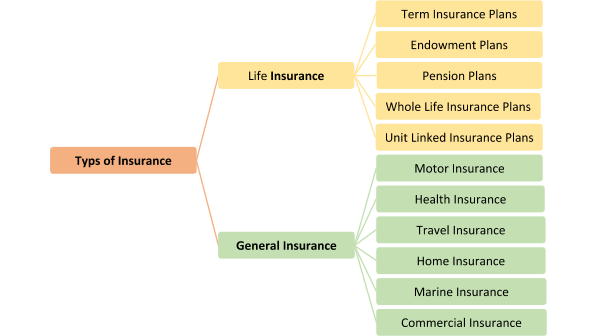
Types of insurance

There are various insurance products available in the market. List of insurance types is non-exhaustive. However, insurance policies are broadly categorised as follows:

Types of insurance

What is life insurance?

Life insurance is an insurance contract wherein the insurance company promises to pay a designated beneficiary a sum of money (sum assured) in exchange for a premium in the event of insured’s death. The life insurance plan provides coverage for a specific period. Apart from term insurance, which is a pure form of insurance, there are many variants in life insurance that also come with savings element attached to it.

Importance of life insurance

Life insurance is one of the most important financial products in your portfolio. Following are some of the major reasons for which you need life insurance cover.

  • To avail future financial security for your loved ones even when you are not around
  • To secure your children’s future educational and other needs
  • For your family to deal with unpaid debts in your absence
  • To save for your golden years through pension plans
  • To achieve your long-term financial goals by way of disciplined investments into an endowment or unit-linked insurance plans.
  • To avail tax benefits under Section 80C of the Income Tax Act

Advantage of life insurance

Life insurance products come with numerous benefits depending on the policy that you avail. Here are the key benefits offered by life insurance plans or investments:

  • Safety and security: Death is unavoidable. But, unfortunate events like death can have a financially devastating impact on dependants. Life insurance provides the needed protection during the demise of the family of the insured. The lump-sum amount can help the family achieve financial stability. Ultimately, by protecting the loved one’s life insurance gives you peace of mind.
  • Wealth creation: Life insurance plans like money back plans, endowment plans and unit-linked investment plans come with ‘investment’ component attached to it. This helps you in building wealth for you and your family’s future.
  • Tax benefits: Life insurance is one such financial product that gets favourable tax treatment. The premiums you pay towards life insurance policy qualifies for tax deduction under Section 80C of the Income Tax Act, thus help you save tax. Lump-sum proceeds of life insurance are free from income tax under Section 10 (10D) of the Income Tax Act.

What is general insurance?

General insurance is an insurance contract that does not come under the scope of life insurance. General insurance gives protection for the things we value such as our health, vehicles, home, business and many other things. There are various types of general insurance products available to provide protection against every possible risk.

Importance of general insurance

General insurance is important to lead a risk-free life. Risk is associated with everything that we own and value such as home, bike, car and business. Also, health is our true wealth. It’s important to protect our health also. Following are the reasons that make general insurance an important need.

  • To avail protection for your valuable assets against man-made and natural calamities
  • Insurance keeps you financially prepared for any kind of mishaps
  • Insurance for your business helps you maximise the profit and continue to grow without hassles
  • It’s important to be insured to deal with emergencies effectively.

Advantage of general insurance

There are a variety of general insurance products available in the market to cover numerous risks and uncertainties. Following are some of the common benefits offered by general insurance plans:

  • Provides financial security for your health and assets during unforeseen events
  • Lowers your tax burden by way of tax benefits and reliefs
  • General insurance provides coverage against a wide array of risks and helps you deal with contingencies effectively and efficiently.

The process to apply for insurance

Insurance plans based on your need can be bought online instantly. It is quite easy and simple to buy insurance through Turtlemint. Following are the simple steps to buy insurance online:

  • Log on to Turtlemint home page
  • Choose the category of insurance
  • Once you click on the category, various types of insurance available are displayed. For example, if you choose ‘life insurance’ category types of life insurance plans available will be displayed
  • Select the type of plan you are looking for
  • Provide your profile details such as gender, marital status, date of birth, income details and contact details and more depending on the plan type you have chosen
  • Once you submit the profile details, a wide range of plans available for the particular type of insurance you have chosen will be displayed
  • You can compare the plans of various insurance companies on the side by side basis and select the right one as per your needs
  • Once you choose the right plan, provide the relevant details and continue to make payment

That’s it! Details needed may differ depending on the insurance type you are buying.

Frequently Asked Questions

  1. What is whole life insurance policy?Whole life insurance policy is a policy that gives you life-long protection along with building cash value. A portion of the premium that you pay is used for building cash value. The policy will remain in force as long as the insured is alive.
  2. What is underwriting in insurance?Underwriting in insurance is the process of assessing the risk based on various factors surrounding the subject matter to be insured. For example, in life insurance policies risk is assessed based on age, health history, medical reports and many more.
  3. What is the free-look period in insurance?Free-look period is the time given by insurance companies to the new policyholders to cancel the policy without any penalties if the policyholder is not satisfied with the terms and conditions. However, the reason needs to be stated for the cancellation of the policy.
  4. What is the period of general insurance policies?Generally, most of the general insurance policies are for one year. And the policies are renewable on an annual basis.
  5. Are natural calamities covered under motor insurance?Yes. Any damage or loss caused to the vehicle due to natural calamities such as flood, earthquake, cyclone, tempest, landslide and rockslide etc. is covered.

Difference Between Comprehensive & Third-Party Insurance

Traffic rules and regulations are laid down in the Motor Vehicles Act, 1988. The Act specifies the rules for driving on Indian roads for all types of vehicles. One such rule specified by the Act is the requirement of a valid insurance policy on the vehicle. The Act states that if a vehicle is to be used on Indian roads, the vehicle should have valid insurance coverage. This coverage would protect the interests of third parties if the vehicle causes them any type of harm.

Based on the directives of the Motor Vehicles Act, 1988, motor insurance policies are offered by general insurance companies. These policies fulfil the legal mandate of the Act and also help the vehicle owner deal with financial losses associated with the vehicle. Motor insurance policies come in two variants – third-party liability and comprehensive. Let’s understand these variants and the coverage that they offer:

Third-party liability insurance

A third-party liability policy covers any third party liability that you face in case of accidents involving your vehicle. These liabilities include the following –

  • If any individual is killed due to your vehicle, you face a financial liability
  • If any individual is physically hurt, injured or wounded due to your vehicle you face a financial liability
  • If you damage anyone’s property with your vehicle, you face a financial liability

    In case of any of these liabilities, the third party insurance policy kicks in. The policy pays the claims which you face freeing you from the financial strain. The Motor Vehicles Act, 1988 mandates every vehicle to have a third party liability insurance policy.

Comprehensive insurance

A comprehensive motor insurance policy is called a package policy because it has a wide scope of coverage. The policy covers the mandatory third-party liability which you face if any third party is harmed due to your vehicle. Moreover, the policy also covers damages suffered by your vehicle itself due to the following causes –

  • Man-made causes like fire, malicious acts, riots, etc.
  • Natural causes like earthquakes, lightning, floods, landslides, etc.
  • Theft of the vehicle
  • Damages suffered when the vehicle is being transported, etc.

    The policy, therefore, covers the mandatory third-party liability and also the damages suffered by the vehicle. It pays for the repair costs incurred when the vehicle is damaged and undergoes repairs. In case of theft also the policy pays a lump sum value and compensates the loss.

Difference between comprehensive and third party insurance

Here are the main differences between comprehensive and third party insurance plans –

Basis of differenceThird-party insuranceComprehensive insurance
CoverageThe policy covers only third party liabilityThe policy covers both third-party liabilities as well as damages suffered by the vehicle itself
Determination of premiumThe premiums of third party plans are fixed by the Insurance Regulatory and Development Authority of India (IRDAI). The premiums are, therefore, fixed across all vehicle insurance plans across different companies.The premiums are determined by the insurance company itself. The premiums, therefore, vary across different insurance companies.
Rate of premiumThe premium is low and affordablePremiums of comprehensive insurance plans are higher than third party liability plans. This is because comprehensive plans have a wider scope of coverage than third party liability plans.
Claim payableIn the case of third party liability claims, the claims depend on the rulings of motor accidents tribunal. In case of death, there is an unlimited liability. The insurance company pays the amount decided by the tribunal. In case of property damage claims, though, there is a coverage limit.The claims under comprehensive insurance policies depend on the type of claim. Third-party claims are paid according to the ruling of the tribunal. In case of damages suffered by the vehicle, the actual repair costs are paid. The maximum claim liability taken by the insurance company depends on the Insured Declared Value of the vehicle which is also the value of the insurance policy. In case of theft, the Insured Declared Value is paid.
Add-onsThird-party policies offer only the basic coverage against third-party liability. No add-ons are available under the plan.You can buy additional coverage options called add-ons under a comprehensive policy by paying an additional premium
No claim bonusIf no claim is made in any policy year, the policy does not pay any benefitIf no claim is made in a policy year you earn a no claim bonus. This bonus is awarded as a discount in the renewal premium. Moreover, the no claim bonus also increases after each successive claim-free year.

Which policy to buy- third party or comprehensive?

Third-party policies have lower premiums and they also fulfil the legal requirement of a valid insurance cover. That is why many vehicle owners prefer a third party policy. However, the policy does not cover the damages suffered by the vehicle itself or the theft of the vehicle. In case your vehicle is damaged you would face very high costs of repairs. These costs might take a toll on your finances and so having a comprehensive policy is better. Moreover, in case of theft of the vehicle, you would incur a substantial financial loss. A comprehensive policy covers this loss and gives you financial assistance in such situations. While it is true that the premiums for comprehensive plans are higher, the coverage benefits far outweigh the premium cost.

A third party policy might prove suitable if your vehicle is very old or if you don’t use it very frequently. Otherwise, a comprehensive policy is recommended to cover all the possible instances of financial loss suffered due to your vehicle. So, understand the difference between comprehensive and third party insurance policies to know the coverage that you can get under different types of motor insurance plans. Also, consider the advantages of having a comprehensive motor insurance cover and choose it over third party insurance plans for financial security.

The contributory pension scheme in the National Pension System

Having a source of income post-retirement is necessary so that you can live a financially independent life. That is why many of you invest in retirement oriented funds when you are working so that when you retire you would have created a retirement corpus for yourself. Salaried employees have the benefit of EPF (Employees’ Provident Fund) contributions which help them create a regular corpus. The general public can invest in PPF (Public Provident Fund) and create a retirement fund. Moreover, the Government also introduced the National Pension System which gives you an additional avenue to save for retirement. Here’s how the scheme was introduced –

History of National Pension System

National Pension System was initially launched by the Central Government as a defined contribution oriented pension scheme. The scheme was implemented from 1st January 2004 through a notification titled Ministry of Finance (Department of Economic Affairs) OM Number 5/7/2003 PR dated 22/12/2003. The National Pension System was introduced as a contributory pension scheme. It was applicable to the employees of the Central Government and it allowed them to create a retirement corpus. However, later on in the year 2009, the scheme was opened to the general public as well. Today, even you can invest in the NPS scheme and create a retirement fund for yourself.

The concept of contributory pension scheme

Though the National Pension System is available to all types of investors, for employees of the Central Government the scheme is still a contributory pension scheme. A contributory pension scheme is one wherein the employee has to contribute a fixed part of his salary towards the investment scheme and the employer also contributes an equal amount to build up a corpus. Under the National Pension System, the Government employees who have joined service on or after 1st January 2004 have to mandatorily contribute 10% of their basic pay plus Dearness Allowance towards the National Pension System. The Government also makes an equal contribution to the contributory pension scheme. The contributions of both the employee and the Government, therefore, help in creating a sound retirement corpus.

How does the defined contributory pension scheme work?

Under the defined contributory pension scheme, 10% of the basic pay and dearness allowance of Government employees is deducted and credited to the National Pension System. The Government also contributes an equal amount. The contributions are credited to the investment account of the National Pension System (NPS). There are two types of NPS accounts which are as follows –

  1. Tier I Account

    Tier I Account is the mandatory investment account into which Government employees have to contribute. The Government also contributes towards Tier I Account. This account does not allow partial withdrawals except in specified circumstances. The account matures when the employee attains 60 years of age.

  1. Tier II Account

    Investments in Tier-II Account are not mandatory. An employee can invest in Tier-II Account only if he has invested in Tier I Account. The Government does not make any contributions to the Tier II Account. This account allows free withdrawals anytime that you want. You can also redeem the total fund value of this account before reaching 60 years of age.

  2. Who is eligible for contributory pension scheme?

    Employees of the Central Government who have joined employment on or after 1st January 2004 are eligible to join the contributory pension scheme of NPS. Employees in the armed forces, however, are exempted from the rule.

    Management of the contributory pension scheme

    The contributory pension scheme under NPS is managed by various entities which are as follows –

    1. PFRDA

      PFRDA stands for Pension Fund Regulatory and Development Authority. PFRDA is the main entity which governs the working of the NPS scheme.

    1. Central Recordkeeping Agencies (CRAs)

      CRA is the agency which maintains the records of NPS subscribers, administers the scheme and provides customer care services. The National Securities Depository Limited (NSDL) acts as the CRA of NPS scheme.

    1. Pension Fund Managers (PFM)

      PFMs are companies which manage the investment of the pension funds accumulated under the contributory pension scheme. Since NPS is a market-linked investment avenue, PFMs invest the employees’ money in different types of assets which can be fixed-income instruments or equity investments. They give the employees three investment schemes called A, B and C and each scheme has a different asset allocation. The employees can choose their preferred investment scheme depending on their risk profile and the contributed pension is then invested as per the chosen scheme.

    1. Annuity Service Providers (ASPs)

      ASPs are insurance companies from which you can avail annuity payments after the NPS investment matures.

Withdrawal from NPS scheme

  1. On maturity

    Government employees who mandatorily contribute towards the contributory pension scheme of NPS can exit from the scheme after they attain 60 years of age. At that age, the scheme matures. On maturity, 60% of the accumulated corpus can be received in a lump sum. This lump sum amount would be tax-free and you can decide how to use the amount. However, the remaining 40% of the corpus is mandatorily used to receive annuities. You can choose any of the authorised ASPs to receive annuity payments from 40% of the corpus that you get. These annuities would, however, be considered as an income and would be taxed at your income tax slab rates.

  1. Before maturity

    If, on the other hand, a Government employee leaves the scheme before attaining 60 years of age, 80% of the accumulated fund value would be paid in annuities and the remaining 20% can be withdrawn in a lump sum. The lump-sum amount of 20% would be tax-free but the annuities received from 80% of the corpus would be taxed at the applicable income tax rates.

  1. On death or discharge from service

    If the Government employee dies or is discharged from Government service, the NPS fund created through the contributory pension scheme can be used to receive benefits either under the NPS scheme or the pension scheme which existed before NPS.

    Central Government employees are, therefore, mandatorily covered under the NPS scheme. For them, however, the contributory pension scheme is applicable where they and the Government both contribute a specified portion of the salary towards Tier I Account of the NPS scheme. This account, then, creates a retirement corpus and also promises pension payments after the employee retires from Government service.

Frequently Asked Questions

  1. I am not a Government servant. Would I have to open an NPS account?

    No, NPS investment is not mandatory for employees who do not work in the Central Government. So, you don’t have to open an NPS account. However, you can choose to do so if you want to create a retirement corpus for yourself.

  1. Is the Tier II contribution defined?

    No, defined contribution is only applicable for Tier I. Government employees can invest in Tier-II Account as per their discretion. Such investments are neither mandatory nor defined.

  1. What are the instances wherein withdrawals from Tier I Account are permitted?

    Withdrawals from Tier I Account are permitted only for meeting specific costs like marriage related costs, education costs, buying a house, medical costs, unemployment, etc.

  1. Will the Government contribute to the NPS scheme if I am not a Government employee?

    No, the Government’s defined contribution is available only for the employees of the Government. If you are not an employee, the Government would not contribute towards your NPS account.

Renters Insurance: Everything You Need to Know (Detailed Guide)

A home insurance policy is said to be important to protect against the financial loss suffered if the house is damaged due to any natural or man-made calamities. That is why homeowners invest in home insurance plans so that they can face financial loss if their property is damaged. But, what about tenants? Do they need any insurance cover?

Yes, they do. Though tenants live in rented properties, they still need insurance for the contents of the home. If they own the household contents, they would face a financial loss if the contents are lost, stolen or damaged. Alternatively, if the household contents also belong to the landlord, the tenant has the financial responsibility to ensure that the contents are not damaged due to use. If the contents are damaged or stolen, they might have to compensate the landlord for the damage or theft. That is why a renter’s insurance policy comes in handy. Let’s understand what the policy is and why it proves useful.

What is renter’s insurance?

A renter’s insurance policy is a policy which covers the loss or damage of the contents of the house in which a tenant lives. These policies are home insurance plans which cover only the contents of the home. They are called renter’s insurance because tenants usually buy a home insurance policy covering their household contents.

What is covered under renter’s insurance?

Coverage under a renter’s insurance policy can be subdivided into the following categories –

  1. Coverage for the contents of the home

    A renter’s insurance policy covers the contents of the home against the following risks –

    • Fire
    • Theft
    • Natural calamities
    • Man-made calamities
    • Electrical breakdowns
    • Accidental damages
  1. Coverage for financial liability

    Besides covering the contents of the home, renter’s insurance policy also covers the legal liability that the tenant faces if any individual is hurt in the tenant’s home. For instance, if another individual (who is not the tenant, his/her family or the landlord) suffers any injury when at the home of the tenant, the tenant might face the financial responsibility to pay the injured individual’s medical expenses. This legal liability is also covered under a renter’s insurance policy.

  1. Coverage for special assets

    Under this cover, special assets of the tenant are covered. These assets can be high-value assets like jewellery, expensive gadgets, works of art, curios, etc. These assets are covered against damage due to natural or man-made calamities and theft.

Add-ons under renter’s insurance

A renter’s insurance policy, besides providing the above-mentioned coverage, also has different types of add-ons which help in increasing the coverage of the plan. Some common extensions include the following –

  1. Rent for an alternate accommodation

    If you are unable to live in the rented house due to damages which are being repaired, the policy pays you the cost incurred on seeking alternate accommodation

  1. Coverage for portable electronics

    Portable electronics like laptops, portable gadgets, etc. get covered under this add-on.

  1. Jewellery and valuables cover

    Under this add-on, you can get coverage for your precious jewellery and other valuable items.

  1. Terrorism cover

    If the contents of the home are damaged due to any terrorist activity, the damages are covered under this add-on.

  1. Pedal cycle

    This add-on extends coverage to a pedal cycle that you own. If the cycle is damaged due to fire, accident, natural or man-made calamity, the add-on pays for the loss suffered.

What is not covered under renter’s insurance?

A renter’s insurance policy does not cover damages suffered due to the following instances –

  1. Wilful damage caused deliberately
  2. War, rebellion, mutiny and related perils
  3. Precious items are not covered unless otherwise specified
  4. Very old content which has lived its useful life is not covered
  5. Any type of consequential losses are not covered

Why is renter’s insurance required?

A renter’s insurance policy proves to be a useful cover for tenants because of the following reasons –

  1. The policy covers the financial loss which tenants face if their belongings are damaged due to any calamity
  2. If the house suffers any damage, the landlord would pay for the repairs of such damages but if the tenants lose their belongings, the financial loss is theirs alone. This loss is covered by renter’s insurance policy which gives tenants financial relief
  3. Since the renter’s insurance policy also covers third-party liability, it gives tenants a sense of financial security that if any individual is hurt in their rented apartment they would not have to bear any losses
  4. If you accidentally damage the landlord’s assets in the house, the policy would give you compensation for such damages too
  5. The add-ons available under the policy increase the scope of coverage and give additional financial protection
  6. The premiums are very low and you can easily buy renter’s insurance policy for your household contents

How much does renter’s insurance cost?

The premiums of a renter’s insurance policy depends on various factors. These are as follows –

  • The value of the contents to be insured affects the premium. If the value is high, the premiums would be high
  • The risks faced by the property based on its location, age, safety and security measures etc. have a direct impact on the premium. If the risk is perceived to be high, the premiums would be high
  • if add-ons are selected with the basic policy, the premiums would increase

Top #6 Things to remember when buying renter’s insurance

Before buying a renter’s insurance policy, the following things should be kept in mind –

  1. Ensure that all the contents are covered under the policy. If any content is left uninsured, you would have to bear the costs if such content is damaged or stolen
  2. The sum insured of the policy should be sufficient to cover the replacement cost of the contents which are damaged or stolen
  3. Choose the required add-ons if they suit your coverage requirements
  4. Always compare the available renter’s insurance policies before buying one. Comparing allows you to buy the plan which has the most inclusive coverage features at the most reasonable premium rates
  5. Keep the bills and other relevant documents of the content that are insured under the policy
  6. If you have precious jewellery and other valuable items in your possession, get them insured under the available add-ons as their loss would be the most expensive to bear

If you are a tenant and are living in a rented house you don’t have any responsibility in case the structure of the house faces any damage. However, if the contents are damaged or burgled, you tend to incur a financial loss as the contents belong to you. Therefore, insuring the contents of the home is a wise move and since the premiums are not very high you can easily buy renter’s insurance policy. So, invest in a comprehensive renter’s insurance plan and secure your household contents against possible damages.

Frequently Asked Questions:

  1. What is the difference between renter’s insurance and homeowners insurance?

    A homeowner’s insurance policy is a policy which is bought by individuals who own their homes. These policies are usually bought to cover the structure as well as the contents of the home. a renter’s insurance policy, on the other hand, is bought by tenants and the policy covers only the contents of the home.

  1. Who can buy renter’s insurance policy?

    A renter’s insurance policy can be bought by tenants who are living in rented accommodation.

  1. Can the coverage be increased if required?

    Yes, you can increase the coverage level under your renter’s insurance policy when the policy is up for renewal.

All you need to know about the FRDI Bill and its effect on your bank deposits

Fixed deposits are always viewed as secured investment avenues wherein the returns are guaranteed. Many risk-averse investors prefer to invest their hard-earned money in fixed deposit schemes of their banks expecting a guaranteed corpus after the selected duration. But what if your deposits were used to bail out an ailing bank which is on the verge of bankruptcy?

The introduction of FRDI Bill

The Financial Resolution and Deposit Insurance Bill (FRDI Bill) was introduced in the Lok Sabha on 10th August 2017. The objective of the bill was to provide a structural framework which would help banks, financial institutions and insurance companies deal with insolvency and bankruptcy. This Bill aimed at providing an easy way out for eligible financial institutions that are in a financial crisis. According to the proposal of the FRDI Bill, a Resolution Corporation would be established which would have complete authority regarding mergers, transfer of assets, integration of property of the financial institutions which are nearing insolvency.

Role of the Resolution Committee

The Resolution Committee was to handle a sick institution before it becomes completely bankrupt. The role of the Resolution Committee would be to classify the financial firms in five categories based on their financial condition. These categories are as follows –

  • Low
  • Moderate
  • Material
  • Imminent
  • The critical risk to viability

The financial risk of the institution would be evaluated considering the following factors –

  • Assets and liabilities of the institution
  • Capital adequacy
  • Management capability
  • Quality of assets
  • Leverage ratio
  • Sufficiency of earnings
  • Liquidity of the firm, etc.

The Resolution Committee would, therefore, make its assessments and then take measures to salvage an ailing financial institution.

Proposals mentioned in the FRDI Bill and their effects on your deposits

Various proposals were mentioned in the FRDI Bill and each proposal has an impact on your deposits. These proposals and their effects were as follows –

  1. Proposal: non-withdrawal of deposits

    Under the proposed rule under the FRDI Bill, you would not be able to withdraw your bank account balance as per your requirement if the bank is in distress.

    It’s effect:

    Currently, you can withdraw your account balance whenever you require as per the provisions of the Deposit Insurance and Credit Guarantee Corporation Act, 1961. But with this rule, your control on your deposits would be lost.

  1. Proposal

    Your account balance can be converted to fixed deposits by banks and such deposits would be paid after five years

    It’s effect:

    If your savings account or current account balance is converted to fixed deposits, you would lose liquidity and face problems when you need money.

  1. Proposal:

    To bail out an ailing bank your account balance can be reduced. The bank can reduce your account balance substantially.

    It’s effect:

    If your account balance is reduced drastically, you would lose your hard-earned money invested in bank accounts.

  1. Proposal:

    If the bank is in a financial crisis, it has the power to decide how much and in which mode your investments would be returned.

    It’s effect:

    You would have no knowledge of how your money would be handled by the bank and whether you would get the full amount that you have invested. This would create chaos as there would be no security.

  1. Proposal:

    The bank can give their stocks to customers against the value of their deposited money.

    It’s effect:

    Even if you get the stock of the bank, the stock would be exposed to market volatility. This volatility was not present when your money was in the bank account. This measure would not be feasible for risk-averse individuals who don’t like market risks.

  1. Proposal:

    The insurance cover given to accountholders would depend on the account balance maintained by the holders.

    It’s effect:

    Account-holders are given a uniform level of insurance coverage by banks irrespective of their account balance. The insurance cover was for INR 1 lakh. However, with the new rule, the cover would depend on the financial status of individuals. Rich accountholders can enjoy higher coverage while middle-class accountholders would be given a low cover. This would discourage middle-class individuals to keep their deposits in bank accounts.

    The FRDI Bill is supposed to strengthen the framework of handling ailing and insolvent financial institutions. However, it has negative impacts on bank deposits and other bank accounts that you have. Given these negative impacts, the FRDI Bill was open to debates and negative reactions from all sectors. That is why the Government later announced that the FRDI Bill would be dropped. Though currently, the FRDI Bill is not under the proposal, you should know the proposals presented by the Bill and how such proposals would have affected your deposits.

Frequently Asked Questions:

  1. How does the insurance cover given by banks work?

    As per the applicable provisions, bank deposits like a savings account, current account, fixed deposits, recurring deposits, etc. are insured under the Deposit Insurance and Credit Guarantee Corporation (DICGC). The insurance cover is given for up to INR 1 lakhs on your deposit balance. This means, that if you have a savings account and a fixed deposit account in a bank and the total balance of these accounts (including interest) is INR 80,000, you would get coverage for INR 80,000. Even if the bank is wound up, you would get INR 80,000 against your deposit accounts. However, if the balance in the deposit accounts is more than INR 1 lakh, coverage would be available only up to INR 1 lakh.

  1. Can I enjoy multiple insurance cover?

    If the bank account is maintained under different names, you can enjoy multiple insurance cover on each account. For instance, you might have a bank account in your maiden name and another in your married name. In that case, each account would be able to enjoy insurance cover of up to INR 1 lakh.

  1. Can the FRDI Bill be reintroduced?

    The reintroduction of FRDI Bill depends on the Government. The Government might modify the FRDI Bill and introduce it in future if it is feasible for all the segments of the economy.

What is Marine Insurance all about?

What is Marine Insurance all about?

Insurance is an important aspect of growth and success of any business. Financial consequences of unexpected mishaps can get your cherishing business to halt. Having insurance coverage provides protection against unforeseen happenings and various risk involved in the business. Marine insurance is one of the oldest form of insurance that businesses, especially shipping and cargo companies started availing in the 17th century. In this article, let’s learn more about marine insurance and its types.

What is marine insurance?

Every cargo or the ship that carries goods is of value. Irrespective of the value of goods, if there is any unforeseen event happens and the cargo or ship is lost or damaged, it becomes a financial liability for ship owners, shipping companies or to cargo owners. This is when the marine insurance comes in for the rescue. Marine cargo insurance is the most common method used to avail security for your goods from damages, theft or general average etc.

Marine insurance is a type of insurance plan that provides protection to the owner of cargo or ship or to the shipping company against various marine risks. Marine insurance mitigates the risk of loss in an unforeseen event like an accident, loss of life or damage to the property etc. In simple terms, marine insurance provides security to your goods while they are in transit via inland water, road, rail, air, registered post or by courier.

Who needs marine cargo insurance?

Marine insurance can be purchased by import and export merchants, buyers, sellers, buying agents, selling agents, contractors or banks or anyone involved in import and export transactions or domestic transportation of goods. Who needs to buy marine insurance is decided by the nature of the contract. Some of the common contracts of sales are:

  • Free on Board (FOB)
  • Cost & Freight (C&F)
  • Cost, Insurance and Freight (CIF)

In FIB and C&F contracts, the buyer is responsible for buying the insurance. While, in CIF contracts, the seller is responsible for buying the insurance.

Why marine insurance is needed?

While you are in the business of supplying goods or transporting goods of value, it’s important to be covered financially against the potential losses that may arise due to various risks involved in transit. As your goods are the source of revenue for you, securing them ensures continuity and growth of your business. Not just for business, individuals moving their goods from one place to another for personal or professional reasons, securing the valuables while in the transit is extremely important to avoid the financial repercussions of any unfortunate losses or damage. Hence, marine insurance is an important requirement to maintain financial integrity.

Types of marine insurance

Marine insurance policy comes in many variants. Coverage under a marine insurance policy can be customised based on the requirement of the business. Following are the major marine insurance policies available in the market:

  1. Hull insurance

    Hull insurance is a type of marine insurance designed to cover the damages to transportation vessels such as damages caused to ship or boat, its equipment and machinery.

  2. Cargo insurance

    Cargo insurance provides coverage against all potential risks to the cargo or goods that are in transit from one place to another.

  3. Freight insurance

    Freight insurance is a common form of marine insurance that offers extra protection to goods that are being transported from one place to another. Usually, vessel operators are at a loss of freight receivable in case the goods are lost or damaged in the transit. Freight insurance gives them the protection against loss of freight suffered.

  4. Liability insurance

    Marine liability insurance provides liability coverage in the event of vessel collisions. Marine liability insurance also provides coverage against liabilities arising from injury, property damage or loss of life of the third party involved.

    Apart from these, there are various other types of marine insurance policies that can be availed on unique requirements. Following are some of the marine insurance types available:

  5. Voyage policy

    Voyage policy offers coverage for marine risks during a specific voyage. As soon as the ship arrives at the destination, the policy will expire.

  6. Time policy

    Time policy is a marine insurance policy that is valid for a specific time period. Generally, time policies are valid for a year.

  7. Valued policy

    In valued policy, the value of cargo or the goods being transported is ascertained at the beginning. In the event of loss, ascertained value is paid as claim compensation.

  8. Port risk policy

    Port risk policy covers the loss suffered by the ship while it is stationed in the port.

  9. Floating policy

    Floating policies are bought for lump-sum value covering multiple voyages. This policy is suitable for businesses that transport goods frequently.

  10. Open or unvalued policy

    In open policy, the value of goods will not be ascertained initially but the loss suffered will be estimated in the event of loss.

Benefits of marine insurance

There are various benefits of availing marine insurance. Some of the major benefits are as follows:

  1. Marine insurance helps to maintain financial integrity and stability of the business
  2. It helps to manage and reduce various risks associated with the shipment of goods and helps to conduct business without any hassles.
  3. Marine insurance compensates the financial loss that the business may face due to loss or damage to goods during transit

Coverage offered under marine insurance

Following are the coverages offered under a marine insurance policy

  1. Institute cargo clause (C) – covers below named perils
    1. Fire and explosion
    2. Overturning or derailment of land conveyance
    3. Stranding, grounding, sinking and capsizing of the vessel
    4. Discharge of cargo at the port of distress
    5. The collision of vessel or conveyance with any external object other than water
    6. Jettison
    7. General average sacrifice
  2. Institute cargo clause (B) – covers below named perils
    1. Washing overboard
    2. Eruption, lightning, earthquake or volcanos
    3. The entry of sea, river or lake water into the craft, vessel, conveyance or lift van or to the place of storage
  3. Institute cargo clause (A) – Covers all risks both named and unnamed pertaining to the transportation of goods

Many marine insurance policies offer additional coverages at an extra cost of the premium.

Exclusions in marine insurance

Marine insurance policy is customisable with a wide range of extensive coverage options it offers. However, there are certain exclusions to the policy. Following are the major exclusions in a marine insurance policy:

  • Wilful and planned act of negligence and misconduct
  • Delayed shipment
  • Poor and improper packaging
  • Insolvency or bankruptcy of the shipping line
  • War, strikes, riots and civil commotion
  • Wear and tear of cargo
  • Removal of wreck
  • Contamination due to radioactive rays

#4 Tips for identifying the best marine insurance plan

Following are the tips for identifying the best marine insurance plan

  1. Ensure to avail the marine insurance coverage from trusted insurance brand. Do your research on the insurance company’s past records and credentials
  2. Check the nature of coverage offered by the policy and ensure it matches your need
  3. Compare the benefits of marine insurance plans offered by various insurance companies and then choose the plan based on cost-benefit analysis
  4. Read through the fine prints and understand the inclusions and exclusions of the policy thoroughly.

Documents required for marine insurance registration

At the time of registering marine insurance claims, following are the documents required:

  1. Duly filled and signed the claim form
  2. Original insurance certificate
  3. Estimated loss report
  4. Bill of lading copy
  5. Survey report
  6. Shipping specification with a packing list
  7. Original invoice
  8. Details of correspondence exchanged

Frequently Asked Questions (FAQs)

  1. What is ‘General Average’ in marine insurance?

    General average refers to losses that may arise due to voluntary sacrifice of any parts of the cargo or the ship in order to safeguard the ship or the rest of the cargo.

  2. What is ‘bill of lading’?

    Bill of lading is the most common form of a document issued by a carrier to acknowledge the receipt of cargo for shipment.

  3. How should the insured act in the event of loss or damage?

    In the event of loss, insured should first take preventive measures to reduce the impact of an event. Insured must act the same as the case the goods were uninsured. To claim the losses, insured must immediately notify the insurance company about the loss or damage.

  4. What is ‘Free on Board’ (FOB) contract?

    The free onboard contract refers to the contract in which the seller is required to deliver the goods at his cost through a specific route to the destination as designated by the buyer. In this risk transfers from seller to buyer at the FOB point.

  5. What is Cost, Insurance and Freight (CIF) contract?

    In CIF contract, cost insurance and freight expenses are borne by the seller in order to cover the buyer against possible losses or damage to goods in transit.

Liability Insurance: Comparison and Detailed Guide

In today’s uncertain world, insurance has become an important risk management tool. Insurance gives much-needed peace of mind by providing a financial safety net against various risks and liabilities. Life insurance, motor insurance and health insurance are the commonly availed insurance solutions. However, there are many other insurance products that address certain specific issues and offers risk cover for the same. Liability insurance is one such insurance product that covers specific risks. In this article, let’s learn more about liability insurance.

Liability insurance –an overview

Liability insurance is a part of general insurance that offers protection to individuals or businesses against the risk of legal liabilities that may arise due to negligence, malpractice, damage or an injury caused to the third party. There are various types of liability insurance with each one having a different focus. Liability insurance products are most commonly availed by businesses to safeguard themselves against lawsuits and claims that may arise due to day-to-day business operations. Main aspects covered in any liability insurance policy is the cost of defending the lawsuit and the compensation to be paid.

Why liability insurance is needed?

Considering the fact that today we are living in a highly litigious society and business environment, lawsuits are common. Expensive lawsuits can put your business and personal assets at stake. Having adequate liability insurance cover can come to your aid in such situations. Following are the reasons why liability insurance is needed:

  • Liability insurance provides protection against liabilities arising out of workplace accidents and injuries
  • Liability insurance protects businesses or individuals against legal costs that need to be incurred while defending the case of claims placed by third-party
  • Liability insurance helps in settling the expensive lawsuits

Who needs liability insurance?

Every business operating in today’s litigious market environment needs liability insurance. However, there are various types of liability insurance products covering the liabilities of a specific nature. Some covers may be needed for high-risk businesses like manufacturing, construction etc. Not just business entities, liability insurance is needed for individuals living in this litigious society also. Certain liability insurance like auto liability insurance is mandatory by law for every motor vehicle owner.

Types of liability insurance

There are many types of liability insurance policies available which can be chosen based on the nature of the business, need or individual requirements. Following are some of the most common forms of liability insurance:

  1. Public liability insurance

    In any business, accidents are inevitable. Accidents that expose the business to the risk of litigations can financially affect business growth. This is where public liability insurance comes into your business’s rescue. Public liability insurance indemnifies your business for any claims arising out of any injury, damage or accidents that occur on your premises during the course of business operation.
    For example, if a customer slips on a wet floor of your business premise and breaks his leg which needs hospitalisation. In this case, you will have to compensate the customer for medical treatments. Customer may also take legal action. This is where liability insurance policy compensates

    • What is covered in public liability insurance?

      Public liability insurance mainly covers-

      • The legal cost of action
      • Compensation to be paid in claims made against the business
      Along with this, comprehensive public liability insurance also covers legal exposures arising out of-

      • Act of god’s perils
      • Sudden and accidental pollution
      • Transportation of hazardous substances and many more
    • What is not covered in public liability insurance?
      Some of the exclusions in public liability insurance are:

      • Libel and slander
      • Fines and penalties
      • Punitive and exemplary damages
      • War
      • Deliberate non-compliance of any statutory provisions
  2. Employer’s liability insurance

    Employer liability insurance is an insurance policy that provides covers with the statutory liability of an employer arising out of death or bodily injury caused or an occupational illness sustained by an employee/workmen during the course of employment. The policy covers ‘employee’/’workmen’ as defined in the Employee Compensation Act. There is also a provision to cover employees who do not come under the purview of the term ‘workmen’ as per the Employee Compensation Act.

    • What is covered under Employers liability insurance?

      Following statutory liabilities of the employer are covered under the policy:

      • Death of an employee due to a workplace accident or occupational illness
      • Bodily injury resulting in disablement caused due to a workplace accident or occupational illness
      • Liabilities arising under common law 
      • Costs and expenses incurred by the insured with the consent of the company
    • What is not covered in the Employer’s liability insurance?

      War and nuclear perils

      • Employer’s liability to employees of contractors
      • Occupational diseases mentioned in Part ‘C’ of Employees Compensation Act
      • Insured’s liability which attaches by virtue of an agreement
  3. Product liability insurance

    Product liability insurance is very important for product manufacturers to manage the risk. Product liability insurance is an insurance plan that covers liabilities that may arise due to damage caused to the third party by the product of the insured. The coverage includes defence cost incurred to defend the case and also the compensation to be paid. However, the policy excludes liability for product recall, pure financial loss, product guarantee and loss of goodwill etc

  4. Directors and Officers liability insurance

    Directors and officers are the key personnel of any company who takes the crucial decisions for the company in their managerial capacity. Adverse consequences of their decisions can bring in a lawsuit against them from various sources such as shareholders, creditors, employees, customers, suppliers, competitors and regulators. Such expensive lawsuits can put directors and officers personal assets at stake.

    Directors and officers liability insurance provide protection against personal liability of directors and officers arising due to any wrongful act committed by them in their managerial capacity. Coverage includes management liability and indemnification, spousal liability extension, coverage for legal representatives of deceased insured and cover for new subsidiary etc. However, directors and officers insurance policy do not cover claims covered by other insurers, misuse of company’s fund, criminal act, dishonesty, pending litigations and breach of law etc.

  5. Third party liability insurance

    Third party liability insurance covers the damages caused by the insured to the third party. For example, let’s say in an accident you cause a damage to third party property. The other person can take legal action on you claiming for the loss. In this case, third party liability insurance pays for the cost of defending the case along with compensation to be paid for the damages occurred.

  6. Professional indemnity insurance

    Professional liability or indemnity insurance is a type of liability insurance that protects professionals such as doctors, lawyers and accountants against the liabilities arising out of negligence or errors and omissions done at the time of providing services to their clients.

  7. Cyber risk insurance

    Social media and use of technology play a key role in the growth of any organisation. Cyber risk insurance policy helps in reducing the risk exposure of the organisation in relation to a cyber-related security breach. Typically, the cyber risk insurance policy covers expenses related to cyber-related security breaches such as investigation cost, privacy and data breach notification, business losses and legal expenses.

  8. Trade credit insurance

    Trade credit insurance policy provides protection to the business for non-payment of commercial debt. The policy protects the manufacturers, service providers and traders against the losses of non-payment.

How to decide the premium amount for a liability insurance policy?

Premium amount for the coverage sought by the insured individual or business will vary depending on their needs and requirements. Insurance company’s base rate for the policy will be considered in the first place while accessing the premium rates. Other factors like the nature of business and risk exposure to the particular company, previous claim history and business environment will be considered while assessing the insurance cost.

Liability insurance claim process

The claim process may vary depending on the nature of the claim, type of liability insurance product. The process for claim will also vary from insurance company to insurance company. In case claims where no lawsuits are brought against, insured needs to fill in the claim requisition form and submit it along with the relevant documents. In case of lawsuits from third-party, the process will again vary depending on how settlements are made, whether in court or as out-of-the court settlement.

Frequently Asked Questions (FAQs)

  1. How much liability insurance is ideally required?

    The amount of liability insurance coverage depends on the type of liability insurance cover you or your business is seeking. There are various factors that are to be considered while deciding the coverage that you need such as type and size of the business, type of customers, number of employees and many more.

  2. How are directors and officer’s liability insurance structured?

    Directors and officers liability insurance are structured with layered coverage. There are three layers in the policy and you can structure them based on your unique needs.

    • Side A cover: Directors and officers personal liabilitySide A cover: Directors and officers personal liability
    • Side B cover: Company reimbursement
    • Side C cover: Entity securities coverage
  3. Does directors’ and officers’ liability insurance cover the entity?

    Though directors and officers liability insurance are designed to protect the personal assets of directors and officers of the organisation, it also covers organisational entities from securities claims.

  4. What are the damages that need to be compensated for in a defective product case?

    In case of defective product case, compensation will include past and future medical expenses, funeral expenses and diminished or impaired earning capacity due to emotional distress, disability, pain and disfigurement.

  5. Is employers’ liability insurance a legal requirement?

    Yes. Employer’s liability insurance is a legal requirement in India under the Workmen Compensation Act, 1923 or Employee Compensation Act.