Complete Information on How to Transfer Vehicle Ownership

Are you looking to sell off your car and buy a new one? You are aware of whom to contact for selling but not sure about how the Transfer of ownership will take place? Is it something which is very difficult? Well, certainly not, the process of Transfer of ownership is simple and easy and all you need to know is why it is important and under what circumstances with the procedure of doing the same. Transfer of ownership of vehicles or a Registration Certificate Transfer is significant as it safeguards the vehicle and all the lawful obligations are being shifted to the purchaser. Transferring of the ownership would imply shifting the car owner’s name from your name to the buyer’s name or transferring the title of the vehicle from one owner to the other owner Transfer of ownership is obligatory under Indian law of Motor Vehicle Act, 1988. A transfer of ownership of the vehicle is indispensable to avoid any problems and complications in future about vehicle registration, insurance policies, etc. Transfer of ownership helps both the seller and the buyer or in some cases only the buyer to have a clear Registration Certificate book with no disputes. Hence, you must abide by this law of transfer of ownership, follow the necessary process or steps without fail to have a smooth sail of the vehicle. There may be several situations (discussed as below) where the ownership of the vehicle needs to be transferred from one person to the other. Let us have a comprehensive view of the process of transfer of ownership of vehicles or the two-wheeler.

You must remember that when you are selling your vehicle, it consists of two parts and hence

  • The 1st one is Transfer of ownership of the vehicle
  • The 2nd part is Transfer of the vehicle insurance policy- This is important as because you will not be in a position to claim insurance if need be in future

Situations for where Transfer of ownership is required:

  1. Transfer of ownership when you are selling off the car to another buyer

    As soon as the vehicle is sold off, the name of the buyer is recorded as the registered owner instead of the earlier registered owner and this is the process called and named as the transfer of ownership.

  2. Transfer of ownership upon the death of the owner of the vehicle

    As soon as the registered owner of a vehicle dies, transfer of ownership is effective in the name of the legal heirs of the expired registered owner and the usage of the vehicle can be for a period of 90 days within 30 days from the date of death of the owner.

  3. Transfer of ownership in auction

    When a vehicle is sold in public auction, the name of the buyer is recorded as a registered owner instead of the earlier registered owner and once again this is the process called and named as the transfer of ownership.

Process of Transfer of Ownership of vehicle or the two-wheeler

The steps of how to transfer vehicle ownership can be summarized as below:

⮚ If you are a buyer you will have to submit the application form for transfer of ownership of the two-wheeler at the same RTO department where from the vehicle or the two-wheeler was earlier registered when you bought it the first time

⮚ You will then have to submit the form no 29* and form no 30** at the Directorate of Transport office with additional documents in original like the insurance details, RC, receipts of tax paid, address proof of the seller, photograph of passport size, etc.

⮚ After all the necessary inspection is completed by the RTO, the ownership and insurance-related papers of the vehicle will be transferred to the new buyer within 14 days

⮚ If the buyer and the seller are from the same state, the buyer will provide all the required details of the transfer to the registration office within two weeks’ time. On the other hand, if the buyer and seller are living in different states, then the buyer will have to notify the registering authority within 45 days about the forms and related documents for the transfer of vehicle

⮚ If the seller of the two-wheeler dies the buyer of the vehicle must inform the authority of registration with the necessary forms and related documents for the transfer of vehicle with the certificate of death. of the buyer can now go ahead and apply for the transfer of ownership within 3 months of the death of the seller.

Now that we have understood the process of Transfer of Ownership, let us see the related documents which are needed for this process and also the other additional documents needed under various situations as mentioned above

List of documents required for Transfer of Ownership

The below list of documents is mandatory and is needed to complete the Transfer of Ownership properly:

  1. Certificate of Registration:

    This is a compulsory document for the Transfer of Ownership process. The seller has to give this certificate of registration to the buyer. This document basically confirms and endorse the fact that the vehicle belongs to the seller.

  2. Pollution Certificate or PUC:

    Again, a compulsory document to confirm that vehicle or the two-wheeler has followed all the necessary rules related to the pollution control and is PUC**** certified.

Certificate of Insurance: A mandatory document for all the vehicles. The RTO office will not allow any registration without a valid Certificate of Insurance. The insurance policy will also have to be transferred in the buyer’s name and to complete the process of transfer the insurance certificate is essential. And while buying the vehicle, the insurer should be communicated so that the insurance policy can be transferred in the buyer’s name

List of other documents essential for Transfer of Ownership in case of a usual buying and selling:

We know by now that there are 3 mandatory documents needed for Transfer of Ownership, however, there are other documents as well which are needed when you are buying or selling the vehicle. Let us have a look at the below documents which are required under various situations of Transfer of Ownership

  • Original Registration Certificate
  • Form no 29* filled and signed by the seller of the vehicle
  • Form 30 **
  • If the buyer and seller are living in different states, then at that time, you will have to provide the No Objection Certificate of the entry tax for that state. An important point to note is that in the case of moving the vehicle from state to the other, the vehicle should not be more than 30 months old
  • If the seller had bought the vehicle through a loan, and the loan is continuing at the time of selling the vehicle, then a No Objection Certificate or NOC from the lender will also be required. The respective bank or the financial institution should issue the No Objection Certificate which is needed to be submitted to the registering authority at the time of transfer
  • Copy of the attested certificate of insurance
  • Copy of the attested address proof of the purchaser
  • Attested Certificate confirming about the vehicle or the two-wheeler’s pollution clearance status
  • Fee for transfer of ownership
  • Copy of attested PAN Card or Form 60 and 61 as appropriate

Documents to be submitted in the case of Death of the Owner:

If the of the vehicle dies, the buyer will have to submit the documents as mentioned below for the transfer of ownership

  • Form number 30- application for notification of transfer has to be completed carefully with the correct details with a chassis label
  • Form number 31 application for transfer of ownership in case of the death of the seller
  • Form TCA, TCR (for only transport vehicle)- TCA- This is an intimation of transfer by the buyer and TCR- An intimation of transfer by the seller. Since the seller has died, the buyer has to submit the death certificate to the RTO
  • If the owner has expired, then a certificate of death needs to be presented
  • Important documents, for example, a succession certificate, affidavit from the former owner of the vehicle or the two-wheeler and the No Objection Certificate from financier is needed as well
  • Documents or receipts related to the fee for the registration of the vehicle or the two-wheeler
  • Original RC, emission test for pollution, documents for insurance, receipts of tax payment, photographs- passport size, proof of address of the seller, etc.

How to transfer Insurance Policy after the vehicle is transferred?

By now, you must have got clarity about Transfer of Ownership, how the process flow is and the documents related to it. Your next question: how should I transfer insurance? Are there any legal implications if I miss transferring the insurance? Well, it is very crucial that you transfer the insurance as well to avoid any kind of dispute in case of an accident, otherwise you will not get the claim. The steps are simple and easy to follow:

Step 1- Intimation to the insurance company and obtaining a No Claim Bonus Certificate

Once you inform the insurance company about the selling of your vehicle and transfer of ownership, the insurance company will proceed to transfer your insurance. Remember, that you must get an NCB retention certificate from the insurer in case you have no claim bonus in your name and you can still retain the bonus while selling off your vehicle thereby using the same for your new car. You need to submit certain important documents mentioned below:

Ø A request letter for cancellation of the insurance policy

Ø Policy Document in original

Ø Insurance certificate

Ø Form 29*

Ø Form 30**

Ø Registration Certificate copy

Ø Proof of delivery to the buyer

Step 2- Transfer of the insurance policy

After the 1st step, you need to submit the following set of documents for transferring the policy

Ø The modified Registration Certificate with form number 29*

Ø Policy document

Ø No Objection from the seller which is you

Ø Application form for the new policy

Ø Copy of the inspection report which is done by the insurer

Ø The variance between the original premium and the new premium post no claim bonus

You must be wondering about the charges for transfer of ownership which needs to be paid to the RTO. Here is a quick view of the same.

Two-wheeler ownership transfer fees:

Type of Vehicle

Amount (INR)

Light Motor Vehicles for Transport

500

Light Motor Vehicles for Non -Transport

300

Medium Goods for passenger vehicles

500

Medium Goods for passenger vehicles

750

Medium Vehicle for goods

500

Heavy Vehicle for goods

750

One can know the vehicle transfer status easily from the site named  https://parivahan.gov.in/rcdlstatus/ by just putting the registration number and entering a code for verification.

Always remember to transfer the vehicle ownership together with insurance while selling the car, this is not only mandatory as per the law but also advantageous to you if you are selling the buyer as well as the buyer. Let us have a hassle-free and a smooth possession of vehicles and drive freely and safely

FAQs

  1. I have bought a car lately but the insurance of the car expired before transferring the ownership in my name? What should I do now?

    You need to renew the insurance policy in the name of the initial or the first owner and then put an application for transfer of the RC after which when the RC will reflect your name, then only you can transfer the insurance.

  2. I am from Mumbai and I want to purchase a used car from another state? Will I be able to buy it?

    Yes, you can, however, you will need the No Objection Certificate from the preset RTO where the initial registration has taken place with the seller agreement, form 29 * and form 30** signed by both buyer and the seller.

  3. I purchased a car a year back. The first owner in the same State has also given the No Objection Certificate, but I missed transferring the same in my name. Now I want to sell off the car, can I do that?

    No, you will not be allowed to do that. You need to have the transfer done in your name for you to sell the car.

  4. Is a No Objection certificate needed if I wish to transfer the ownership within the same RTO?

    The initial and the first owner’s No objection Certificate will be needed to do the transfer of ownership in the same RTO.

  5. What is the time frame for transferring vehicle ownership?

    The time is usually 10-15 working days after all the necessary documents are submitted.

Save your Health Insurance premium and make your plan more pocket-friendly

Having a health insurance policy with a sufficient sum insured is needed. How else would you be able to meet the expensive treatment costs of a medical emergency?

When you opt for an optimal sum insured level for complete coverage, you cannot overlook the premium associated with it. If a high sum insured is chosen, the premium, invariably, becomes high. In such cases, you have to choose between an optimal coverage and an affordable premium and the choice is not very easy. What if you can make your health insurance premiums affordable?

There are many ways in which you can save on your health insurance premiums. Let’s find out what these ways are –

  • Following a healthy lifestyle

    Your health insurance premium is directly proportional to your health and your lifestyle habits. If you practice healthy living and choose healthy lifestyle habits, your premiums would be lower and vice-versa. So, you should maintain your health as premiums for healthy individuals with no medical complications tend to be lower than premiums for individuals suffering from medical problems. Similarly, if you smoke and/or drink, your health insurance premiums would be high as these habits impact your health negatively. That is why health insurance companies charge lower premiums from non-smokers than smokers.

  • Wellness benefits offered by insurers

    The Insurance Regulatory and Development Authority of India (IRDAI) has asked insurance companies to include wellness benefits in their health insurance policies to promote healthy living. These benefits offer premium discounts if you are healthy or if you practice regular exercising and adopt healthy habits. These benefits also offer discounts on medicines and wellness programs at merchants partnered with the insurer. When buying a health insurance plan, look for these wellness benefits available in the policy and use these benefits to reduce your premium amount.

  • Premium discounts

    Health insurance plans also allow different types of premium discounts in the policy for making the policy more pocket-friendly. Some of the commonly available discounts include the following –

    • Family discount for covering 2 or more members under the policy
    • Discount for buying a long term plan for a period of 2 or 3 consecutive years
    • Discount for buying the policy online
    • Discount for choosing voluntary co-payment under the plan

    You can hunt for these discount in the policy and use them to reduce your premium outgoes.

  • Avoiding small claims

    When you don’t make claims in a policy year, you earn a no claim bonus. This bonus either increases the sum insured free of cost or it allows a discount in the renewal premium. So, during the policy year, if you incur small medical expenses, don’t make claims for such expenses. Avoidance of claims would help you avail no claim bonus and either get a higher sum insured at the same premium or a premium discount on renewal.

  • Splitting the premium between spouses

    Health insurance premiums are allowed as a deduction from your taxable income up to INR 25,000 under Section 80D of the Income Tax Act, 1961. If, however, your health insurance premium is more than INR 25,000, you can split the premium with your spouse and claim double tax benefits. This splitting is allowed if the premium of the policy is paid through two bank accounts. In that case, the insurance company might issue two tax certificates allowing you and your spouse to claim a deduction from your respective taxable incomes. For instance, say your aggregate health insurance premium works out to be INR 35,000. In this case, you can pay INR 25,000 from your bank account and ask your spouse to pay the remaining INR 10,000 from his/her bank account. This way, you can claim a deduction of INR 25,000 under Section 80D from your taxable income and your spouse can claim a deduction of INR 10,000 from his/her taxable income. This splitting would, therefore, give you higher tax deductions and reduce your tax liability.

    Premium splitting might or might not be allowed by insurance companies. So, find out from your insurer whether it would allow such splitting and provide you with two tax certificates so that you can claim dual deductions on a single policy. (Source ET article)

  • Choosing a super top-up plan

    To enjoy a high cover at a low premium you can opt for a super top-up health plan. The plan comes with a sum insured and a deductible limit. If the aggregate claims made in a policy year exceed the deductible limit, the excess claims are paid by the super top-up plan. A super top-up policy can act as a supplemental coverage on an existing plan. The deductible of the plan can be taken to match the existing coverage of your policy so that claims up to the deductible get paid by the existing health plan and excess claims get covered by the super top-up plan. A super top-up plan, therefore, is a good choice for increasing your coverage while reducing the premium cost.

Which of these ways would you choose to reduce your health insurance premium?

You can choose one or all of the ways mentioned above but do be smart about buying your health insurance policy. A high sum insured doesn’t always mean a high premium and you can use the above-mentioned steps to reduce the premium effectively. To enhance the sum insured, opt for super top-up plans and get comprehensive coverage which is also light on your pockets.

Watch the below video to find out more ways on how you can lower your health insurance premiums.

What is Personal Accident cover in Bike Insurance Plans?

When you buy a bike, you need to buy a valid insurance policy on the bike as well. The Motor Vehicles Act, 1988 governs transportation laws in India and one such rule specified by the Act is the need of a valid third party insurance cover on every vehicle being used on Indian roads. So, when you buy a bike, you need a mandatory third party cover on it as well.

A third party policy protects you against the financial liability that you suffer if any third party is physically injured or killed due to the bike. Moreover, if your bike damages any third party property, the financial loss suffered would also be covered under the policy. However, the third-party policy does not provide coverage for the damages which the bike might suffer itself. This is why you need a comprehensive bike insurance policy which covers both third party liabilities as well as the damages suffered by the bike.

Whether you buy a third party liability plan or a comprehensive one, you are required to opt for a mandatory personal accident cover too. Let’s understand what this cover is all about –

What is personal accident cover in bike insurance?

A personal accident cover is a cover which should be taken with a third party policy or a comprehensive one. It covers the owner or driver of the bike. Under this cover, you get coverage for the following –

  • Accidental death
  • Permanent total disablement suffered due to an accident
  • Permanent partial disablement suffered due to an accident

The sum insured for the personal accident cover is INR 15 lakhs. In the first two instances, i.e. accidental death and permanent total disablement, 100% of the sum insured is paid to the owner or driver who suffers these contingencies. In case of permanent partial disablement, however, a percentage of the sum insured is paid depending on the severity of the disability suffered.

Features of personal accident cover in bike insurance

Here are some salient features of the personal accident cover which is available in a bike insurance policy –

  1. The cover is offered only for the owner or driver of the bike. This means that if any individual, other than the owner, is driving the bike and suffers accidental death and disablement, the claim would be payable
  2. The premium for the personal accident cover can be up to a maximum of INR 750

The rule regarding personal accident cover in bike insurance

While personal accident cover is a mandatory part of your bike insurance policy, you can opt-out of it in the following circumstances –

  1. You have an existing personal accident cover of a minimum of INR 15 lakhs in a car insurance policy
  2. You have an existing personal accident cover of a minimum of INR 15 lakhs in a standalone personal accident policy

This means that if you already have a personal accident cover in your name and the coverage level is a minimum of INR 15 lakhs, you don’t need to opt for a personal accident cover in your bike insurance policy. 

Personal accident cover for the pillion rider

The mandatory personal accident cover in bike insurance plans covers only the owner or driver of the bike. Any rider riding pillion is not covered. Thus, in an accident, if the pillion rider suffers any accidental contingencies, no claim would be paid for him/her. If you usually ride your bike with a pillion rider, insuring the rider against accidental contingencies is a wise choice. To do so, you can opt for the personal accident add-on for the pillion rider. Let’s understand –

What is accident cover in bike insurance for pillion riders?

Comprehensive bike insurance plans allow a personal accident cover for pillion riders through an add-on. You need to opt for this add-on by paying an additional premium. If the add-on is selected, coverage for accidental death and disablement is extended to the pillion rider thereby increasing the scope of coverage of the bike insurance plan.

Personal accident cover for paid riders

Businesses which hire paid riders to drive bikes for commercial purposes are bound by the Workmen’s Compensation Act, 1923 to provide compensation to such riders in case they suffer accidental death or disablements during the period of their employment. As such, businesses can buy a personal accident cover for their bikes covering their paid riders. The cover is optional in nature and when bought, it covers the named riders of the bike against accidental death and disablement.

Exclusions under personal accident cover

The personal accident cover does not pay claims on death or disablements suffered due to –

  1. Suicide or self-inflicted injuries
  2. Driving without a license
  3. Driving under the influence of alcohol and/or drugs
  4. Driving outside the boundaries of India
  5. Criminal activities
  6. Participating in hazardous activities or adventure sports
  7. Mental disorders

Types of accident cover in bike insurance

As is evident from the afore-mentioned accident covers, a bike insurance policy provides different types of accident cover. They can be summarized as follows –

  1. Third party accident cover wherein compensation is paid to the third party if they suffer any accidental injury or death due to the bike. This is a mandatory cover which is available in both third-party and comprehensive bike insurance plans
  2. Personal accident cover for the owner or driver of the bike which is also a mandatory cover under both third party and comprehensive bike insurance plans
  3. Personal accident cover for the pillion rider which is an add-on available under comprehensive bike insurance plans. This add-on covers the pillion rider against accidental death or disablement 
  4. Personal accident cover for the paid rider of a commercial bike. This is an optional cover which can be taken under a third party or comprehensive policy

Why buy a personal accident cover with bike insurance?

First and foremost, a personal accident cover for the owner or driver of the bike is mandatory if you don’t have any other personal accident cover in your name. Thus, you need the cover to fulfil the legal mandate. Secondly, bikes are quite prone to accidents and such accidents usually result in severe injuries and even death. With the fast-paced life that has become a feature of modern times, road accidents have increased considerably. In case of accidental death or disablement, there is an immense financial loss for the rider as well as for the family. To cover this loss, a personal accident cover is a must.

In case of the personal accident cover for a pillion rider, the add-on makes sense if a rider rides the bike frequently. In an accident, the pillion rider is also prone to death or disablement and such a contingency would cause a financial loss for the rider as well. Thus, the add-on should be bought to cover the pillion rider so that any possible financial loss can be easily compensated.

How to buy personal accident cover in bike insurance?

You can buy a personal accident cover in bike insurance when buying the policy online. The cover should also be renewed every year for continuous coverage. The personal accident add-on, on the other hand, can be bought either at the time of buying the policy or at the time of renewal. To buy online you can visit https://turtlemint-stage.dreamhosters.com/two-wheeler-insurance/ and enter in your bike details. Thereafter you would be provided with the premium quotes of leading insurance companies. Choose the personal accident cover and/or add-on cover and the premium would be updated. You can compare and choose a policy offering the best coverage at the lowest premium and then buy the plan online through Turtlemint itself. The process is simple and quick.

How to claim for a personal accident?

In case of accidental death or disablement involving your bike, you should inform the insurance company immediately. A police FIR should also be filed for the accident. An insurer’s surveyor would assess the damages and prepare a report. You would have to fill and submit a claim form along with the relevant documents to get the claim under the policy.

So, choose a personal accident cover for yourself as well as the pillion rider and stay financially secured against accidental contingencies.

Frequently Asked Questions

  1. What documents are needed to make a personal accident claim?

    You need to submit the police FIR, claim form, policy document, RC book of the bike, details of the accident, death certificate (in case of accidental death), disability certificate from a recognized medical practitioner (in case of disability), surveyor’s report, hospital records (if any) and any other document which the insurance company needs.

  2. Are temporary total disabilities covered in the personal accident cover in bike insurance?

    No, temporary total disablements are not covered. Only permanent disablements are covered under the personal accident cover in a bike insurance policy.

  3. Is the pillion rider add-on mandatory?

    No, personal accident cover for pillion riders is an optional add-on which is not mandatory to buy.

  4. Does the personal accident cover provide coverage for accidental hospitalisation?

    No, the personal accident cover does not cover the cost of accidental hospitalisation. It pays a lump sum benefit only on accidental death or permanent disablement.

Now PUC Certificate is a must for Motor Insurance renewals

Pollution has been a grave concern all over the world and especially in the National Capital Region (NCR), the problem is quite intense. The levels of air pollution in the NCR have been so high that the Government introduced the odd-even system for vehicles on the roads. Even the Supreme Court of India had issued directives that insurance companies should not allow motor insurance renewals without a valid PUC certificate but the practice was seldom followed. So, the Insurance Regulatory and Development Authority of India (IRDAI) issued a circular on 20th August 2020 mandating insurance companies follow the Supreme Court Directive. While the IRDAI guideline is meant for renewals across India, special emphasis has been put on the NCR region of Delhi given the high pollution levels in the area.

What does the IRDAII circular state?

The Supreme Court of India, in the case of MC Mehta v/s the Union of India in July 2018, asked insurance companies to ensure that a vehicle which does not have a valid PUC certificate is not insured on renewals. 

The Central Pollution Control Board (CPCB) raised a concern that the Supreme Court mandate of having a valid PUC certificate at renewals was not properly followed by insurance companies. Following this concern IRDAI issued its circular asking insurance companies to follow the Supreme Court directive without fail.. 

The concept of PUC Certificate

PUC (Pollution Under Control) Certificate is a certificate which verifies that the emissions coming out from the vehicle meets the norms prescribed in the pollution control standards. This ensures that the vehicle is not polluting the surrounding air when it is being used. The certificate issued is valid for a stipulated tenure which depends on the type of vehicle being used. Once the tenure expires, a new PUC certificate should be availed instantly. If the vehicle does not have a valid PUC Certificate, you are liable for fines if caught by the authorities. For new vehicles, the requirement of PUC certificate is after a year of registration of the vehicle.

The impact of the guidelines

The new guidelines issued by the IRDAI would have an impact on you, the vehicle owner, and also the insurance company. Let’s understand –

  • For you

    You would have to ensure that your PUC certificate is up-to-date every time your motor insurance policy is up for renewals. This would allow you to do your part for the environment and also avoid traffic penalties for being caught without a valid PUC.

  • For the insurance company

    Motor insurance renewals would become a bit complex for insurers as the PUC certificate would have to be verified by them before allowing renewals. This might take some time in verification of the validity of the PUC Certificate and insurance companies would have to come up with solutions to seamlessly integrate the verification in the renewal process.

The IRDAI circular stresses on the adoption of the Supreme Court directive specifically for cars being renewed in Delhi where pollution is notoriously severe. The guideline is, therefore, considered to be beneficial for the environment of Delhi and aims to reduce the pollution levels in the area. How it impacts the air quality in Delhi is yet to be seen. Moreover, the guideline would be implemented pan India so that pollution levels of the whole country come down. The IRDAI guideline is, therefore, a welcome move which is essential in these times when pollution levels are becoming toxic.

Fixed benefit or indemnity health plan, which one to choose for covering COVID?

The number of Coronavirus cases is increasing with no relief in sight as India is expected to record the highest number of cases in the world. Since a vaccine is still in its development stage, people are looking at health insurance plans to solve their immediate financial needs if they test positive for Coronavirus and require hospitalisation. Health insurance plans have, therefore, become important in these testing times.

Normal health insurance plans allow coverage for COVID related hospitalisation and treatment. However, the cost of consumables like gloves, sanitizers, face masks, etc., is not covered under a normal policy. Since these costs are considerable, considerable out-of-pocket expenses would be incurred even after having a health insurance policy. Moreover, home treatments for COVID might not be covered under health insurance plans. Keeping these factors in mind and the need of a health cover for COVID, two new plans were launched – Corona Kavach and Corona Rakshak. 

Both these policies cover COVID related claims. However, while the former is an indemnity policy, the latter is a fixed benefit plan. This causes confusion for individuals as to which plan they should choose: indemnity or fixed benefit? 

Indemnity health plans are those which cover the actual medical costs incurred while fixed benefit plans pay a lump sum benefit in case of claims. So, while under Corona Kavach your hospitalisation bills would be covered, Corona Rakshak would pay a lump sum benefit if you suffer from Coronavirus and are hospitalised for three continuous days. So which to choose?

Let’s analyse the options in different situations –

  • When you already have a health plan

    When you have an existing health insurance policy, your policy would cover COVID related hospitalisations partially. For full coverage you can opt for Corona Kavach plan and get covered for all medical costs if you are hospitalised for 24 hours or more. 

    Alternatively, you can buy Corona Rakshak and get a lump sum benefit. This benefit would help you cover –

    • Additional medical costs not covered by your health insurance policy
    • Lifestyle expenses when you are indisposed
    • Any loan EMIs which you are unable to pay because of loss of job, salary cut or loss of income due to business shutdown

    In fact, a Corona Rakshak policy would make more sense in these cases since it would provide a holistic coverage for your financial needs when you suffer from Coronavirus.

  • If you don’t have a health insurance plan

    If you don’t have a health insurance policy altogether, opt for a Corona Kavach plan. The plan would cover your hospitalisation expenses incurred on COVID with a short waiting period of 15 days. Under other normal indemnity health plans, this initial waiting period can go up to 30 to 90 days which would not be feasible for COVID which is spreading so fast. So, for your short-term needs, you can opt for Corona Kavach and get covered for the hospitalisation expenses incurred on COVID. However, you should also buy a comprehensive regular indemnity health plan for coverage of other illnesses and injuries.

    A Corona Rakshak policy can also be taken, in addition, for getting complete financial assistance for other expenses which you might incur due to COVID. While the Kavach policy would take care of your hospitalisation costs, the Rakshak policy would provide coverage for all other costs which you might incur.

The bottom line

While both Kavach and Rakshak have been developed specifically for covering COVID, the choice between the two ultimately rests in your hands and whether or not you have an existing health plan. If you have an existing health plan, Corona Rakshak would be a good solution and if you don’t, you should opt for Corona Kavach and supplement it with a Corona Rakshak plan. The premiums of both these policies are quite low. You can, therefore, choose both the plans for a comprehensive scope of coverage too. So, assess your needs and then make a choice.

COVID-19 Insurance: Corona Kavach & Rakshak Health Insurance Plan

The Coronavirus pandemic is getting worse day by day as more and more individuals are being infected globally. In India, as of 27th August 2020, there are more than 7.29 lakh active cases of COVID infection (Source:Worldometers) while globally, the cases have touched the 24 million mark and the numbers are still climbing. (Source: Worldometers).As more and more individuals are falling prey to the virus, the need to face the financial implication of the illness has become important. That is why there is an increased emphasis on health insurance plans to cover the medical costs incurred due to Coronavirus. While the normal health plans offered by health insurers provide coverage for COVID related hospitalisation, new plans have also been developed for addressing the coverage needs of individuals. Health insurance companies and the Insurance Regulatory and Development Authority of India (IRDAI) have designed and launched specific COVID oriented health insurance plans to meet the demand for health insurance for COVID coverage. Let’s understand what these plans are

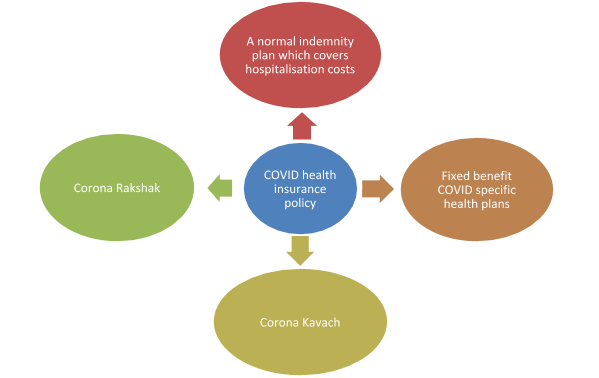
Types of COVID-19 health insurance policies in 2020

health insurance

  • Indemnity oriented health insurance plans

    The indemnity health insurance plans which are offered by health insurance providers cover hospitalisation expenses. As such, if you are hospitalised due to Coronavirus, the expenses incurred on such hospitalisation and associated treatments would be covered under the existing health plan that you have.

  • Fixed benefit health insurance plans

    Seeing the rise in COVID cases, many health insurance companies launched a COVID specific, fixed benefit health insurance policy. These policies were launched under the Sandbox initiative of IRDAI on a trial basis. The policies promised the payment of the sum insured in lump sum if the insured tested positive for Coronavirus infection

  • Short term, COVID specific health insurance policies

    While the existing health insurance plans cover the cost of hospitalisation due to COVID, the cost of PPE kits and consumables are excluded. In case of COVID hospitalisation, such excluded costs constitute a primary portion of your medical bills and result in considerable out of pocket expenses. Moreover, the fixed benefit COVID specific plans were issued on a trial basis by few insurance companies making these plans not easily available. As such, IRDAI asked insurers to come up with a short-term COVID 19 health insurance plan which would cover only the medical costs incurred in case of Coronavirus. An English proverb says necessity is the mother of invention and the IRDAI’s directive resulted in the birth of two new COVID insurance plans – Corona Kavach Insurance and Corona Rakshak Insurance. Both these plans are short-term health insurance plans which provide coverage only when the insured tests positive for Coronavirus.

Corona Kavach Insurance Policy

The Corona Kavach insurance policy is an indemnity oriented health insurance plan which covers the costs incurred if you are hospitalised due to Coronavirus. The features of the policy are as follows –

  • Individuals aged between 18 years and 65 years can buy the policy on an individual or family floater basis. For dependent children, the entry age is 1 day to 25 years. If, however, the child is aged over 18 years and is financially independent, the child would not be allowed coverage under the family floater plan.

  • Under the family floater variant, self, spouse, dependent children, dependent parents and parents-in-law can be covered
  • The sum insured start from INR 50,000 and goes up to INR 5 lakhs in multiples of INR 50,000
  • There are three policy tenures to choose from – 3.5 months (105 days), 6.5 months (195 days)and 9.5 months (285 days)
  • Coverage is available after a waiting period of 15 days. Coverage is offered only for hospitalisation due to COVID.
  • The plan does not offer the benefits of lifelong renewals or portability
  • Pre-existing illnesses as well as co-morbidities are covered under the policy
  • A single premium is payable to buy the plan
  • There is no limit on room rent coverage offered by the policy
  • A 5% premium discount is offered to healthcare workers if they buy the policy

Coverage under the COVID Kavach health insurance plan is offered for the following –

  • Room rent
  • Boarding and nursing expenses
  • ICU and ICCU room rent
  • Fees payable to surgeons, doctors, consultants, anaesthetists and medical practitioners
  • Cost of anaesthesia, oxygen, blood, ventilator, surgical appliances, medicines, diagnostics, PPE kits, masks, gloves and other consumables
  • Cost of ambulance up to INR 2000
  • Treatment taken at home, which would have otherwise required hospitalisation, for up to 14 days after being diagnosed COVID positive. In such cases, the cost of diagnostics, medicines, consultations, oximeter, nursing expenses, etc. would be covered. Home treatments would be covered only after obtaining an approval from the insurance company 
  • AYUSH treatments for COVID
  • Pre-hospitalisation expenses for 15 days
  • Post hospitalisation expenses for 30 days

Moreover, there is an add-on hospital cash benefit allowance which can be chosen at an additional premium. This benefit pays 0.5% of the sum insured for each day of hospitalisation for up to 15 days.

Corona Rakshak Health Insurance

Another standard COVID 19 health insurance plan is the Corona Rakshak health insurance plan. Contrary to Corona Kavach insurance, this plan is a fixed benefit health insurance plan. This means that the plan pays a lump sum benefit if you test positive for Coronavirus. The features of the plan are as follows –

  • The plan is available on an individual sum insured basis only
  • Adults in the age group of 18 years to 65 years can be covered under the plan. 
  • The policy comes in three durations – 3.5 months (105 days), 6.5 months (195 days)and 9.5 months (285 days)
  • Sum insured is available from INR 50,000 to INR 2.5 lakhs in multiples of INR 50,000
  • You can avail a premium discount if two or more family members are covered under the same plan on an individual sum insured basis
  • No pre-entrance health check-ups are required to buy the policy

Coverage under Corona Rakshak health insurance plan

Corona Rakshak policy covers COVID infection. It pays the sum insured in lump sum if you test positive for Coronavirus and you are hospitalised for at least 72 hours.

Corona Kavach insurance premium

Being a short term COVID health insurance plan, Corona Kavach insurance premium is low and affordable. Though the coverage features are standard across all insurance companies, the premium varies. Here are the sample Corona Kavach insurance premium rates charged by different insurance companies for different tenures. The age is taken to be 35 years and the sum insured is INR 5 lakhs –

Insurance company 

Term 3.5 months

Term 6.5 months

Term 9.5 months

IFFCO Tokio

INR 1167 

INR 2037

INR 2731

National Insurance

INR 1360

INR 1975

INR 2385

Star Health

INR 3831 

INR 4597

INR 5172

Future Generali

INR 552

INR 695

INR 839

Manipal Cigna

INR 7748

INR 9535

INR 11,919

Premium rates for Corona Kavach

Being a short term COVID health insurance plan, the premium of Corona Kavach is low and affordable. Though the coverage features are standard across all insurance companies, the premium varies. Here are the sample premium rates charged by different insurance companies for different tenures. The age is taken to be 35 years and the sum insured is INR 5 lakhs –

Insurance company 

Term 3.5 months

Term 6.5 months

Term 9.5 months

IFFCO Tokio

INR 1167 

INR 2037

INR 2731

National Insurance

INR 1360

INR 1975

INR 2385

Star Health

INR 3831 

INR 4597

INR 5172

Future Generali

INR 552

INR 695

INR 839

Manipal Cigna

INR 7748

INR 9535

INR 11,919

Premium rates for Corona Rakshak

Similar to Corona Kavach, Corona Rakshak also has a standard coverage across all insurers but the premium rates vary. The premiums of different insurance companies are given below considering a sum insured of INR 2.5 lakhs and an age of 35 years –

Insurance company 

Term 3.5 months

Term 6.5 months

Term 9.5 months

IFFCO Tokio

INR 1028

INR 1795 

INR 2406 

Star Health

INR 3846 

INR 4615 

INR 5192 

Future Generali

INR 321

INR 416 

INR 512 

Difference between the plans

Though both Corona Kavach insurance and Corona Rakshak plan are standard health plans offered solely for covering the medical costs incurred due to Coronavirus infection, both these plans are different. Here is a table showing the comparative difference between the two –

Points of difference

Corona Kavach insurance

Corona Rakshak insurance

Type of policy

Indemnity plan which covers actual medical costs 

Fixed benefit plan which pays a lump sum benefit 

Basis of coverage

Both individual and family floater coverage allowed

Only individual coverage allowed

Sum insured

INR 50,000 to INR 5 lakhs

INR 50,000 to INR 2.5 lakhs

Payment of claim

On hospitalisation due to COVID for at least 24 hours or on home treatments

On hospitalisation due to COVID for at least 72 hours. Home treatment is not covered

Exclusions under Corona Kavach health insurance plan

Though Corona Kavach policy for COVID – 19 covers all possible medical costs of Coronavirus infection, it has exclusions too. These exclusions include the following –

  • Cost of diagnostic investigation and evaluation for any medical condition not related to COVID
  • Cost incurred in bedrest or recovery where no treatments are undertaken
  • Cost of dietary supplements (vitamins, proteins, minerals, etc.)which are bought without any prescription 
  • Expenses incurred on unproven or experimental treatments
  • Cost of treating Coronavirus when the infection was diagnosed before the policy started
  • Costs incurred on day care treatments
  • OPD expenses
  • COVID related costs incurred during the waiting period of 15 days
  • Medical treatments or diagnosis of COVID outside India
  • Cost of COVID testing at a centre which is not authorized by the Government
  • If the insured individual travels to any country where the Indian Government has put up travel restrictions, the coverage under the policy would stop

Exclusions under Corona Rakshak health insurance plan

Corona Rakshak policy does not provide coverage in the following instances –

  • Costs of diagnostics and evaluation
  • Claims which occur within the first 15 days from buying the policy
  • Illnesses or diseases which are not related to Coronavirus 
  • COVID testing which is done at a centre that is not authorized by the Government
  • Claim for COVID wherein the insured tested positive for the virus before the policy start date
  • If the insured travels to a country where travel restrictions have been imposed by the Indian Government, the coverage under the policy would stop

Benefits of Corona Kavach insurance

Here are some benefits which you can get if you buy COVID Kavach insurance plan –

  • Coverage for the cost of consumables incurred on treating COVID
  • No out-of-pocket expenses in case of COVID treatments since the plan has no deductibles
  • Comprehensive coverage since the plan covers co-morbidities as well as pre-existing illnesses
  • Tax benefit on the premium paid under Section 80D of the Income Tax Act, 1961
  • Affordable premiums which allow you to avail coverage for your whole family under a single plan
  • Ease of buying the policy since no pre-entrance health check-ups are needed to buy the plan

Benefits of Corona Rakshak insurance

Corona Rakshak health insurance policy is beneficial because –

  • It provides a lump sum financial benefit which you can use for meeting your treatment costs or for any other financial obligations that you have
  • The premiums are affordable making it easy for you to buy the policy
  • You can buy and avail coverage instantly since no pre-entrance health check-ups are needed
  • The premiums are affordable and they also earn you tax benefits under Section 80D of the Income Tax Act, 1961
  • The waiting period is very low allowing you coverage at the earliest. Moreover, the plan covers pre-existing illnesses and co-morbidities ensuring claim settlements in case of Coronavirus

Which one should you buy?

Both these policies are suitable for your short term coverage needs against COVID infection. Even if you already have an existing indemnity health plan, remember that the plan would not cover the cost of consumables in case of COVID hospitalisation. Since the cost of consumables would be high, you can buy Corona Kavach insurance which covers all possible costs incurred if you are hospitalised due to COVID. In fact, the COVID Kavach insurance plan also covers home treatment expenses thereby allowing you coverage for home quarantine too. While your normal health plan might not provide coverage for home treatments, the Corona Kavach insurance policy would and it would cover all possible costs incurred in treating you. The premiums are also quite low making the plan all the more feasible.

When it comes to Corona Rakshak health insurance plan, it gives you a lump sum benefit on hospitalisation for 72 hours or more. This benefit would help you meet the non-medical financial costs which you might suffer if you are tested positive for COVID. The plan, therefore, acts as a supplemental coverage which you can opt for if you have an existing indemnity policy. 

Here is a comparative analysis of all available health insurance options for covering COVID costs –

Type of health plan

Pros

Cons

What to do?

Indemnity health plans

  • Coverage for hospitalisation costs in case of COVID
  • High sum insured options available
  • Do not cover the cost of consumables
  • Have a long waiting period of 2-4 years
  • Might have deductibles and sub-limits
  • Home treatment expenses might not be covered

If you don’t have health insurance at all, invest in a comprehensive indemnity health plan with a high sum insured for other medical contingencies. If you have a health plan, look for options to cover COVID related costs completely

Fixed benefit COVID specific plans

  • Lump sum benefit in case of COVID diagnosis
  • No need of hospitalisation 
  • Limited availability
  • Limited sum insured

You can opt for these plans as supplemental plans for COVID

Corona Kavach

  • No deductibles or sub-limits
  • Coverage for consumables
  • 15-day waiting period
  • Home treatments covered
  • Limited sum insured
  • Coverage only for COVID related claims

Buy the plans specifically for COVID related claims

Corona Rakshak

  • Lump sum benefit in case of COVID diagnosis
  • Optimal sum insured levels
  • Hospitalisation for 72 hours is a must

It can act as a supplemental plan to cover COVID related cases for additional financial assistance

Both these policies are the need of the hour when COVID cases have become as common as the common flu. With more and more households falling victim to this dreaded illness, it is better to have complete coverage for the possible medical expenses that you would incur if you suffer from the infection. Corona Kavach and Corona Rakshak are short-term plans which cost low but provide complete financial protection against the medical expenses of COVID. So, invest in these plans and secure your finances against this pandemic.

Information on long term health insurance and its benefits

Medical expenses have become unaffordable for the common man and given the rising trend of medical inflation, the costs are expected to increase in the coming time. Given the unaffordability of medical expenses, a health insurance policy becomes the most important part of your financial portfolio. The policy covers the medical expenses which are incurred if you or your family member is hospitalised giving you financial relief. These health insurance policies are offered as annual contracts which you need to renew every year for continued coverage. Moreover, with lifelong renewability available under all health insurance plans, if you renew the policies on time, you can enjoy coverage for as long as you live.

While health insurance plans come as an annual contract, there are long term health insurance policies too which provide you continued coverage for a specified duration. Do you know what these long term insurance plans are all about?

What is a long term health insurance policy?

A long term health insurance policy is nothing but a health insurance policy which is offered for two or three consecutive years at once. You are required to pay the aggregate premium for the duration of the coverage at once when you buy the plan and then the long term policy provides continuous coverage for the said duration without the need of annual renewals.

Features of long term insurance plans

 Long term health plans have the following salient features –

  • The policy is issued for a period of two or three years as per your choice
  • The premium is usually payable at once when buying the policy. However, many companies are also allowing the facility of instalment premiums wherein you can avail long term insurance plans by paying premiums in instalments.
  • There is a premium discount when you choose a long term duration
  • The no-claim bonus is added on an annual basis even when you have a long term insurance plan

Long term v/s short term health insurance plans – the pros and cons

Long term insurance plans have both merits and demerits compared to short term health insurance plans. Let’s have a look at what they are –

Pros 

  1. No hassles of annual renewals

    Short term health insurance plans require you to renew them after the end of every year for continuous coverage. This might lead to a possible lapse of the coverage if you forget to renew within the due date. In long term insurance plans, however, there is no hassle of annual renewal. Once you buy the policy, you are secured of the coverage for a continuous tenure of two or three years. 

  2. Less probability of lapse

    Renewing yearly has a high risk of lapse because of the high frequency of renewing year on year. Compared to this, under long term health insurance plans, since the frequency of renewals is reduced, the probability of lapse is also reduced.

  3. Premium discounts

    There is a marked benefit in opting for long term insurance plans as you get a premium discount in choosing a multi-year policy. This discount ranges from 5% to 10% and lowers the effective premium payable for annual health insurance coverage. This discount is not available under short term health insurance plans making their premiums dearer.

Cons

  1. Loss in tax benefit

    When you buy a long term insurance policy and pay the premium at once, you are able to claim a deduction from your taxable income in the year in which you pay the premium. In the next year, since no premium is paid, the tax deduction is lost. So, while in the first year, you can save a higher tax, in the subsequent years, when the policy is running, you lose the tax saving benefit of buying a health insurance policy. Short term plans require annual premiums and therefore, provide annual tax savings on the premiums paid.

  2. Inability to port the policy

    After buying a long term policy, if you are dissatisfied with the plan or the insurance company, you would not be able to port the policy to another insurer for the coverage duration that you have already opted for. This limits portability and you are stuck with the insurance policy for the long term duration that you have selected. Since short term health insurance plans are annual plans, you can port to another policy on renewal if you are not satisfied with the plan that you have bought or the insurance company. 

  3. A higher pocket pinch

    Since you are required to pay the premium of a long term insurance plan upfront when buying the policy, you suffer a higher pocket pinch. Even though the effective annual premium comes out to be lower than the premium payable for a short term plan, the aggregate premium payable might prove to be unaffordable for some.

Benefits of buying long term insurance plans

While the above-mentioned pros and cons highlight the benefits and drawbacks of long term policies, here is a quick guide to the benefits of such health insurance plans –

  1. You are freed from the hassle of renewing the policy every year
  2. You are assured of a long term coverage without the possibility of lapse during the coverage tenure
  3. You can claim a higher tax deduction in the year you buy the long term insurance plan since you pay a higher premium upfront to buy the policy
  4. You can enjoy premium discounts of up to 10% when buying a long term health insurance policy

So, to avoid remembering to renew the policy every year, you can buy long term insurance plans. It would cut down your efforts of maintaining your health insurance coverage and would ensure that you afford the medical expenses suffered in a medical contingency.

How to choose the right long term insurance plan?

There are a variety of long term health insurance plans available in the market. As such, when buying a policy for yourself, you should be careful in the product that you choose. The following factors should be kept in mind when choosing the right long term insurance plan –

  • Choose an all-inclusive scope of coverage

    Different health insurance plans allow different coverage benefits and so you should choose a plan which has the most coverage benefits to cover all medical expenses. A plan with an inclusive scope of coverage would cover maximum medical expenses thereby reducing your out-of-pocket costs.

  • Avoid sub-limits

    Under some long term health insurance plans, there might be sub-limits on room rent. These sub-limits limit the coverage available and if you get admitted in a room with a higher rent, your entire claim amount would be reduced. Thus, opt for plans which have no sub-limits so that you can enjoy maximum coverage from your policy.

  • Check the premiums vis-à-vis coverage 

    It is foolish to compare apples to oranges. Therefore, when comparing health insurance plans, you should always compare the premiums vis-à-vis the coverage offered by the plan. Compare premiums of those plans which offer similar coverage benefits and then choose the policy which allows the lowest premium without compromising on the coverage.

  • Check the network hospital list

    If you want to avail the benefit of cashless treatments, you should be admitted to a hospital which is tied-up with the insurance company. In case of non-networked hospitals, claims are settled through reimbursement which causes an unnecessary financial strain on you. So, before buying a plan, check its list of networked hospitals. If the plan has tie-ups with the hospitals in your vicinity, choose them for availing easy claim settlements.

  • Maximize the discounts

    Long term insurance plans allow attractive premium discounts for choosing long term coverage period, for adding family members, for being healthy, etc. Look for these discounts offered by the different plans and choose a plan which offers the maximum possible discount. The higher the discount that you get the lower would be the premium charged.

    To ensure all these factors are considered, you should always compare and choose the most suitable long term insurance policy for your needs. Also ensure that all your family members are covered under the plan and opt for a sum insured which is sufficient enough to cover the expected medical costs.

Top long term health insurance plans in India

Here is a list of some of the best long term insurance plans available in the market –

Name of the plan

Sum insured 

Coverage tenure

Salient features 

Religare Care

INR 4 lakhs to INR 6 crores

1 year to 3 years

  • Automatic restoration of sum insured in case it gets exhausted on previous claims
  • Coverage for more than 540 day care treatments
  • Range of policy add-ons to enhance the coverage and customize your plan

Manipal Cigna ProHealth Plus 

INR 4.5 lakhs to INR 50 lakhs

1 year to 3 years

  • Provides worldwide coverage in case of emergencies
  • The sum insured is restored if it is used up in earlier claims
  • Coverage for OPD expenses is available through the Health Maintenance Benefit feature

Star Health Family Health Optima

INR 3 lakh to INR 25 lakhs

1 year

  • Air ambulance cover is available under the policy
  • New born baby is covered from the 16th day till the end of the policy term
  • Coverage is available for medical evacuation, compassionate visit and repatriation of remains

National Mediclaim Policy 

INR 50,000 to INR 5 lakhs

1 year

  • Non-allopathic treatments are covered till 20% of the sum insured
  • Pre-determined package rates are fixed for specific treatments thereby lowering the cost of such treatments

Aditya Birla Activ Health Platinum – Enhanced

INR 2 lakhs to INR 2 crores

1 year to 3 years

  • Up to 30% of the premiums can be earned as HealthReturns and you can use this earned premium to off-set the renewal premium
  • OPD coverage is available for chronic illnesses
  • The sum insured is restored if it is exhausted on any previous claim

HDFC Ergo Health Optima Restore

INR 3 lakhs to INR 50 lakhs

1 year or 2 years

  • A daily cash benefit is paid for choosing shared accommodation
  • 100% of the sum insured is restored if it is exhausted
  • 50% of the sum insured is increased after the first claim-free year

How to buy long term insurance plans?

You can buy long term health insurance plans online after comparing the available plans and then choosing the one which is the most suitable. Online policies can be bought at your convenience either from the company’s website or from the website of an insurance aggregator. Turtlemint is also a platform which allows you to buy a long term insurance policy online after comparison. Turtlemint is tied-up with leading health insurance companies giving you the option of some of the best long term health insurance plans available in the market. You can, then, compare the available plans on their coverage benefits and premium rates and then choose a suitable policy. After selecting the policy, you can also buy it online directly from Turtlemint by paying the premium digitally. Once bought, the policy would be issued and you would get the copy of the policy in your email. Turtlemint also helps you with your health insurance claims. In case of a claim you can simply contact Turtlemint and its claim team would help you get your claim settled at the earliest. 

Frequently Asked Questions

  1. Can I switch insurers in a long term insurance plan?

    Switching insurers is called portability and this portability is allowed at the time of renewal when the duration of the policy comes to an end. Thus, in a long term insurance policy, you cannot switch insurance companies during the coverage duration. You would have to wait for the duration to complete after which such switching would be allowed.

  2. Will my no claim bonus be affected in a long term health insurance policy?

    No, there would be no affect in your no claim bonus in a long term insurance policy. The no claim bonus would be allowed after every claim-free year irrespective of whether you have bought a long term health insurance policy or a short term one.

  3. Can senior citizens buy a long term policy?

    Yes, many senior citizen health insurance plans allow long term coverage for senior citizens. You can, therefore, choose such plans to avail long term coverage.

  4. Can I add riders under a long term insurance policy?

    Yes, you can add riders to a long term insurance policy. These riders can be added either at the time of buying a policy or at the time of renewing the policy.

  5. Can a new member be added to the coverage in a long term insurance policy?

    Yes, a new family member can be added to the coverage mid-term in a long term insurance plan. This addition can be done by paying a proportionate additional premium to the insurance company along with a written request to add the member to the coverage.

  6. What happens to the pre-existing waiting period in long term health insurance policies?

    The pre-existing waiting period does not get affected in a long term health insurance plan. The waiting period gets reduced after the completion of each policy year whether you opt for a long term health plan or an annual policy.

IRDAI’s New Guidelines for Claims Reported Under Coronavirus

The Coronavirus pandemic is spreading despite the various efforts taken by the Government and the health department. More and more individuals are getting infected even as the lockdown curbs are easing in many parts of the country. If you read the newspapers or watch the news, you would know that the numbers have crossed 3.5 million and they are rising everyday!!

The infection is resulting in hospitalisation and, in certain cases, even death. In case of hospitalisation in a Government hospital, the charges are minimal or even nil. But if you seek hospitalisation in a private hospital, be prepared to face huge costs. Private hospitalisation is expensive and the costs are considerably high making it difficult for an average man to bear. This is where you can call on your health insurance plans. The plans cover the hospitalisation expenses incurred due to COVID infection thereby helping you financially. Moreover, in case of death of an individual, life insurance plans provide the much needed financial assistance to the deceased’s family. 

Because insurance can play an important role in tackling the financial implication of this pandemic, the Insurance Regulatory and Development Authority of India (IRDAI) has issued various guidelines for health insurance companies. These guidelines have been issued in the interests of policyholders so that their health insurance plans can come to their rescue in case of COVID related claims. Here’s what the guidelines say –

For health insurance claims which cover hospitalisation expenses –

  • If the health insurance policy covers hospitalisation, insurance companies should settle COVID-related claims of hospitalisation quickly
  • The medical costs incurred by policyholders during hospitalisation due to the virus and also during the quarantine period should be settled as per the terms and conditions of the policy. Moreover, the settlement should be in compliance with the regulatory framework. In case of home quarantine however, claims would not be admissible.
  • If a claim is being rejected or repudiated, the claim should be thoroughly reviewed by the claim review committee of the insurance company before such rejection or repudiation

Health insurance companies are also encouraged to offer COVID specific health insurance policies which would cover the treatment costs of the virus effectively.

The guidelines were issued by the IRDAI on 4th March 2020 under the provisions of Section 14(2)(e) of the IRDA Act, 1999 and they came into force immediately.

Though there were no specific guidelines for life insurance companies, they were urged by IRDAI to handle their death claims in an expeditious manner so that the family of the policyholders can get claim settlements as quickly as possible. 

These guidelines are proving beneficial for policyholders who are facing the threat of COVID infection. They are being able to make claims in their policies easily. You should also know these guidelines so that you know what to expect from your health insurance plans and how to handle your claims in case of an emergency.

IRDAI says: Health Insurance Claims not Contestable After 8-year of Premium Payment

Health insurance claim settlements can prove to be a challenge if the health insurance company contests the claims and rejects or repudiates it. After all, with the policy promising assistance in a medical contingency, claim rejection can be a nightmare!! In such cases, policyholders face huge medical costs and might suffer a financial strain. To safeguard your and other policyholders’ interests, the Insurance Regulatory and Development Authority of India (IRDAI) has, therefore, issued fresh guidelines with regards to health insurance claim settlements. These guidelines are aimed to standardize health insurance terms and conditions and to simplify them for the common man. Let’s find out what IRDAI guidelines state –

IRDAI guidelines on health insurance claim settlements 

According to the latest guidelines issued by the IRDAI, health insurance companies will not be allowed to challenge claims in a policy where premiums for eight continuous years have been paid. Thus, in simpler terms, if you have a health insurance policy which has been continuing non-stop for the last 8 years or above and you have paid regular premiums under the policy, your claims would be settled easily. The insurance company would not be able to challenge claims on such policies given the tenure for which the policy has been in existence. 

The other points highlighted in the guidelines are as follows –

  • Any health insurance policy which does not comply with this new guideline would be modified from 1st April 2021 as and when they are up for renewal. This means that on renewals after 1st April 2021, all health insurance policies would have to comply with the new guidelines.
  • The eight years specified in the guideline would be called the moratorium period. During this moratorium period, health insurance companies can judge whether the claims that you make are genuine or not. However, when this trial period is over, health claims cannot be challenged and the contestability clause would be revoked.
  • The moratorium period would apply to the sum insured originally chosen by the policyholder. If, however, the sum insured is increased, an additional moratorium period would be applicable to the enhanced amount. For instance, if you buy a health plan of INR 5 lakhs on 1st June 2020, the moratorium period would end on 1st June 2028. However, if the sum insured is enhanced to INR 8 lakhs on 1st June 2022, a moratorium on INR 5 lakhs would end on 1st June 2028 but a moratorium on INR 3 lakhs would end on 1st June 2030.
  • Claims would be allowed to be contested only in cases of frauds which the company would have to prove and in the case when a medical cost is specifically excluded from coverage in the policy contract. In the case of frauds, misrepresentation or non-disclosure of material facts, the policy would be considered null and void and the premiums paid by the policyholder would be forfeited by the insurance company
  • Any sub-limits or co-payments applicable under the health insurance policy would continue to apply
  • The new guideline would apply only to indemnity oriented health insurance plans which cover the actual cost of hospitalisation
  • Health insurance companies would have to settle or reject their claims within 30 days of receiving all claim-related documents. If there is any delay in claim settlement, the insurance company would be liable to pay interest on such delay. The interest payable would be calculated @ bank rate + 2%.
  • Even in the case of portability, the moratorium period would be applicable on the ported policies from the date the policy was first bought. For instance, if you buy a policy on 1st June 2020, the moratorium period would end on 1st June 2028 irrespective of the number of times you port the policy to another insurance company.

Impact of the guidelines

IRDAI has issued these guidelines to simplify the claim process of health insurance plans and to protect policyholders from the fear of claim rejections in their existing health insurance plans. With these guidelines, the claim related terms and conditions of health insurance policies would be simplified for the common man and you can expect quick and easy settlement of your health insurance claims.

So, in a nutshell, this move by the insurance regulator would ease your claim settlement process. You would not have to lose your sleep on health insurance claims once eight years have passed. Your claims would be settled easily and quickly.

The IRDAI is the insurance regulator which makes necessary changes and regulations in the interest of policyholders. This guideline is also aimed in the best interest of policyholders and would definitely give you an advantage in your health insurance claims.