COVID vaccine guide

Ever since the COVID vaccine was launched in January 2021, a new ray of hope has emerged. Though the infection is still not under control, the hope of a vaccine has created a positive environment in the country. Now, with the vaccine available for all adults, the Government of India has undertaken a massive vaccine drive. So, here’s everything that you need to know about the COVID vaccine. 

Types of vaccines

Currently, two COVID vaccines have been authorized by the Central Drugs Standard Control Organization (CDSCO) for use in India. These are as follows –

  • Covishield ® which is AstraZeneca’s vaccine developed by the Serum Institute of India
  • Covaxin ® which has been manufactured by Bharat Biotech Limited

Development of COVID vaccines

Ever since the COVID pandemic struck, India has been involved in launching a vaccine as soon as possible. As such, the two vaccines have been developed. The development of vaccines has been done in different phases which are explained below-

  1. Pre-clinical –
    vaccine is tested in lab animals
  2. Phase 1 –
    Clinical trial in limited participants to determine the right dosage
  3. Phase 2 –
    Clinical trial in a few hundred participants to check whether the vaccine generates an immune response
  4. Phase 3 –
    Clinical trial in thousands of participants over 1-2 years

Both the vaccines have completed the first two phases of trials and Covishield has completed the third phase trial in the UK and the bridging trial in India.

Administration of COVID vaccine – the timeline

Administration of COVID vaccine

The Government of India introduced the vaccination in a phased manner. The vaccination drive started with frontline and healthcare workers who were at the highest risk of contracting the infection. Then it was percolated down in descending order for individuals with the highest risk of COVID. 

Here’s the timeline of how the vaccine drive was introduced by the Government of India in phases –

  • 16th January 2021
    • Both the vaccines were launched
    • They were available for healthcare workers and frontline workers
  • 1st March 2021
    • Persons aged 60+ eligible for the vaccine
    • Persons aged between 45 and 59 eligible if they have co-morbidities
  • 1st April 2021
    • Vaccine available for those who are aged 45+ years
  • 1st May 2021
    • Individuals aged 18+ become eligible for vaccination

Registration for vaccination

Registration for vaccination

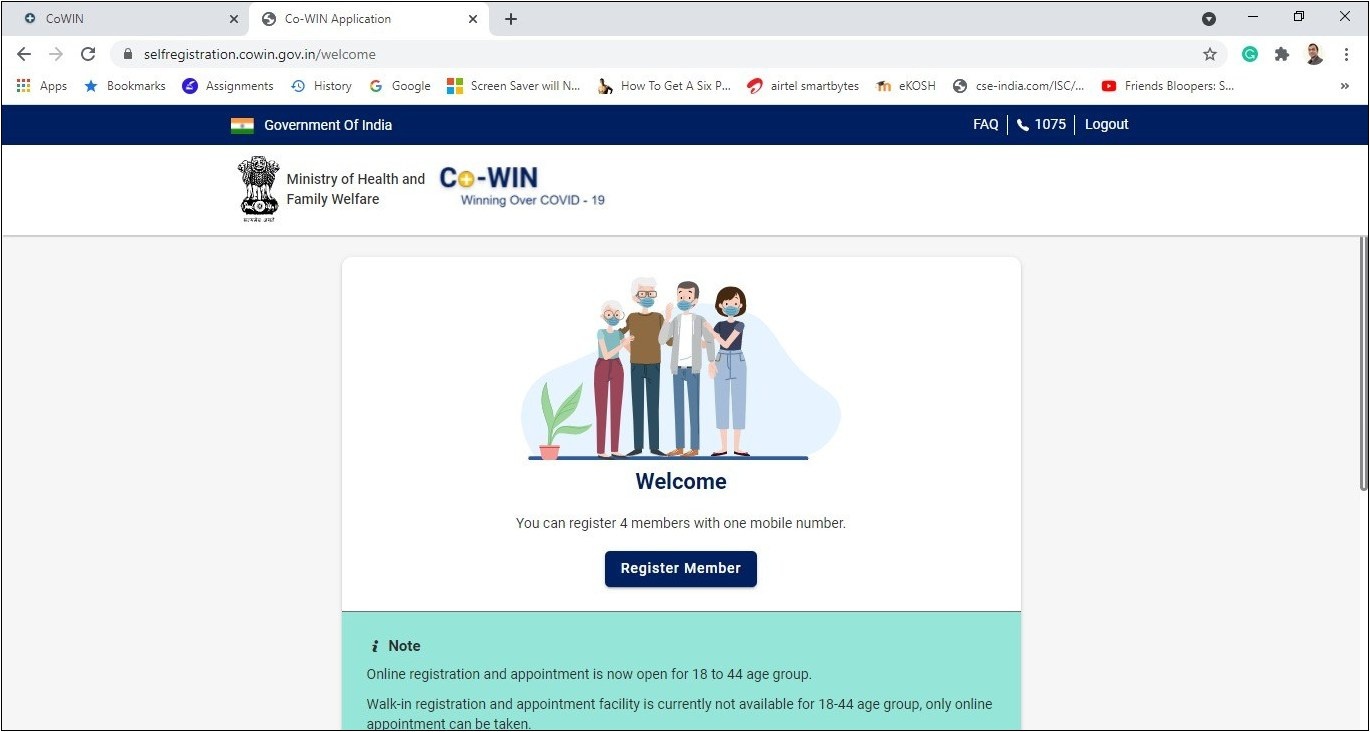
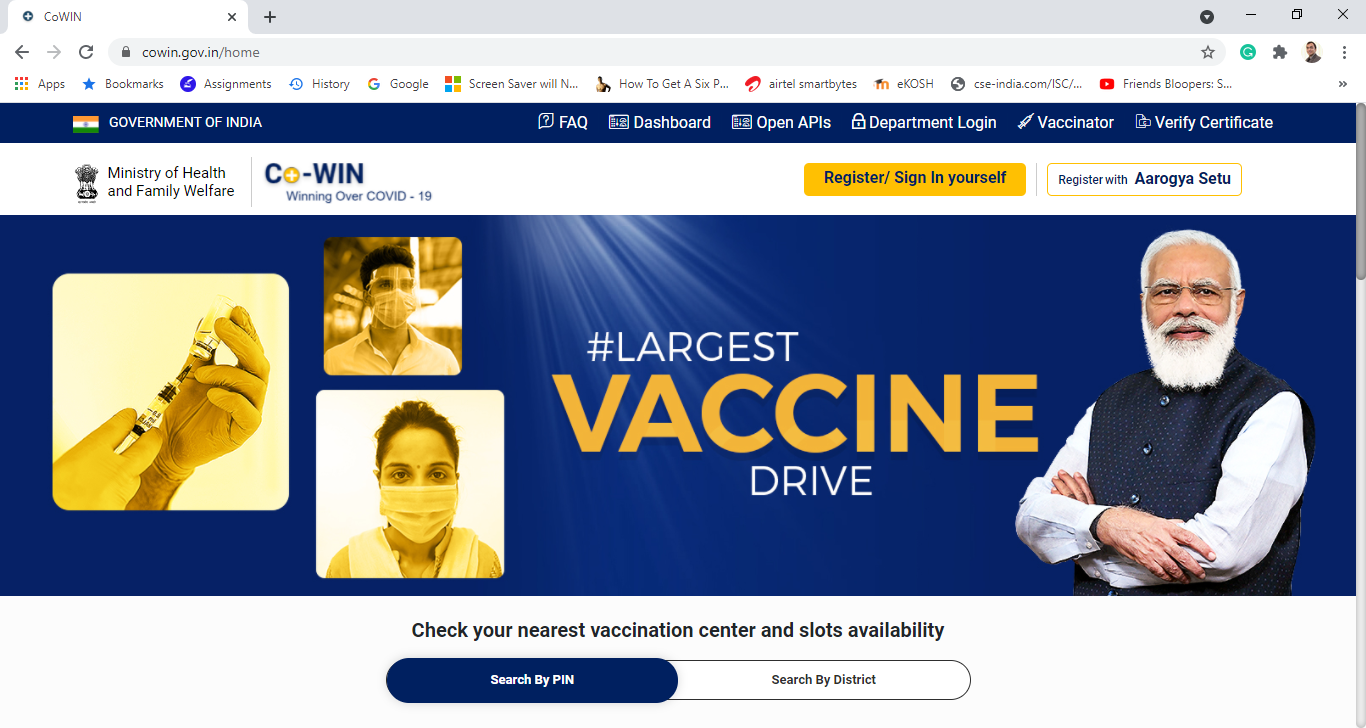
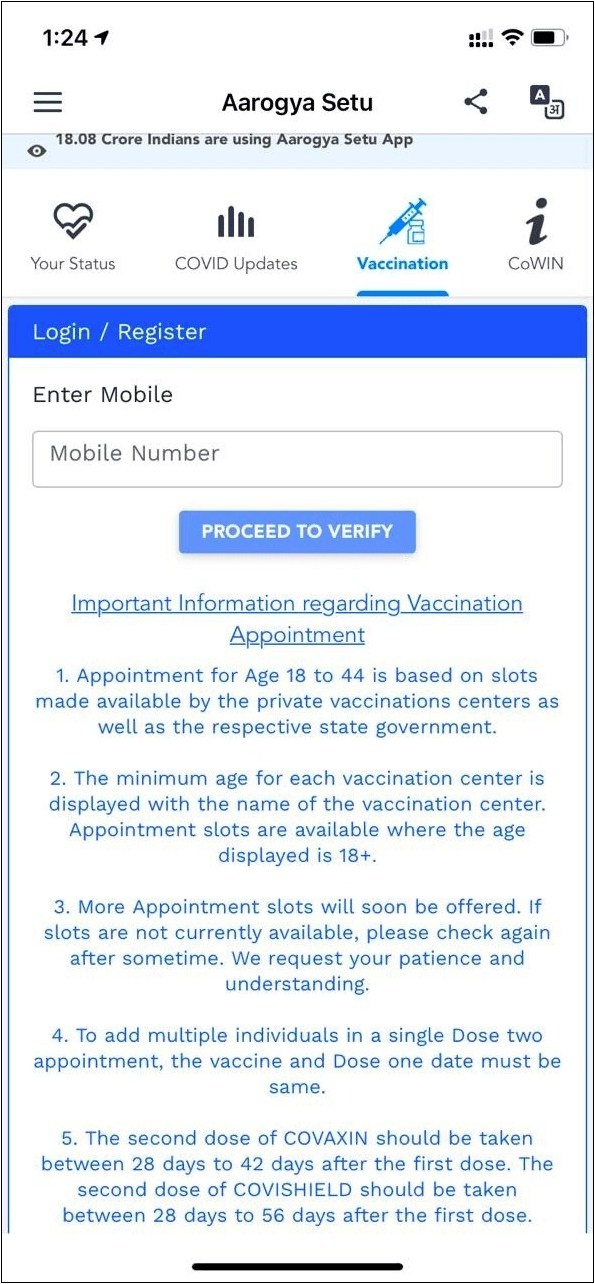
If you or any of your family members are eligible for availing of the vaccine, you would have to register yourself for the same. Registration is compulsory either in advance or on the spot. You can register online on the Co-WIN portal developed by the Government or on the COWIN or Aarogya Setu mobile applications.

Relevant Links: CO-WIN website 

Download the Arogya Setu App from PlayStore 

Or simply scan to download Arogya Setu Mobile App

Benefits of registration

Here are some of the benefits of registering for the COVID vaccination –

  • You can enrol yourself and your family members for the vaccination
  • You can fix the time for availing of vaccination
  • You can choose the vaccination centre wherein you want to get vaccinated
  • You can also reschedule the vaccination date if you miss or are unable to visit the centre on the scheduled date
  • Your vaccination certificate would be shared with you when you are registered

Vaccination details

Vaccination details

  • Vaccines would be given at both Government health centres and private health facilities. These are called COVID Vaccination Centres (CVC). 
  • In the case of vaccination in private CVCs, you have to register yourself prior to vaccination.
  • In the case of vaccination in Government health centres, a part of the slots would be reserved for online registration. However, the rest of the slots would allow walk-in or on-site registrations and appointments.
  • The appointment slots for any date would close at 12 pm a day before such date.

The process of registration 

The process of registration

Here is a step-by-step guide to register yourself and/or your family members on the COWIN portal for vaccination –

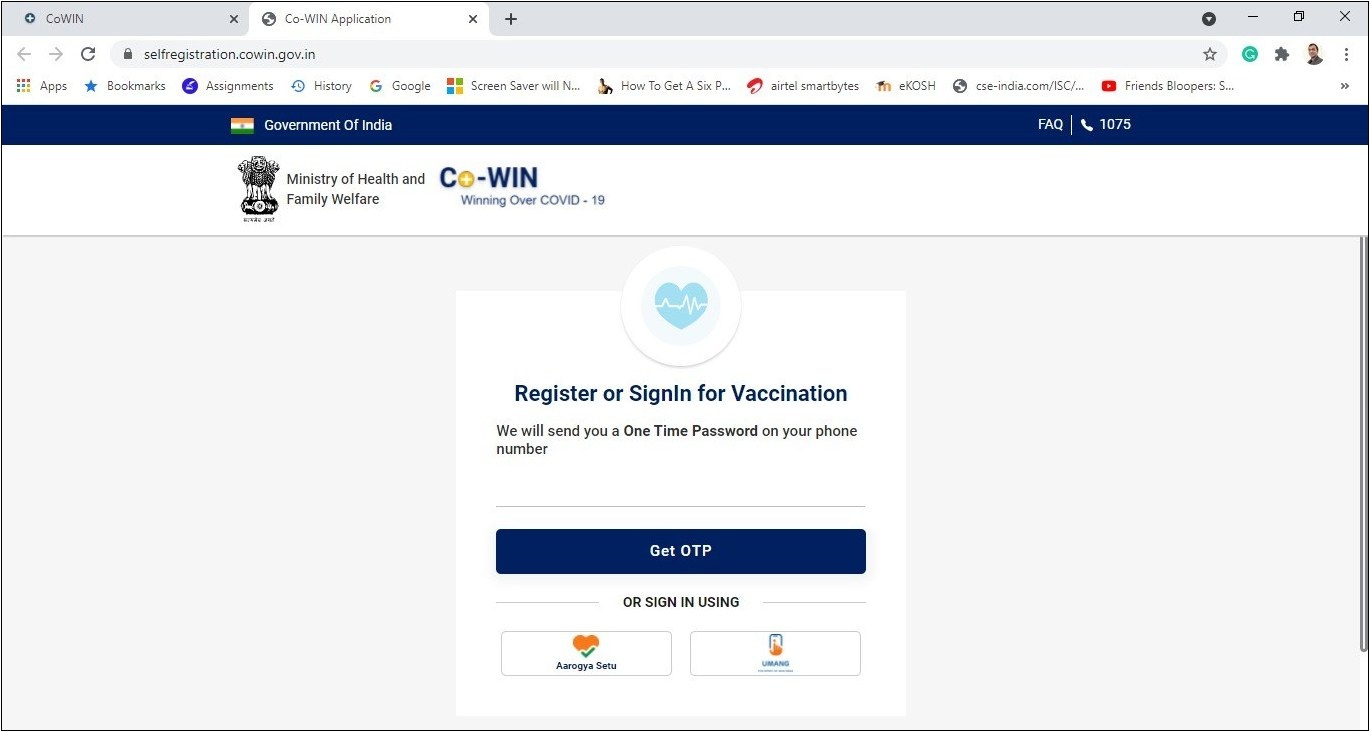
  • Visit www.cowin.gov.in and click on ‘Register / Sign In Yourself’
  • Development-of-COVID-vaccines

  • A new page would open wherein you would have to provide your mobile number for getting an OTP. Alternatively, you can sign in using the Arogya Setu or Umang application.
  • COWIN portal

  • Enter the OTP received for verification and to proceed with the registration
  • registration

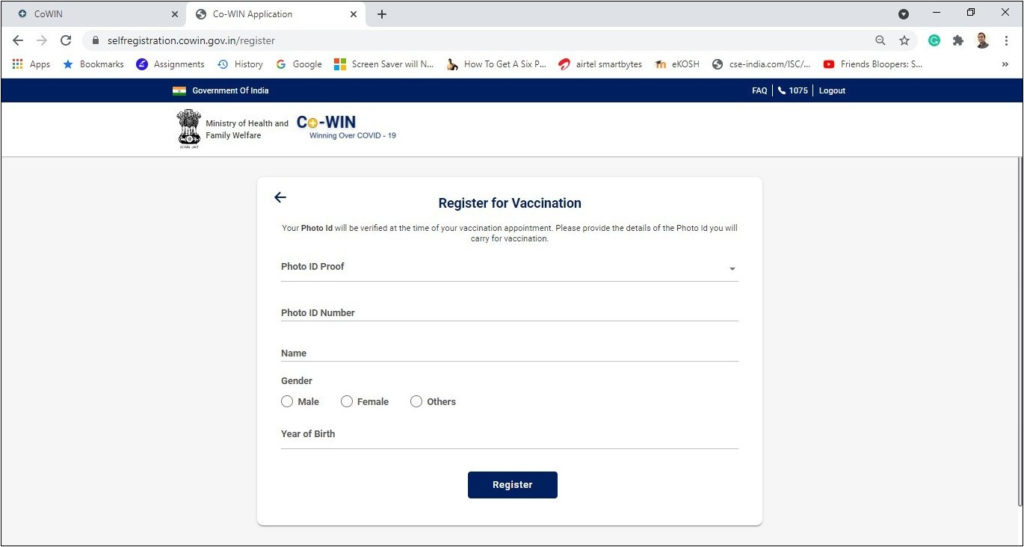
  • A new ‘Registration for Vaccination’ page would open containing the fields which you need to fill with your information.
  • Registration-for-Vaccination

  • The information that should be provided includes –
    • The photo identity proof that you are submitting for registration
    • Number of the identity proof
    • Name
    • Gender
    • Birth year as in the identity proof
  • After the details are provided, click on ‘Register’ and you would be able to register yourself successfully.
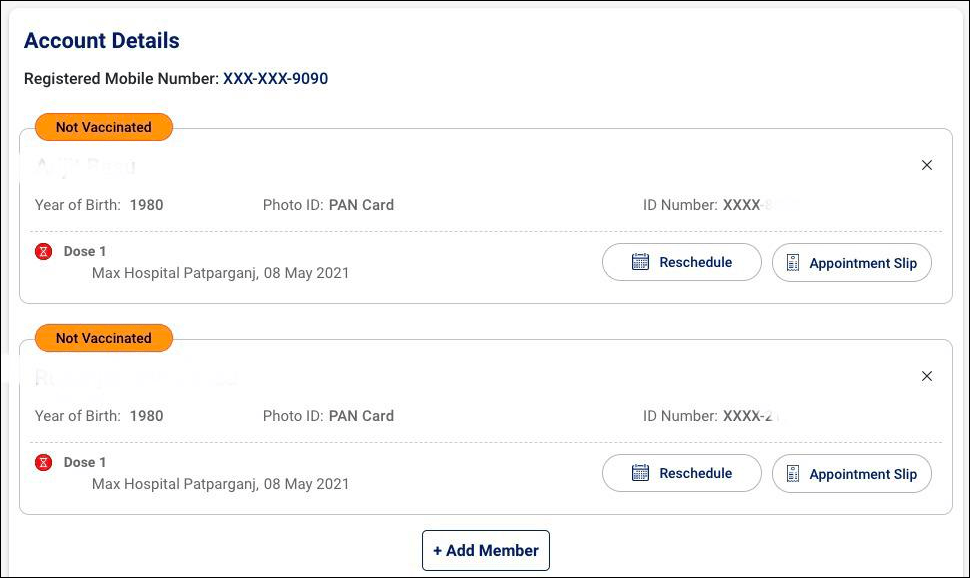
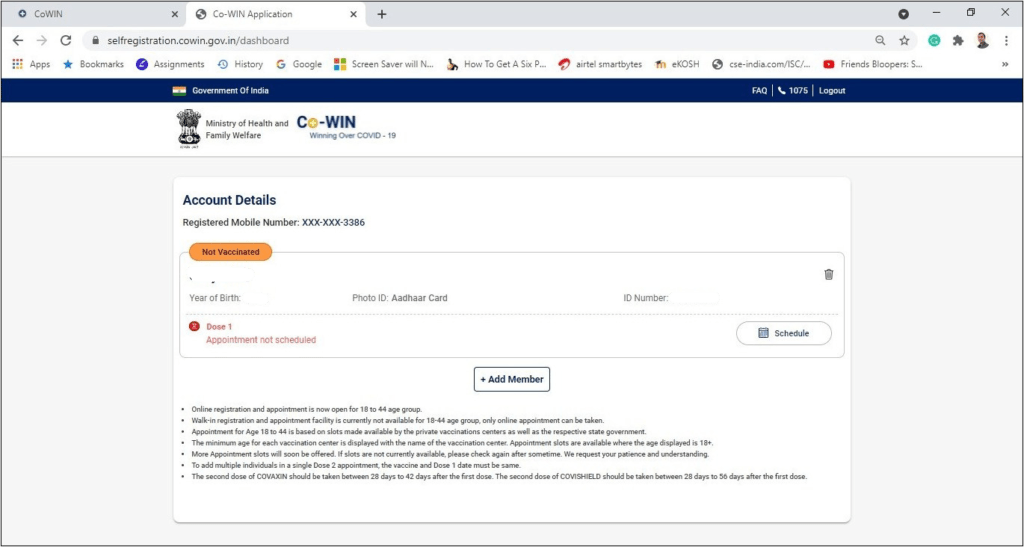
  • You can, then, go into your account and check your details. You can also add up to four additional family members under a single registration
  • To add members, click on ‘Add More’ on your ‘Account Details’ page. Provide the information of the member (s) and the member (s) would be added
Appointment for vaccination

Appointment for vaccination

Once the registration process is complete, you can fix your appointment for vaccination. It can be done using the following steps –

  • On the ‘Account Details’ page, click on the ‘Schedule’ button next to the registered name to schedule an appointment.
  • Appointment for vaccination

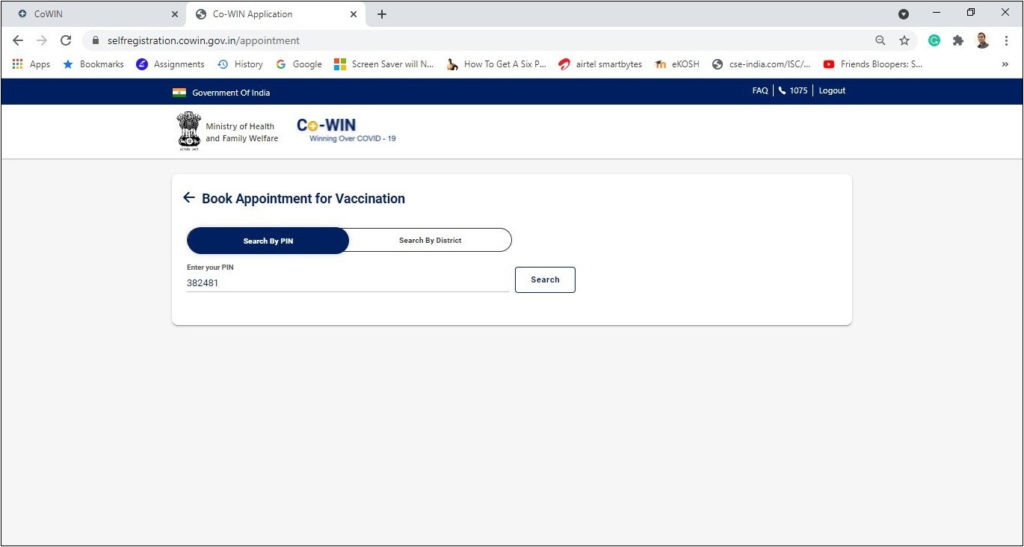
  • You need to enter your PIN code or your district name to find the CVCs wherein vaccinations are available.
  • enter your PIN code

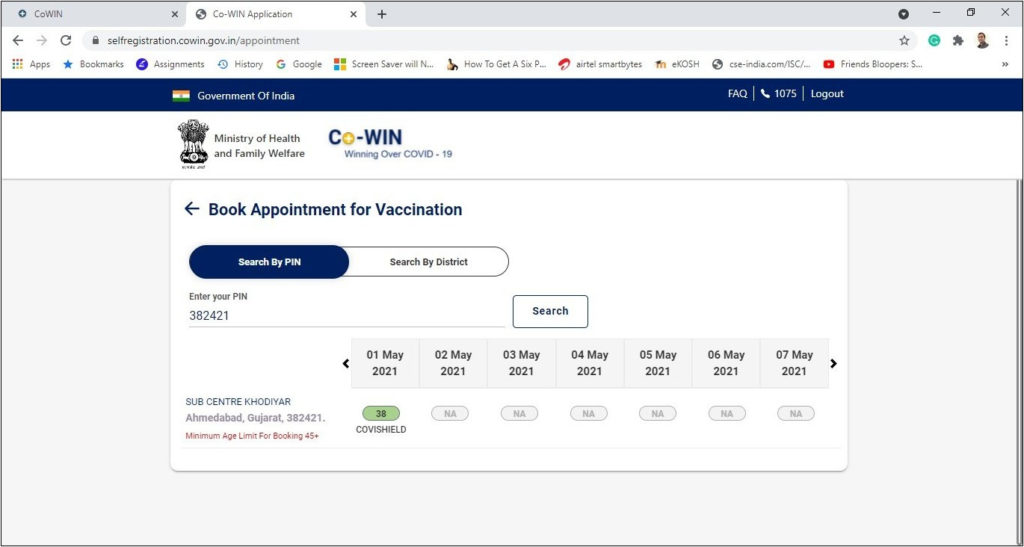
  • When you choose any centre, the available slots would be displayed for a particular date. It would also show the capacity of the respective slot.
  • displayed for a particular date

  • Choose a relevant and suitable date and fix your appointment
  • After you choose any slot, click on ‘Book’. An ‘Appointment Confirmation’ page would open that would show your name, date and time of appointment.
  • Click on ‘Confirm’ to confirm the details and your appointment would be booked.
  • You would, then, be able to see an ‘Appointment Successful’ page such as
Appointment Successful

Then you can download the Appointment Slip as well. The appointment slip has the details of the centre, date and time along with your name and your ID document with a registration ID.
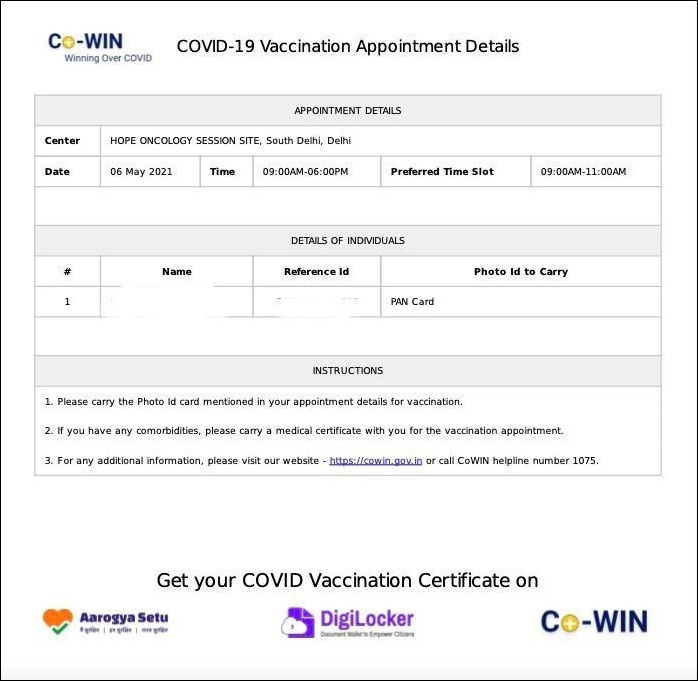
appointment slip

The confirmation of your appointment is shared with you through an SMS that states the date, time and the centre of vaccination. Once you take the vaccination on the scheduled date, another date is automatically allotted for the second dose.

Rescheduling your appointment

If you want, you can reschedule your appointment any time before the appointed day. To do so, log in to the COWIN portal with your mobile number. Verify your account with an OTP. Thereafter, here are the steps for rescheduling the appointment –

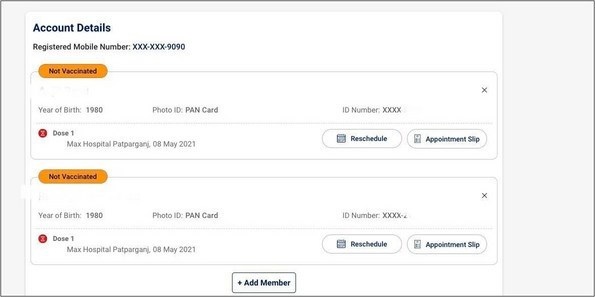
  • Go into the ‘Account Details’ and click on the calendar icon to reschedule your appointment
  • Rescheduling your appointment

  • Choose a new date and then click ‘Book’ to reschedule 
  • Click on ‘Confirm’ and verify the date and appointment time
  • A new page would open showing that your appointment is rescheduled 
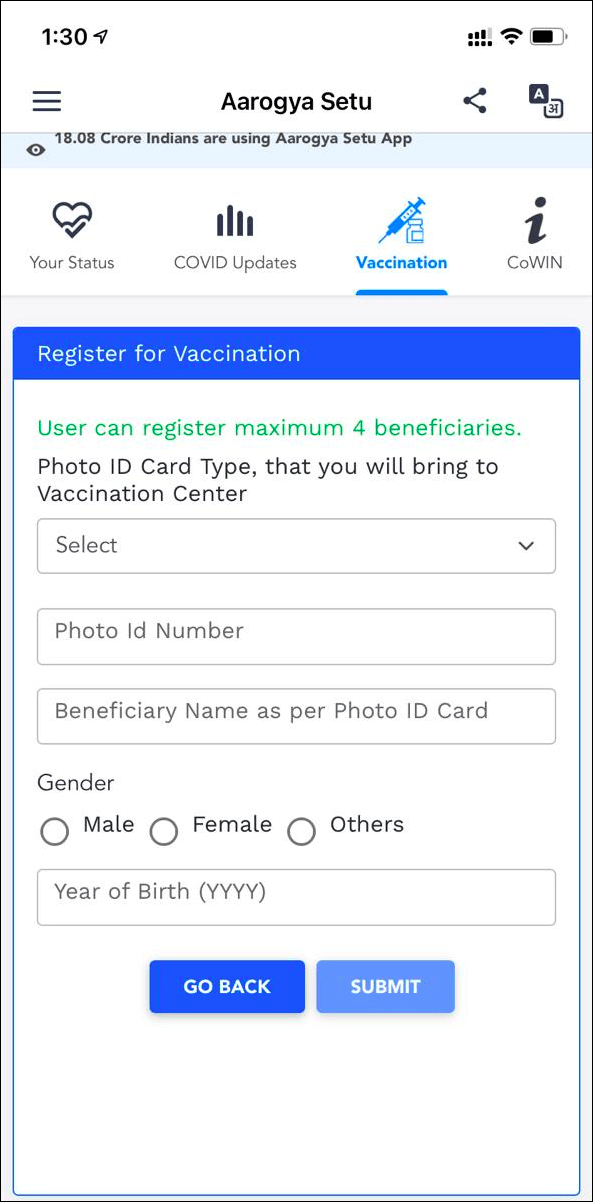
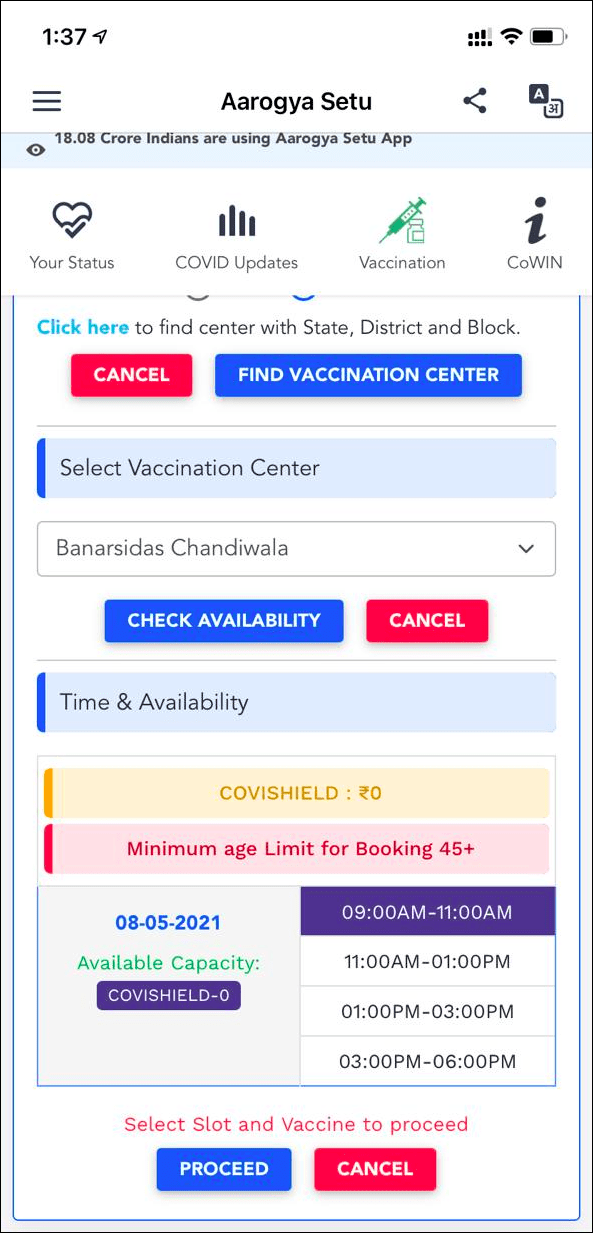
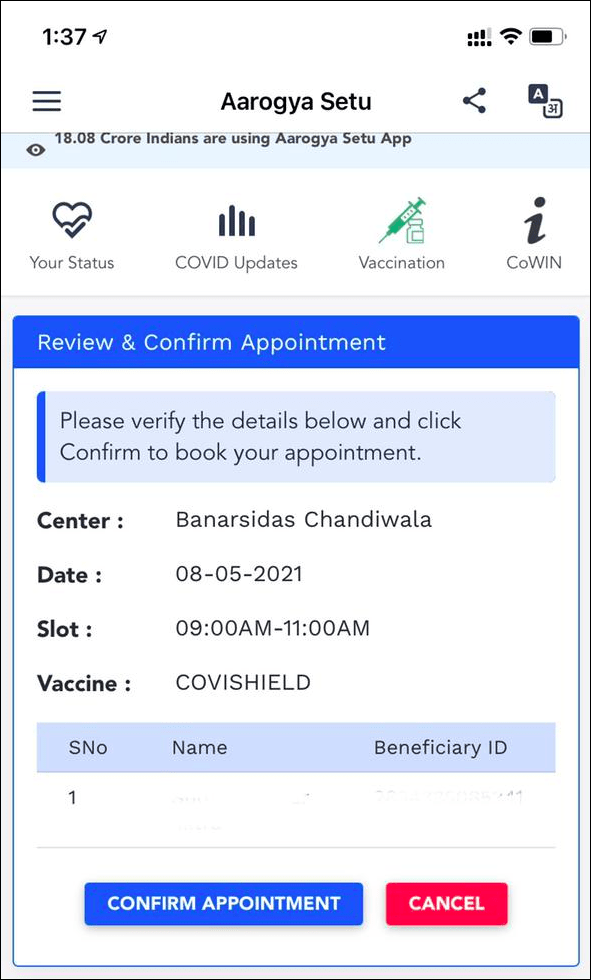
Booking the appointment through the Arogya Setu App

  1. You need to log in with your phone number and OTP
  2. phone number and OTP

  3. You can register up to 4 people with the ID, Photo ID Number, Beneficiary Name, Gender and Year of Birth
  4. register

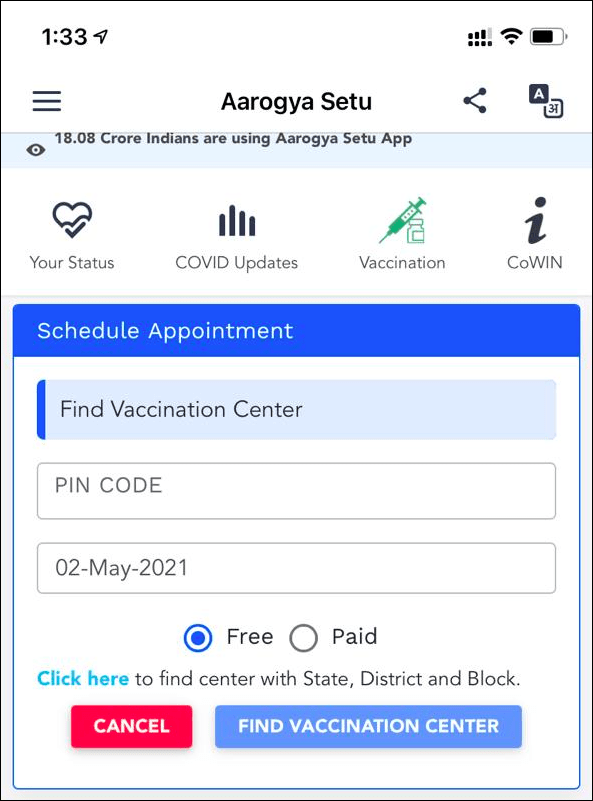
  5. Once the registration is done, you need to schedule the appointment. Click on the same and schedule for vaccination
  6. You can search by Pincode and Date to find the nearby vaccination centre
  7. vaccination centre

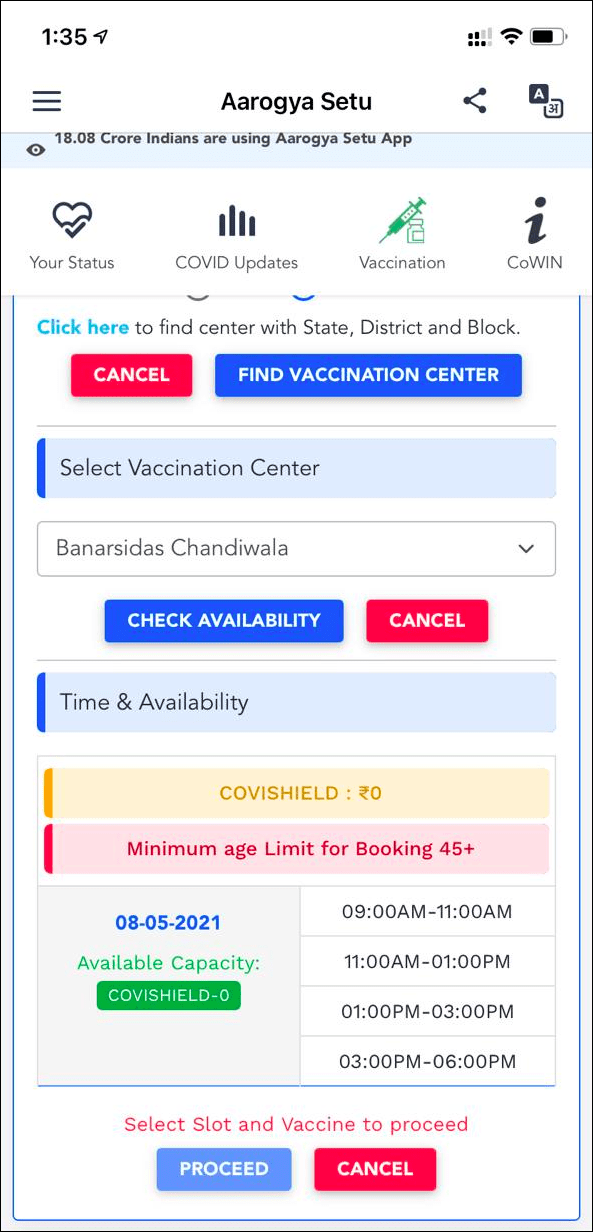
  8. Check and confirm the time and availability of the vaccination
  9. availability of the vaccination

  10. Confirm the time slot and then click proceed
  11. click proceed

  12. Then the appointment details would reflect and you need to confirm the appointment
  13. confirm the appointment

  14. The appointment details would reflect in your App. 
Documents needed for vaccination

Documents needed for vaccination

You need to provide identity proof that would be required for registering for vaccination. Some of the acceptable identity proofs include the following –

  • Acceptable identity proofs:
    • Aadhaar card
    • Driving License
    • PAN Card
    • Passport
    • Voter ID Card
    • Bank passbook

    Besides these, you can also provide the following as identity proofs –

  • MNREGA Job Card
  • Health insurance Smart Card that has been issued under the scheme launched by the Ministry of Labour
  • Any official identity card which is issued to MPs, MLAs, or MLCs
  • Any pension-related document
  • A service identity card issued by the Government to Government employees

What is Comorbidity?

What is Comorbidity

If multiple health conditions are present in a person, it is known as comorbidity. So, if you have hypertension or diabetes, etc. and then have Covid-19, then hypertension or diabetes are considered as comorbidities along with Covid-19.

Furthermore, if you have any comorbidity, you would have to carry a certificate of comorbidity, filled and signed by a registered medical practitioner. The certificate of comorbidity should be filled in the format provided in the link: Certificate of comorbidity.

Once the vaccination is done, you would get a digital certificate certifying the completion of the vaccination. A provisional certificate would be issued after the first dose and once the second dose is completed, you would get a QR code-based final certificate. You can, then, download the certificate for your use.

Dosage for the vaccine

After the first dose of the Covishield vaccine is taken the second vaccine should be taken within the next four to eight weeks. In the case of the Covaxin vaccine, the second dose should be taken within four to six weeks after the first dosage.

In case of people diagnosed or suspected of COVID infection are required to wait for 14 days for taking the vaccine. On the other hand, if you have recovered from COVID you should wait for at least four to eight weeks to get the vaccination.

The body takes about two to three weeks to develop an adequate immune response to COVID after both the doses of the vaccine are taken.

Side effects of the vaccine

Side effects of the vaccine

Like other vaccines, Covishield and Covaxin have side effects too. These include the following –

  • Mild fever
  • Pain or irritation at the site of the injection
  • Mild fever
  • Irritability 

To deal with these side effects, you can take paracetamol.

Cost of the vaccine

The cost of COVID vaccines is different for the different types of medicines. Moreover, the cost also varies depending on the COVID Vaccination Centres (CVCs) that you choose. Here are the costs –

  1. For individuals aged between 18 and 45 years 
    • Covishield Vaccine – For State Government INR 400 and for private hospitals INR 600
    • Covaxin Vaccine – For State Government INR 600 and for private hospitals INR 1200

    However, many State Governments are offering free vaccines at Government health centres. These States include the following –

    • Kerala
    • Haryana 
    • Madhya Pradesh
    • Goa
    • Jammu and Kashmir
    • Telangana 
    • Uttar Pradesh
    • Bihar 
    • West Bengal
    • Sikkim
    • Assam
    • Tamil Nadu
    • Andhra Pradesh 
    • Chattisgarh 
    • Maharashtra
  2. For others 

    Healthcare workers, frontline workers and individuals aged beyond 45 years can get free vaccinations at Government healthcare centres.

Source: Economic Times & Bloombergquint

So, understand everything about the COVID vaccines and register yourself for the vaccination if you are eligible for the same.


How the Standardisation of Health Insurance Plans can lead to Increased Premium?

The Insurance Regulatory and Development Authority of India (IRDAI) made several standardisations in health insurance plans. These standardisations were done with three main objectives –

  1. To make health insurance plans easy to understand 
  2. To make health insurance plans comprehensive in their scope of coverage 
  3. To increase the penetration of health insurance in India

The first two objectives aimed to make health insurance more customer-friendly so that the coverage needs of individuals are duly fulfilled. The third objective was aimed to make health insurance an important part of everyone’s financial portfolios.

Though these standardisations have improved the benefit structure under health insurance plans, in many cases they have given rise to increased premiums. However, before analysing the reason for the increase in premium, here’s a quick look at the main standardisations that were implemented in health insurance plans –

  • Standardised policy wordings for common coverage benefits
  • Coverage for mental illnesses, modern treatments and robotic surgeries
  • Coverage for developmental ailments and learning difficulties, for example, dyslexia
  • Standardisation of free-look period across all plans, payment of penal interest if claim payment is delayed, clauses of portability and migration, grievance redressal and renewal
  • Complete disclosure of information by the insurance company
  • A standardised proportionate deductible clause in case of room rent limit
  • Coverage for telemedicine
  • Standardised Arogya Sanjeevani Policy

All these standardisations have made health insurance plans more exhaustive in their scope of coverage. 

Reasons for the increase in premium

With these standardisations, health insurance premiums have undergone a change and have increased for many policyholders. Following are some of the reasons for such an increase –

  • Wider coverage

    As insurance plans are offering a wider scope of coverage, the premiums for the policies have increased. If you buy a modern-day health plan or port to one, you would have to pay an additional premium for availing of a comprehensive scope of coverage where modern and robotic treatments and telemedicine are also covered.

  • Higher claim experience 

    Due to standardisations, health insurance plans have become more inclusive in their coverage. So, as new and advanced policies are being designed to include the standardisations mandated by the IRDAI, insurance companies face a higher probability of claims. So, to make the plans financially feasible and profitable, health insurers have to increase the premium rates.

How does it impact you?

As a customer, your premium outgo would increase as premiums are hiked across policies. However, you are also getting the benefit of wider coverage from the health plan. In fact, the scope of coverage far outweighs the marginal increase in premium that has been observed. 

Moreover, since health insurance plans now allow instalment premiums, thanks to IRDAI’s directive, you can bear the premiums easily, without hurting your pockets. So, a wider scope of coverage with the facility of instalment premium is a win-win situation even if there is a premium hike.

Also, comparison across different health insurance plans has become easy with standardised terms and conditions and coverage benefits. You can, therefore, compare different plans on their coverage parameters and premium rates and choose the most comprehensive policy with the most reasonable rate of premium.

The bottom line

Under IRDAI’s regulation, health insurance plans would evolve further. The associated premiums might also undergo a change as health plans become more inclusive. Don’t be afraid of a premium hike because the coverage offered would have a higher value proposition compared to the hike. So, enjoy the modern-day health insurance plans with comprehensive features and get covered against unexpected medical emergencies on better terms.

ULIPs can now attract tax. Find out how

Life insurance plans are a great tax saving tool. Besides providing financial security against the risk of premature death, life insurance plans allow you to save tax on the premium that you pay as well as earn tax-free benefits. Unit linked insurance plans provide investors with a good mix of investment returns, insurance coverage and tax-saving benefits. However, in the latest Union Budget 2021, the Finance Minister, Mrs. Nirmala Sitharaman, made ULIPs taxable in certain cases. Do you know the latest tax implication on ULIPs?

Before we jump to the new changes, let’s brush up on the existing tax benefits that ULIPs provided policyholders –

  • Tax benefit under Section 80C

    Premiums paid towards ULIPs, except pension ULIPs, are allowed as a tax-free deduction under Section 80C of the Income Tax Act, 1961. The maximum deduction available under this Section is INR 1.5 lakhs.

  • Tax benefit under Section 80CCC

    Premiums paid towards a deferred pension ULIP plan are allowed as a deduction under this Section. The limit is INR 1.5 lakhs that includes the limit under Section 80C as well.

  • Tax benefit under Section 10(10A)

    On maturity of a deferred pension ULIP plan, you can withdraw up to 60% of the accumulated corpus in lump sum. Technically, this withdrawal is called the commutation of pension. Up to 33% of the withdrawn corpus is allowed as a tax-free benefit under this Section.

  • Tax benefit under Section 10(10D)

    This section is relevant for maturity proceeds received from the ULIP plan. If the premium that you paid for the policy did not exceed 10% of the sum assured (20% for policies issued on or before 31st March 2012), the maturity proceeds would be tax-free. 

    Besides these benefits, partial withdrawals, premium redirections and switching are also tax-free under ULIPs.

What has changed?

A new provision has been introduced in the Union Budget 2021 regarding the taxation of ULIPs. As per the new rule, if the aggregate premium exceeds INR 2.5 lakhs, ULIPs would attract long term equity taxation. That means, if the returns earned from ULIPs exceed INR 1 lakh, the excess returns would be taxed @10% under Section 112A of the Income Tax Act, 1961. If the ULIP is held for less than 12 months, the returns earned would be considered a short-term capital gain and would be taxed @15%. That being said, since ULIPs have a lock-in period of five years, short term capital gains would become irrelevant. 

Here are some important rules to remember with respect to the latest tax implication on ULIPs –

  1. The new tax rule would be applicable on new plans that you buy on or after 1st February 2021. For existing unit linked plans, the rule would not be applicable and you can enjoy full tax benefits
  2. If you invest in multiple unit linked plans, the aggregate premium of all the plans would be considered against the threshold limit of INR 2.5 lakhs
  3. The death benefit would always be tax-free irrespective of the premium amount
  4. The new tax rule would be applicable only on the maturity benefit
  5. The tax benefit on premium would be allowed under Section 80C and 80CCC

So, the next time you are investing in ULIPs and you are paying a high premium, remember the new tax rules to assess your tax liability on maturity. Also, remember that your premiums would still be allowed as a deduction and so, you can invest in ULIPs for saving taxes on the amount you invest. Invest in ULIPs, despite the tax implication, because you can earn investment returns while at the same time enjoying insurance coverage, a benefit that is not available under other investment avenues.

Buying Health Insurance? Use this checklist

Buying a health insurance policy is important to face the rising medical costs. Thankfully, this awareness is slowly spreading across the Indian population and people are investing in health insurance plans for financial protection. However, when it comes to buying health insurance, buying the right policy is important so that the policy delivers on your expectations. Your health insurance purchase decision should, therefore, be backed by careful consideration and research. 

For simplifying the health insurance purchase process, here is a complete checklist which can guide you to buy the right plan –

  • Choosing the right type of policy

    Health insurance plans come in different variants. As such, the first step is to pick the right type of plan. Here are some tips to do so –

    • If you don’t have health insurance coverage at all, buy a family floater health insurance plan. 
    • If you have a health plan but the coverage is low, you can opt for super top-up health insurance plans. These plans would help in increasing your coverage at affordable premiums
    • Critical illness health insurance plans are also essential as they pay a lump sum benefit in a critical illness. Add these plans to your portfolio for added protection
  • Opt for an optimal sum insured

    After deciding on the type of policy, the next step is to choose an optimal sum insured. Remember that the health plan would cover you only up to the chosen sum insured. Given the high medical expenses, a high sum insured is essential. If the high premiums make a high sum insured difficult to avail of, go for super top-up plans and supplement your coverage. Whatever you do, ensure that your coverage is sufficient to cover the expensive medical treatments.

  • Cover all the family members

    The next step is to ensure that all family members are being covered under the health insurance policy. Don’t leave any member out. For parents, opt for a separate senior citizen policy. Do not include them in your family floater policy as it would drive up the premium and eat into the no claim bonus. Moreover, a separate plan would also give you additional tax benefits. So, buy a floater plan covering yourself, spouse and dependent children and another plan for your parents.

  • Check the coverage benefits

    You should ensure that the health insurance plan has all the necessary coverage features that you and your family needs. If, for instance, you would are planning to have a child in the near future, ensure that the plan allows maternity coverage. Similarly, if there are frequent consultations and outpatient treatments, check for OPD coverage. The plan’s coverage benefits should suit your coverage requirements so that all possible medical costs get covered.

    Also, health plans allow optional coverage benefits too called riders or add-ons. Check the riders available in the plan. If the riders are suitable to your needs, add them to your basic plan for an enhanced coverage. For example, if you want coverage against critical illnesses and the plan offers the critical illness rider, choose the rider and get covered against critical illnesses. Similarly, the maternity cover can also be offered as a rider which you can choose if you would be planning a family in future.

  • Check for coverage sub-limits

    Many health plans impose a sub-limit or restriction on their coverage benefits. The most common example is the room rent sub-limit. These sub-limits restrict the scope of coverage and incur out-of-pocket expenses. So, check the sub-limits applicable under the plan. Try and avoid plans with sub-limits, especially in case of room rent. Except room rent sub-limit, if there are other limits in the plan, like limit on ambulance cost, domiciliary treatments, AYUSH coverage, etc., check the extent of such limits. The higher the limit, the wider would be the scope of coverage.

  • Check the no claim bonus and health check-up benefit

    Health plans allow no claim bonus if no claim is made in a policy year. This bonus can either be an increase in the sum insured or a reduction in the renewal premium. Check the bonus allowed. Try and opt for cumulative bonus which increases the sum insured free of cost.

    Moreover, free health check-ups are also allowed either annually or after 2-4 continuous years. Look for the limits of such check-ups and their frequency.

  • Check the hospital list

    For cashless claims you need to take treatments in a networked hospital. So, when buying health insurance, consider the hospital network list. Ensure that the hospitals in your city and locality are featured on the list so that you can avail easy cashless settlements in emergencies.

  • Check the exclusions

    Knowing what is covered under the plan is not enough. You need to know what is not covered as well. Check the exclusion list of the policy to find out what the policy won’t cover. Check the pre-existing waiting period, especially if you or any family member suffers from a pre-existing condition, to know when such conditions would be covered by the plan.

  • Compare the premium

    Lastly, compare the premium charged by different health insurance plans when buying. Compare the premiums vis-à-vis the coverage benefits to ensure that you don’t miss out on the coverage while seeking out the lowest premium. Choose a plan which offers the widest scope of coverage at the lowest premium rate.

Tick off all the above-mentioned points when buying a health insurance policy. The checklist would ensure that you get a right policy which would cover you against medical eventualities. After all, if the plan is right, you get complete financial security, don’t you?

Will your Health Insurance policy cover the cost of COVID 19 Vaccine?

After almost a year of battling with the Coronavirus pandemic the vaccine for the illness has become a reality. Although the vaccine rollout program is still in its nascent stages, the road ahead is positive. Institutes and companies like Bharat Biotech, Pfizer and Serum Institute of India have already applied for the authorization to sell their vaccines in the market while the vaccine being developed by Zydus would be available by the end of the year 2021. Frontline warriors have already begun getting the vaccine shot and senior citizens have been registered for the same. What about the cost of such vaccination? Would it be covered under your health insurance policy?

If you are looking for a generic answer, the answer is ‘No’. The cost of vaccination forms a part of OPD expenses which are not covered by most health insurance policies, even COVID-specific health insurance plans. However, this is not the universal answer. In some cases the cost of the vaccination can be covered under the health insurance policy. Let’s find out how –

Case 1 – If vaccination is a part of inpatient hospitalization

If you are hospitalized for COVID and you get the vaccination shot as a part of treatment of the illness, the vaccination would be considered to be a part of your inpatient hospitalization treatment. In such cases, all health insurance plans would cover the cost of the vaccine.

Case 2 – If your policy has an OPD cover or you opted for one

Another situation in which the cost of the vaccine would be covered under your health insurance policy would be if you have OPD coverage in your health insurance plan. Though most health insurance plans do not allow coverage for OPD expenses, many policies have an inbuilt OPD coverage benefit. Moreover, many plans offer OPD coverage as an optional additional benefit. So, if your plan has OPD coverage as an inbuilt benefit or you have paid an additional premium to avail OPD coverage under the plan, the cost of vaccination would be covered.

However, under OPD coverage, here are a few points that you should remember –

  • Plans with inbuilt OPD coverage might have higher premiums
  • If you opt for OPD cover as an add-on, the premium would be increased
  • OPD coverage is allowed up to a certain limit. If the cost of the vaccine is higher than the allowed coverage limit, you would incur out-of-pocket expenses

What should you do?

Check the coverage of your health insurance plan. If you are opting for elective vaccination and your plan does not have OPD coverage, you would have to bear the cost of the vaccine. Even if the plan has OPD coverage, check the coverage limit as you might incur additional costs on the vaccine. If, on the other hand, you are hospitalized for COVID and you get vaccinated, your health insurance plan would cover the cost of the vaccine. 

So, the coverage for the cost of the vaccine depends on your health insurance plan and when is the vaccine administered. Even if the cost is not covered in your health insurance policy, it would not be too considerable to be affordable. Getting vaccinated against the pandemic is important, even if you have to pay from your pockets, isn’t it?

Do you know about the Customer Friendly Initiatives IRDAI took in 2020?

The Insurance Regulatory and Development Authority of India (IRDAI) keeps the interests of policyholders in mind when framing regulations. The apex body continuously tries to make positive changes in insurance policies so that you can benefit from better coverage. In 2020 also IRDAI made many changes, some specific to the COVID pandemic and others for making insurance policies more consumer-friendly. Let’s have a look at some of the main initiatives undertook by IRDAI in 2020 –

The ‘Sandbox’ initiative 

Innovation and invention are needed so that insurance policies meet the new-age demands of customers. However, launching innovative products can prove financially challenging for insurance companies, especially if their products do not become popular. So, to promote innovation while keeping the cost-factor in control, IRDAI has launched the ‘Sandbox’ initiative. This initiative is for innovations in insurance. Under this initiative, insurance companies can test-launch pilot products providing specific benefits. For example, the ‘Pay-As-You-Drive’ motor insurance policy was launched under the ‘Sandbox’ initiative. The plans launched under the ‘Sandbox’ initiative are offered for a limited period of time. If, within that time, they become popular, insurance companies can launch a full-fledged policy. The ‘Sandbox’ initiative, therefore, promotes insurance companies to experiment and offers you, the customer, new benefits.

Health insurance initiatives

The widespread pandemic increased the importance of a health insurance policy. Individuals having health insurance plans started depending on their policies more than before and those who were uninsured bought health insurance to cover the medical bills if COVID came knocking. Amidst the uncertainty in this crisis, IRDAI issued many directives to insurance companies to make their health insurance policies customer-centric. Some of these directives are as follows –

  • Handling of health insurance claims

    To ensure that policyholders got their health insurance claims settled easily during the pandemic, IRDAI asked insurers to expedite their claim settlement process. Moreover, it urged insurance companies not to reject their claims unless under unavoidable circumstances. 

  • Launch of COVID specific health plans

    COVID hospitalisation incurred a considerable consumables cost, cost which is excluded from normal health insurance policies. Due to this exclusion, policyholders were facing considerable out-of-pocket expenses if they were hospitalised due to COVID. To solve the financial dilemma of COVID infection, IRDAI introduced two new health insurance plans, especially for COVID. Corona Kavach was launched as an indemnity policy covering all hospitalisation costs without any deductibles. Corona Rakshak, on the other hand, was launched as a fixed benefit plan which paid a lump sum if you were hospitalised for 72 hours or more due to COVID. Both these policies have solved the health insurance needs of individuals at low premiums and comprehensive coverage. They have also become the most popular plans as the pandemic is still threatening a large number of people.

  • Introduction of wellness benefits in health insurance plans

    IRDAI has also asked insurance companies to offer wellness related benefits to their policyholders as a part of their health insurance policies. With this initiative, you would be rewarded for maintaining a healthy lifestyle, exercising and also for staying fit. This would, therefore, promote healthy living. Moreover, it would also benefit insurance companies because when the policyholders become healthy, the claim experience would be favourable.

Life insurance initiatives

Even in the life insurance segment, IRDAI made two major changes which are as follows –

  • Launch of Saral Jeevan Bima

    Term insurance is the most basic type of life insurance policy and yet modern day term plans have a comprehensive benefit structure with multiple layers. This confuses an average policyholder and makes it challenging to choose a suitable policy. To standardize the humble term plan, IRDAI has introduced the Saral Jeevan Bima policy. This would be a standard policy offering a standard coverage that would also be affordable. The policy would come into effect from 1st January 2021 and is expected to make buying term insurance easier.

  • Introduction of online KYC

    Earlier, physical signatures were necessary on the proposal form so that its authenticity can be proved. However, with social distancing norms still in place, buying and selling of insurance plans was becoming difficult. The IRDAI, therefore, introduced the concept of online KYC wherein physical signatures have been replaced with online ones. Now, you don’t have to physically sign the proposal form to buy the policy. The KYC verification can now be done through OTPs, digital signature or through an authentication link sent to your email ID. This has made buying and selling life insurance easier.

Motor insurance initiatives

In the motor insurance segment there was only one change. IRDAI removed the concept of long term own damage coverage. With effect from 1st August 2020, only third party coverage is available for a long term period and that too only for new vehicles. Own damage cover can be taken on an annual basis only making it cheaper and more transparent with respect to the no claim bonus that you can get.

All these changes are positive changes which have made insurance more accessible, more relevant and also more useful. While you can find the solution for your insurance needs much more easily, insurance companies can also benefit from a rise in popularity of their insurance plans. Moreover, with these changes, insurance penetration is also expected to increase. A win-win for all, isn’t it?

Importance of Health Insurance at Young Age

When you are young you feel that you don’t need health insurance plans as you are free from health issues and are not even likely to contract any in the near future. But are you correct in your thinking?

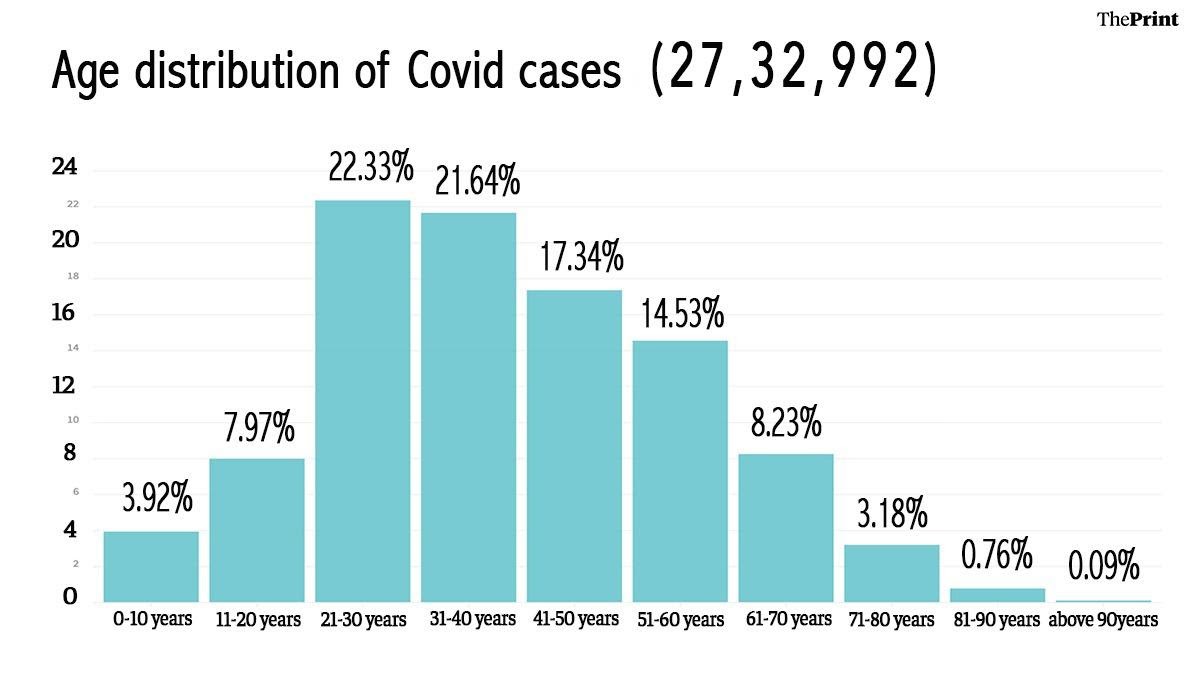
Health insurance plans are important even in younger ages, not only when you are in your middle ages. In fact, if the COVID infection is any indicator, people in the young age groups are not immune from the threat. As per the data published by the Indian Council of Medical Research (ICMR), people in the age group of 21 and 30 years accounted for more than 22.33% of COVID cases in India. Have a look –

Importance of Health Insurance

As you can see, the highest percentages of cases are in the age groups of 21-30 and 31-40 years. Do you still think that you don’t need health insurance when you are young?

Youngsters today are more health conscious. They opt for balanced diets, exercise, Yoga and healthy living to maintain their health. However, despite their attention to their health, illnesses and accidents don’t come announced. Increasing level of work-related stress, dependence on junk food and, of course, the COVID threat all point towards the necessity of a health insurance policy. 

Moreover, when you buy a health insurance policy at a younger age, you get the following benefits –

  1. Comprehensive coverage

    When you are young and healthy you can buy a comprehensive health insurance policy since insurers do not impose coverage restrictions for young individuals.

  2. Waiting out the pre-existing waiting period

    When you are young, chances are that you don’t have pre-existing illnesses. As such, when you buy a health insurance policy, you can easily wait out the applicable waiting period for pre-existing illnesses. Then, when you actually suffer from any illness in later years, you can avail instant coverage since the waiting period is already over.

  3. Earning no claim bonus

    Under a health insurance plan, every year that you don’t make a claim, your sum insured increases by a specific percentage through no claim bonus. This helps you in increasing the sum insured by 50% or 100% of the original amount and gives higher coverage at the same premium with NCB. When you are young, you are less likely to make claims thereby accumulating the no claim bonus which would give you a wider coverage under the plan.

  4. Tax benefits on the policy

    Let’s not forget the tax advantage which your health insurance policy would provide. The premium that you pay for the health insurance policy would allow you a deduction on your taxable income up to INR 25, 000 under Section 80D of the Income Tax Act, 1961. Thus, the policy would not only provide coverage against sudden illnesses or injuries, it would also help you save taxes.

  5. Financial security

    The last reason why health insurance plans make sense is the financial security that they provide. With a health insurance policy you can be secured that any medical contingency, however unforeseen, would not impact your finances. Given that you are young and might have limited savings, a health plan gives you the necessary financial security against medical emergencies. You can, then, plan for other financial goals and ensure that planning for such goals does not get impacted in a medical emergency. 

Modern day millennials have become smart about their finances and investing in a health insurance plan is another smart decision which you should take. Emergencies might disrupt your well-laid plans but when you have a health insurance policy in your armour, you can face medical emergencies without any strain.

Get a Simplified Term Plan “Saral Jeevan Bima”

A term insurance policy is a must for financial protection against the risk of premature death. If the breadwinner dies, the family needs sufficient financial reserves to help them meet their lifestyle expenses and financial responsibilities. A term insurance plan does exactly that and becomes important in financial planning. Given the importance of term insurance, every insurance company offers this coverage. Moreover, modern day term plans have become comprehensive and offer a range of coverage benefits to policyholders. Understanding these benefits and choosing an affordable plan might become challenging and so the Insurance Regulatory and Development Authority of India (IRDAI) has introduced the concept of a standard term insurance plan called Saral Jeevan Bima. Let’s have a look at what this plan is all about–

What is Saral Jeevan Bima?

Saral Jeevan Bima is a standardized term insurance plan which would be offered by all insurance companies with a uniform set of coverage features. The plan would launch on 1st January 2021 and insurance companies are required to file this product with IRDAI by 1st December 2020. The coverage benefits, exclusions and eligibility parameters of the plan would be uniform across all insurance companies. However, the premium rate can be fixed by the companies based on their pricing policies.

Salient features of Saral Jeevan Bima

Here are some of the salient features of Saral Jeevan Bima for your knowledge –

  • You can choose the sum assured within the minimum and maximum limits in multiples of INR 2.5 lakhs
  • You can pay the premium once, for a limited period or throughout the policy tenure depending on your affordability
  • The plan does not have any maturity benefit
  • On death, higher of the following would be paid –
  • 10 times the annual premium or 1.25 times the single premium
  • Sum assured
  • 105% of total premiums paid till death for limited or regular premium plans
    • You can opt for two riders for a comprehensive scope of coverage. The riders allowed include Accident Benefit Rider and Permanent Disability Benefit Rider
    • There is no surrender value or loan payable under the plan
    • Death within 45 days of buying the policy, except due to accidents, would not be covered
    • The plan has no exclusions except suicide. If the insured commits suicide within a year of buying or reviving the plan, the death benefit would not be paid only the premiums paid would be refunded

Eligibility conditions of Saral Jeevan Bima

Here’s a look into the eligibility conditions and coverage criteria of Saral Jeevan Bima –

Details MinimumMaximum 
Entry age18 years65 years
Maturity age23 years70 years
Policy tenure5 years40 years
Sum AssuredINR 5 lakhsINR 25 lakhs
Premium paying termRegular premium – throughout the policy tenure

Limited premium – 5 years or 10 years

Single premium – once

What does the plan mean for you?

Saral Jeevan Bima is a right step in the direction of standardizing term insurance plans. Given the range of policies available in the market with exhaustive coverage, choosing the best plan might prove difficult, especially when you are short on time. Moreover, affording a very high sum assured might not be possible for many. Saral Jeevan Bima overcomes these difficulties and allows you to buy a term plan with decent coverage at affordable premiums. You can also compare the plan across insurers based on its premium because the other features would be the same. So, comparing and buying a term insurance plan would become easier for you.

What does the plan mean for insurers?

For insurance companies, this standardization is beneficial. As the policy is simple to understand and easy to buy insurers can sell the plan over-the-counter and increase their revenue. Moreover, as the plan becomes popular, insurance penetration is expected to increase. Insurers can target low-income individuals who want suitable coverage at affordable costs and provide them with the much-needed insurance cover and boost their business at the same time.

The Saral Jeevan Bima plan is, therefore, beneficial for both customers and insurance companies and once the plan is launched, it is expected to become popular.

How to Get Health Insurance without Medical Checkup – Complete Guide

Medical costs are increasing by leaps and bounds as modern-day medicine has become advanced and technology-driven. At the same time illnesses are rising as lifestyle changes have made people prone to health risks. In this scenario, affording quality healthcare has become difficult and challenging for many because of financial constraints. That is why people invest in health insurance plans to protect against the financial strain of a medical emergency.

When it comes to health insurance plans, buying them is easy as the plans can be bought online. However, there is a concept of pre-entrance health check-up under many policies before the coverage is granted. Let’s understand what this check-up is all about –

What is pre-entrance health check-up?

When you buy a health insurance plan, the insurance company insures the risk of diseases and injuries. While injuries cannot be predicted, it is easy to predict the occurrence of diseases based on your medical health. That is why many insurance companies ask you to undergo specific medical check-ups before you can avail coverage. These check-ups are called pre-entrance health check-ups as they are required before buying the policy. 

Why such medical check-ups are required?

Insurance companies want to assess the probability of claims in the policies that they issue. To assess this probability they insist on pre-entrance medical check-ups. The medical check-ups help insurers understand the present medical condition of the insured and to find out if there are any pre-existing illnesses or medical complication. If the medical reports are found to be favourable, insurance companies can easily offer coverage to the insured. If, however, the medical reports show some medical complications, health insurance companies can do one or more of the following –

  • Increase the premium to compensate for the higher health risk that they are undertaking by issuing the policy
  • Restrict the amount of coverage available
  • Put restrictive coverage terms on coverage of specific illnesses which might arise due to the medical complication found in the report
  • Reject the proposal for insurance altogether if there is a very high health risk

The requirement of medical check-ups in health insurance plans

Now that you know why medical check-ups are required by health insurance companies, you should know that not all health insurance plans need you to undergo pre-entrance health check-ups. The requirement of pre-entrance medical check-ups occur in one or more of the following instances –

  • If your age is high

Usually, health insurance plans require pre-entrance health check-ups if you are aged 46 years and above. It is believed that individuals up to 45 years of age are comparatively healthy and as the age advances, medical complications set in. So, under many plans, you would find the requirement of pre-entrance health check-ups if you are aged above 45 years. Some plans, however, do not need pre-entrance health check-ups till 55 or even 60 years of age.

  • If you opt for a high sum insured

If you choose a sum insured which is high, the risk for the insurance company increases as the claim amount increases. As such, for high levels of the sum insured, pre-entrance health check-ups are needed even when you are young. Generally, the sum insured level above which pre-entrance medical check-ups are required is INR 10 lakhs while some plans might even allow coverage up to INR 20 lakhs without medical check-ups. However, if you choose a higher limit of sum insured, medical check-ups would become mandatory even when you are young.

  • If you declare an adverse medical condition in the proposal form

When filling up the proposal form you are required to divulge your medical history and present medical condition to the best of your knowledge. So, when filling up the proposal form if you mention that you suffer from an adverse medical complication or condition, the insurance company might ask you to undergo a medical check-up before issuing the policy irrespective of your age and the sum insured that you choose.

Health insurance without medical check-up

When it comes to undergoing pre-entrance health check-ups, many individuals tend to avoid buying the health insurance plan altogether. The reasons for such avoidance are as follows –

  • They are averse to the idea of pre-entrance medical check-ups even when such check-ups can help them know about their health. 
  • Many also fear the detection of a medical condition which might increase the premium charged and avoid buying plans with medical tests. 
  • People find it inconvenient to undergo health check-ups before buying the policy
  • The insurer bears the cost of pre-entrance health check-ups only if the policy is issued. If the policy is rejected, the cost falls on the shoulders of the policyholder which is an added expense
  • Many companies pay only 50% of the cost of health check-ups making policyholders pay the remaining 50%. This is an added expense which many individuals do not like to undertake

Whether it is a mental aversion to health check-ups, the costs involved or the inconvenience of undergoing the test, pre-entrance medical tests are not favoured by all. That is why many people look for health insurance plans which do not require medical check-ups. Are there such plans available?

The answer is ‘Yes’. There are health insurance plans which do not require pre-entrance health check-ups up to a certain age and/or sum insured limit. Let’s have a look at such health insurance plans without medical check-ups –

Name of the health plan

Salient features

The need for medical check-ups

Star Health Family Health Optima

  • Sum insured restoration is inbuilt under the plan
  • Free annual health check-ups after every claim-free year
  • Coverage for assisted reproductive treatments

No medical check-ups needed till 50 years of age. However, if an adverse medical history is mentioned in the proposal form, medical check-ups would be needed

HDFC Ergo Health Easy Health Plan 

  • Coverage is offered for up to INR 50 lakhs
  • There are three plan variants and you can choose a variant as per your need
  • Maternity and air ambulance cover is offered under higher variants of the plan

Pre-entrance medical check-ups depend on the entry age and the sum insured opted. If the tests are required, 100% of the cost of the tests would be borne by the insurance company

Universal Sompo Complete Healthcare Insurance Plan 

  • Accidental dental treatments are covered under the plan
  • There are three plan variants and you can avail coverage up to INR 10 lakhs
  • A range of optional benefits are available under the policy for customization 

Pre-entrance medical check-ups are not needed till 55 years of age. However, if there is a medical complication disclosed in the proposal form, medical check-ups might be required even if you are below 55 years of age

Care Health Insurance Plan

  • Sum insured up to INR 6 crore
  • A range of optional covers for enhancing the scope of the policy
  • Comprehensive coverage with annual health check-ups and sum insured restoration feature

Pre-entrance medical check-ups are not required till 45 years of age if the sum insured is below INR 15 lakhs. For higher sum insured levels and/or higher ages, medical check-ups would be compulsory

Manipal Cigna ProHealth Plus 

  • The plan allows the worldwide emergency cover
  • The sum insured is restored automatically if it is exhausted in a policy year
  • There are a range of value-added and optional coverage benefits which make the plan comprehensive

No pre-entrance medical check-ups would be required till 45 years of age if the sum insured is up to INR 50 lakhs. For higher ages and/or sum insured, pre-entrance health check-ups would be needed

Disclosures at the time of buying health insurance

Even if you are young or you choose a low level of sum insured, you might be required to undergo pre-entrance health check-ups if you disclose about any adverse medical condition in the proposal form when you apply for a health insurance policy. Fearing this many individuals try to hide important medical information when buying a health insurance policy. This is a mistake because of the following reasons –

  • If you hide material information which directly impacts the risk undertaken by the insurance company, you breach the principle of utmost good faith. If the insurance company finds about your non-disclosure, the policy would be cancelled and it would become null and void. You would not only lose coverage but also the premium paid under the policy
  • At the time of claims, if the insurance company finds out that you did not disclose about your medical condition when buying the policy, it might reject your claim

To avoid claim rejections and termination of coverage, you should always disclose about your medical condition when buying a health insurance plan. In case of an adverse medical complication, the company might increase your premium or limit the coverage but your claims would be honoured when the time comes and even your policy would not become null and void. So, complete disclosure at the time of buying a health insurance policy is a must.

While there are health insurance plans which do not require medical check-ups, remember that such plans would allow only limited coverage without health check-ups. So, if you are looking for a higher sum insured and want comprehensive protection, do not avoid medical check-ups. Undergo the required medical tests and get comprehensive coverage.