LIC Surrender Value Calculator: What Is Surrender Value & Its Types

Life insurance is a long-term financial product. Though you may buy any LIC insurance or investment policy with a specific purpose to meet a long-term need, your investment perspective can change over the years of time. Sometimes you may have to exit from your long-term LIC investment for various reasons such as a change in your requirement, sudden personal economic hardship or the product is a misfit for your current investment portfolio. Whatever may be the reason, Life Insurance Corporation allows you to surrender your policy mid-way with certain conditions attached to it in specific to each policy. 

With the convenient option of allowing policyholders to surrender policies, insurance plans from LIC not only secure your future but also help in emergencies. Browse through the top insurance plans from LIC today via a few simple steps by clicking here.

Are you planning to surrender your LIC policy? But, are you aware of the value attached to the cancellation or surrender of the policy? If not, read on to know the surrender value in detail and how to calculate LIC surrender value.

What is the surrender value?

Surrendering the LIC policy means terminating the policy before the date of maturity. As the name implies, surrender value is the amount that is paid by the insurance company on terminating or surrendering the policy.

‘Surrender value’ exists for only those LIC policies that have savings component attached to it. For such savings plus insurance plans, the surrender value will be paid on terminating the policy in return of all the premiums paid by you till the date of surrender. In many cases, depending on the terms and conditions of the policy surrender charges will be levied. The final surrender value payable is determined after deduction of charges if any.

Usually, in most of the traditional LIC investment policies, policy acquires the surrender value after the payment of premium for at least two to three policy years.

Demerits of surrendering LIC policy

It is not advised to surrender a LIC policy since it completely ruins the purpose of opting insurance, however, if you are unable to pay the premium, you can surrender the policy anytime.

  • When you surrender your policy, the life cover factors also become unavailable.
  • Depending on the terms and conditions, the accumulated bonus on the LIC policy is given. Since surrendering the policy can be counted as a breach of the policy, therefore only a part of the premiums paid is returned.
  • If you wish to invest in the same policy a few years later, the premium amount will increase owing to your increased age and risk as well.
  • The surrender value will completely become zero if you surrender the policy before the completion of three years.

Types of the surrender value:

There are two types in surrender value – guaranteed surrender value and special surrender value. Higher of the two is paid as ‘surrender value’ at the time of surrender.

What is guaranteed surrender value?

Guaranteed surrender value is the amount that is guaranteed to be paid by the insurance company in case of surrendering the policy during the policy term after the policy acquires a surrender value. Guaranteed surrender value is generally a certain percentage of total premiums paid excluding the additional premiums paid for riders if any. Percentage may vary depending on the policy term and the policy year at which you are surrendering the policy. Percentage or the surrender value factor increases with policy terms. That means percentage applicable will be more as the policy nears maturity.

In most of the policies, along with guaranteed surrender value, the surrender value of vested bonuses will also be paid (if applicable). Based on the policy year of surrender, percentage of vested bonus payable varies.

For example, let’s say you have invested in LIC’s New Jeevan Anand plan for 15 years. Let’s say you are paying a yearly premium of INR 40,000 (net of tax). In case, after the third policy year you wish to surrender, your policy’s guaranteed surrender value will be 30 %( surrender value factor applicable) of total premiums paid. Following will be the guaranteed surrender value:

Guaranteed surrender value = Surrender value factor X Total premiums paid

                                                    = 30% X (40,000 X 3) = INR 36,000

Let’s say, vested bonus for your policy at the time of surrender is INR 61,500. Surrender factor applicable for accrued bonuses is 17.66%, then surrender value of vested bonuses will be:

The surrender value of vested bonuses = Applicable surrender factor X Accrued bonuses

                                                               = 17.66% X 61,500 = INR 10,861

What is special surrender value?

Special surrender value is the non-guaranteed amount which is either equal to or higher than the guaranteed surrender value. The special surrender value will depend on a number of premium instalments paid by you, policy term and the bonus accrued (if any). Special surrender value is calculated as:

Special surrender value = [{Basic sum assured X Number of premiums paid/ number of premiums payable} + accrued bonuses] X applicable surrender value factor

For example, you have invested in a policy for 20 years for sum assured of INR 10, 00,000. Let’s say you are paying a yearly premium of INR 60,000, which you have paid for 4 years. In the fifth year, you want to surrender the policy for some reason, the following will be special surrender value, assuming that the applicable surrender value factor is 50% and bonus accrued is INR 50,000

Special surrender value = [{10, 00,000X4/20} + 50,000] X50% = INR 1, 25,000

With the steps mentioned above, you can easily calculate the surrender value of your LIC policy. The choice of surrendering your LIC policy mid-way gives you the freedom of investing in any other LIC policy without the worries of the future. Choose the best insurance plans for yourself today!

What is the surrender value factor?

The surrender value factor refers to the percentage of total premiums paid. For the initial three years, the surrender value factor is zero and it keeps increasing from the third year itself. However, the increase varies from company to company depending on a lot of factors like- maturity time, type of policy, completed policy years, and profit fund performance if it is a participating policy.

LIC surrender value calculator

LIC surrender value calculator is an online tool that helps you get the approximate details of your LIC policy surrender. By providing some basic information related to your policy, you can calculate your LIC surrender value instantly.

How to use the surrender value calculator?

Surrender value calculator can be accessed online on the website of an insurance technology firm. All you need to do is input some basic details such as your name, mobile number, plan name, policy term, number of premium instalments paid, premium payment mode, instalment premium and number of years completed by the policy. Once you submit these details, LIC policy surrender value calculator instantly calculates the approximate surrender value and the value will be displayed as a result.

Many other leading insurance providers have also used LIC’s model that allows such flexibility. Top life insurance companies and the features they offer can readily be found here.

It is that simple and easy to know the LIC surrender value! However, it is important to understand the fact that by surrendering the policy you will be devoid of the risk cover that the policy was providing. Evaluate every point before you surrender your policy!


New car insurance online India

If you have bought a new car your car dealer must have suggested a new car insurance policy with it too. Do you know why?

A car insurance policy is mandatory to comply with the provisions of the Motor Vehicles Act, 1988. The Act states that every car which runs on Indian roads should have a valid car insurance policy attached to it. If you are found to be driving without a valid car insurance cover, you face legal penalties which might also lead to imprisonment. That is why when you buy a new car you often get the new car insurance policy bundled in the cost.

Though a car insurance policy is mandatory, you should know the aspects of the cover so that you know exactly what you are covered for. Since you are buying a new car insurance policy, here’s a complete guide to understanding the policy –

Types of new car insurance plans

There are two types of car insurance plans which are available in the market which you can choose from. These are as follows –

Types of new car insurance plans

Third party liability plans are mandated by the Motor Vehicles Act while comprehensive plans are bought as per your discretion.

Now, let’s understand the coverage under both these types of plans –

Coverage under new car insurance policies

    • Third party liability plansThird party liability plans cover any financial liability that you might face in the following cases:
      • If your car caused the death of a third party
      • If your car caused physical injuries to a third party
      • If your car caused damage to the property belonging to a third party
    • Comprehensive plansComprehensive car insurance plans, on the other hand, offer a wider scope of coverage which includes the following:
      • Financial liability incurred if your car caused the death of a third party
      • Financial liability incurred if your car caused physical injuries to a third party
      • Financial liability incurred if your car caused damage to the property belonging to a third party
      • Damages suffered by the car due to natural calamities. Examples – flood, earthquake, lightning, cyclones, landslides, etc.
      • Damages suffered by the car due to man-made calamities. Examples – riots, malicious acts, theft, fire, explosion, etc.
      • Damages suffered by the car when it is in transit via road, rail, air or water

Thus, comprehensive plans cover not only the mandatory third party liability but also damages suffered by your car itself. These plans, therefore, offer better coverage and are recommended for your new car.

Moreover, under both third party and comprehensive insurance plans, there is a personal accident cover. This covers the owner/driver of the car against accidental deaths and disablements. If you face any accidental contingency when driving, the personal accident cover would pay a lump sum benefit depending on the contingency that you suffer.

Add-on covers under comprehensive plans

Besides covering the damages to your car, comprehensive plans also allow optional add-on covers. These covers make your car insurance plan comprehensive. You can buy one or more add-on as per your coverage requirement. Each add-on that you choose would require you to pay an additional premium. The commonly available add-ons which are recommended with your new car insurance plan are as follows –

  • Zero depreciation This add-on negates the effect of depreciation on your car insurance claims. In case of damages, the depreciated value of the car’s parts is paid by the insurance company while you have to pay the actual cost. This greatly reduces the claim amount and incurs additional expenses for you. When the add-on is opted, the company does not consider the depreciation on the car’s parts. The actual cost incurred in repairing or replacing the parts is covered by the policy.
  • Roadside assistanceImagine your car breaking down in the middle of nowhere and you have no help at hand! With roadside assistance add-on, help is just a call away. If the add-on is selected the insurance company promises emergency assistance if your car faces breakdown. You can get assistance for flat tyres, empty fuel tank, loss of car keys, etc.
  • Engine protection If your car is submerged in a water-logged area and in starting your car you damage the engine, such damage would not be covered under your car insurance policy. However, the engine protection add-on covers such engine damages and pays the cost of repairs.
  • No claim bonus protectionNo claim bonus is a bonus that you get if you don’t make a claim on your car insurance policy. This bonus allows you a premium discount when you renew the policy. Moreover, the rate of bonus also increases after each consequent claim free year. In case of a claim, however, the bonus becomes zero. If you take this add-on your bonus remains intact even after you make a claim.
  • Return to invoiceThis add-on pays the invoice value of your car in case the car is theft or damaged beyond repair. You don’t get the depreciated cost but the full value of the car.
  • Consumables coverThis add-on covers the cost of consumables incurred in repairing your car. Consumables include oil, lubricant, screws, bolts, etc.

How are premiums calculated?

When you buy a new car insurance plan, you often wonder what your premium rate would be. The premiums of car insurance plans depend on a lot of factors and when you know these factors you would understand the premium being charged. So, here are the factors which affect the premium of your new car insurance policy –

  • Make, model and variant of your carThe make, model and variant of your car determines the off-road price of your car. This off-road price is used to calculate the coverage of the policy. Higher the value of the car higher would be the premium. So, if you buy a luxury car or an SUV, your premiums would be higher compared to when you buy an economic hatchback or sedan.
  • Fuel typePetrol cars are cheaper than diesel cars and so the premium of your car insurance policy also depends on the fuel variant of your car. Petrol cars have cheaper premiums than diesel ones.
  • Type of policy that you buyAs stated earlier, your car insurance policy can be a third party liability policy or a comprehensive package policy. Third party premiums are cheaper than comprehensive plans since they have a limited scope of coverage. So, if you buy a third party plan, the premiums would be lower.
  • Location of registration of the carThe registration location also determines your car insurance premiums because the premiums charged for cars registered in metro cities are higher than those charged in non-metro cities.
  • Type of car that you buyYou can buy a brand new car or a used one. Brand new cars have a higher value and thus their premiums are high. If you are buying a second-hand car, the premium of a new car insurance policy would be low.
  • Add-ons selectedIf you make your car insurance policy more comprehensive by adding add-ons, the premium would increase. Each add-on comes at an additional premium and the number of add-ons that you select will determine your premium.
  • Discounts available There are a range of discounts available in car insurance policies. If you are eligible for such discounts your premiums would be lowered. So, the higher the discount that you can avail the lower would be your premium and vice-versa.

New car insurance – 5 common myths v/s reality

When you are buying a new car insurance policy you have various preconceived notions about the plan. You might believe in myths while the real picture is completely different. Let’s bust some of the common myths associated with buying a new car insurance plans –

Myth #1 – I have to buy the car insurance policy from the car dealer

Many believe that since the car dealer bundles up a car insurance policy in the total cost of the car they would have to buy the policy from the dealer itself. This is a myth.

Reality – The dealer bundles up a policy issued by an insurance company with which it is tied-up. You are under no compulsion to buy the policy from the dealer. You can buy a new car insurance policy independently by comparing the different plans available in the market. You just need to communicate to your dealer about your intention to buy an independent policy whereupon the dealer would deduct the cost of insurance from the cost of the car. You can then buy a policy separately for your new car.

Myth #2 – The dealer offers me the best car insurance policy

It is often believed that the dealer offers you the best car insurance policy with your new car and so many individuals buy the policy from the dealer itself.

Reality – The dealer only offers the policy of the insurer with which it has a tie-up. That policy might not be the best car insurance policy because there are other insurance companies in the market too which offer competitive plans. To buy the best policy you should always compare the available plans in the market and choose the one which has the best coverage benefits at the most reasonable premium rates.

Myth #3 – Buying car insurance from dealer is easier compared to buying a policy independently 

When you buy a new car, the dealer includes a car insurance policy with the other formalities of buying the car. As such, it seems like an easy way to buy the policy from the dealer itself.

Reality Buying a policy independently is not as hard as it seems. There are various online websites which allow you to compare and then buy the best policy for your car. You can buy a new car insurance policy online with some simple clicks of your mouse or Smartphone. The complete process is done online and you can even pay the premiums online. Thus, you can buy the plan yourself easily and also ensure that you get the best coverage.

Myth #4 – Cashless claims can only be availed if I buy the policy from the dealer

Many individuals believe that since the dealer is selling the car insurance policy, they would be able to get cashless claim facility easily. If they buy independently, their claims might not get settled on a cashless basis.

Reality – Cashless claims are offered by all car insurance policies if you take your car to a networked garage. So, it is not mandatory to buy the policy from your dealer. You can buy the policy yourself and still get the benefit of cashless claim settlements.

Myth #5 – The add-ons suggested by the dealer are a must

Many often dealers include a range of add-ons in the car insurance policy. You might believe that these add-ons are in your best interests and you buy them without thinking too much. This, however, is not recommended.

Reality – You should buy only those add-ons that you need. The dealer might include the add-ons unnecessarily which you might not need. This would also increase the premium. You should, instead, understand the add-ons and choose those which you need. For instance, if your area has no water-logging problem, an engine protection add-on would not be required.

How to buy a new car insurance policy?

Now that you know all the important aspects of a new car insurance policy, here’s how you can buy the policy –

    • Buying offline through car insurance agents or the insurance company
    • Buying online through websites after comparing

Though both the options allow you to buy a car insurance policy, the online mode allows you to buy the best policy. It is because when you buy online you can compare the different plans and buy the most suitable one. Turtlemint is an online website which allows you to buy car insurance policies online in an easy manner. Here are the benefits why you should choose Turtlemint to buy car insurance –

  • Turtlemint’s platform is simple and user-friendly. You can buy a new car insurance easily by following some quick and easy steps
  • You can get personal assistance in case you face any problems and queries when buying a car insurance policy. Turtlemint’s team would contact you and personally guide you to choose the best policy and buy it online
  • Turtlemint is tied-up with all the leading general insurance companies which offer the best car insurance policies. Thus, through Turtlemint’s website you can ensure that you buy the best policy available in the market
  • The payment gateway of Turtlemint is encrypted and secured. You can securely pay the premium online without the risk of frauds or data theft
  • Turtlemint also helps you in case of car insurance claims. When you face a claim all you have to do is call up Turtlemint’s toll-free helpline number 1800 266 0101 or send an email at claims@turtlemint.com . Turtlemint’s team would then coordinate with the insurance company and help you get the settlement of your car insurance claim easily and quickly.

So, if you are buying a new car, buy a new car insurance policy on it independently through Turtlemint. You would also fulfil the legal requirement of having car insurance and also get to enjoy the above-mentioned benefits.

Frequently Asked Questions

  1. Can I buy a new car insurance policy if I buy a second-hand car?Yes, you can buy a new car insurance policy on a second hand car if the previous owner’s policy is not relevant.
  2. Do car insurance premiums have any tax benefits?No, the premiums paid for a car insurance policy does not give you any tax benefits.
  3. What is the term of car insurance plans?If you are buying a new car insurance policy on a vehicle bought on or after 1st September 2018, you would have to avail a mandatory three year third party cover. The own damage cover can be availed for one year or for three years as per your requirements.
  4. What premium discounts are available in car insurance plans?Under car insurance plans you get the premium discounts for the following factors –
    • If you have installed safety devices in your car
    • If you have modified the car for the usage of a disabled person
    • If you have a membership of a recognized automobile association
    • If you choose a voluntary deductible.
  5. Can I cancel a new car insurance policy?Yes, a new car insurance policy can be cancelled any time after you buy the plan. When you cancel, a part of the premium paid is refunded back depending on the period after which you cancel the policy.

Difference between Life Insurance and General Insurance

Insurance is an important aspect of everyone’s financial planning. Insurance is a contract that spreads the risk and provides protection against financial losses that may arise due to uncertainty. Insurance helps to achieve financial stability. Insurance is broadly categorised into two types – Life insurance and general insurance. In this article, let’s learn the difference between life insurance and general insurance along with learning the types of plans offered under each of the two insurance categories.

Comparison chart to know the difference between life insurance and general insurance:

Basis of Comparison

Life insurance

General insurance

Meaning

Life insurance is an insurance contract, wherein the insurance company promises to compensate the insured individual for uncertainties of life that are death. Life insurance provides protection against life risk.

General insurance is an insurance contract, wherein the insurance company promises to compensate the insured individual or entity for the financial loss or damage caused due to an unfortunate event. General insurance gives protection for all the valuable things that are important to you.

Term of contract

Long-term contract

Short-term contract

Nature of contract

Life insurance is not a contract of indemnity. It is considered as an investment

General insurance is a contract of indemnity

Insurable interest

Life insurance requires the beneficiary to have an insurance interest in the person who is being insured. That means, insurable interest needs to be present at the time of underwriting

In general insurance policies, insurance interest is expected to exist both at the time of underwriting and at the time of loss.

Payment of claim

Benefits under the policy are paid on the occurrence of an insured event or on maturity

Financial loss caused due to the insured event is remembered on the occurrence of the particular event

Compensation value

The compensation value is dependent on the premium payable under the policy

The compensation value is the actual loss incurred in the insured event (maximum amount payable is subjected to the policy limit)

Premium payment

Premiums need to be paid periodically over the years for a specified term

Premium is paid in a lump sum as the policy is purchased for short-term and plans need to be renewed on expiry

Savings

Many life insurance plans come with a savings element which helps the insured to build corpus or create wealth for future

General insurance plans have no savings component as it’s an indemnity contract wherein you incur the premium cost to avail the protection

Now that we know the difference between life insurance and general insurance, let’s understand both life insurance and general insurance in detail with the sub-categories offered.

What is life insurance?

Life insurance is a contract between two parties – insurance policyholder and insurance company, wherein the insurance company promises to pay a certain sum of money to the designated beneficiary in exchange for a premium during the demise of the policyholder. A pure life insurance policy offers protection against life risk by providing death benefits to the beneficiary of the policyholder on his/her death. However, life insurance plans come in a wider variety. Many life insurance policies come with dual benefit of protection and savings. There are plans that come with savings component attached. Let’s take a look at various types of life insurance plans available.

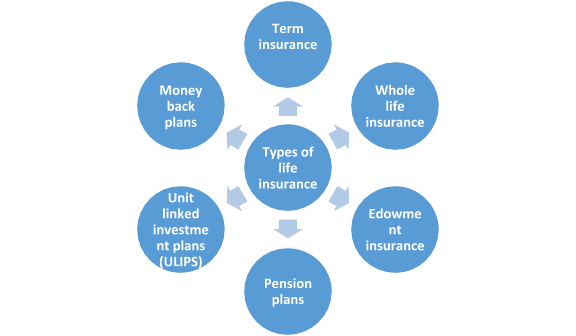
Types of life insurance policies

Types of life insurance policies

  • Term insurance:

    Term life insurance plans are the pure protection plans that provide life cover for a specific term, say 20 years, 30 years and 40 years. Premiums under these policies need to be paid out periodically for the policy period. Sum assured or death benefit will be paid to the beneficiary if the insured dies during the policy term. If the insured survives the policy term, nothing will be paid in return as the policy has no savings component.

    Click on Term Plans to know more.

  • Whole life insurance:

    As the name implies, whole life insurance plans are designed to provide risk cover as long as the policyholder is alive. Whole life insurance plans come with cash value component which will be paid as survival benefit at the end of the policy term/on maturity. However, even after the maturity of the policy, the plan continues to provide the death cover for the whole life of the insured.

  • Endowment insurance:

    Endowment policies are the traditional products that come with a dual benefit of protection and savings. In these policies, if the policyholder dies during the policy term, the beneficiary will be compensated with death benefits. However, if the policyholder survives the policy period, lump sum (survival benefit) amount will be paid on maturity. Endowment insurance policies are ideal for long-term investors looking for safe investment options.

    Click on Endowment Plans to know more.

  • Money-back plans:

    Money-back plans are the type of endowment plans that provide both protection and wealth creation benefits. But, in money back plans survival benefits are paid in proportions over the period of the policy term which helps to achieve major milestones in life.

    Click on to Money-back Plans know more.

  • Pension plans:

    Pension plans are specially crafted investment products for post-retirement income. The premiums paid towards pension plans are accumulated and the lump sum benefit on the maturity is used to purchase an annuity for paying regular income then onwards.Click on Pension Plans to know more.

  • Unit linked investment plans (ULIPs):

    ULIPs are market-linked investment plus insurance plans that invest part of your premium in market-linked financial instruments and the part of your premium is used to provide life cover. ULIPs are the customisable products that come with multiple attractive features and flexible benefits.

    Click on ULIPs to know more.

What is general insurance?

General insurance is an indemnity contract that does not come under the purview of life insurance. Basically, general insurance provides protection against losses arising out of various risks to the important things you value such as health, business, motor vehicle and home. General insurance comes in various types.

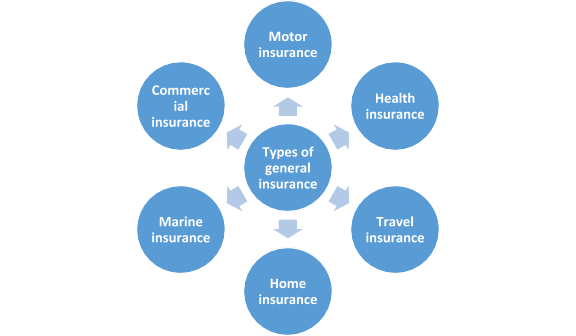
Types of General Insurance:

Types of General Insurance

  • Motor insurance

    Motor insurance provides protection against third party liability arising in an accident, damage to own vehicle due to man-made and natural calamities along with personal accident cover. The insurance can be availed for two-wheelers, four-wheelers and commercial vehicles.

    Click on Car Insurance to know more about four-wheeler insurance plans and Bike Insurance to know more about two-wheeler insurance plans.

  • Health insurance:

    Health insurance plans provide protection against expenses arising out of health contingencies.

    Click on Health Insurance to know more.

  • Travel insurance:

    Travel insurance provides coverage for medical emergencies and other trip-related losses such as trip cancellation, flight accident and lost luggage etc.

  • Home insurance:

    Home insurance is property insurance that covers losses and damages to a home and assets in the home.

  • Marine insurance:

    Marine insurance provides protection against losses or damages caused to ships, cargo and transport by which goods are transferred.

  • Commercial insurance:

    Commercial insurance plans are designed to provide protection to businesses. There are various types of commercial insurance such as professional indemnity insurance, public liability insurance and employer’s liability insurance etc which can be purchased depending on the requirement.

To conclude, life insurance and general insurance policies are required to secure our loved ones and the important things we love. Insurance provides you with peace of mind. Insurance is an effective way to manage risk.

Key things to consider while investing in an insurance plan

Deciding on investing in an insurance plan for the first time can be difficult; especially for someone who has just started earning and is not very clued up about how insurance works. Market research and advice from friends can help a lot. Here are some key things you can consider while doing your research before investing in an insurance plan:

  • Your insurance needs:

    Before any research or advice, take a moment to think about your insurance needs. How much coverage will be good for you and your family? And, why do you need it in the first place? Any insurance agent or friend of yours can sell you dreams of the highest coverage, but do you need it? So, decide wisely.

  • Coverage and premiums:

    After thinking about your needs you can explore and analyse different plans, their coverage and premiums. Turtlemint allows you to compare different plans and their benefits in detail. Take your time to make a decision and select a plan with premiums that you can manage.

  • Add ons

    Along with premiums and benefits, you can also lookout for some add-ons in life insurance. Add ons like disability and critical illness claims can be a good addition to a life insurance investment.

  • The Company that you buy from

    This is probably the most important aspect to consider. The company that you choose should be credible and trust-worthy. An insurance company’s claim settlement ratio is the number of claims they have insured out of the number of claims they have received in a year. Insurance companies with high claim settlement ratios are generally considered to be better to buy from. You can see the claim settlement ratios of companies on the internet. It is important to consider the company’s last year’s Claim settlement ratio if you are thinking of buying insurance from that company.

Frequently Asked Questions (FAQs)

  1. What are the tax implications of life insurance policies?

    You can avail tax benefit on premiums paid for a life insurance policy. A tax deduction is allowed under Section 80C of the Income Tax Act, 1961 which allows exemption up to INR 1.5 lakhs for the year. Lump-sum benefits paid out by the life insurance policies are also exempt from income tax under Section 10 (10D) of the Income Tax Act, 1961.

  2. How can I make premium payments for life insurance policies?

    Premium payments can be made in various methods of life insurance policies. Following are the ways to make a premium payment

    • Cheque/demand draft
    • Online payment 
    • Standing instruction or ECS (Electronic Clearing System)
    • Interactive Voice Response facility offered by the insurance company
  3. What if I change my mind after purchasing the insurance policy? Can I cancel the insurance contract?

    Yes. In most of the insurance policies ‘free look period’ is given wherein, you can go through the contract in detail and cancel the plan without any penalty if you are not satisfied with the terms and conditions of the policy with the reasons stated for rejection.

  4. What is ‘claim’ in insurance policy?

    The claim is nothing but placing a formal request to the insurance company to ask for compensation based on the terms and conditions of the policy. Once the claim request is placed, the insurance company will review and access based on the documents and information provided. Post verification, the claim will be approved and payment will be made.

  5. What is indemnity insurance?

    Indemnity insurance is a contractual agreement wherein the insurance company promises to compensate for the actual or potential losses and damages sustained by the policyholder in return of premium paid.

Comprehensive Car Insurance India

Indian traffic rules are governed by the Motor Vehicles Act which was passed in the year 1988. The Act lays down the rules which every vehicle should follow. One such rule prescribed by the Act is the requirement of a valid car insurance policy on every car which is running on Indian roads. The Act requires you to have a third party liability coverage which would protect the interests of other individuals if they suffer any loss due to your car. However, the third party cover does not cover the damages that your car might suffer. For such damages you would have to bear the repair costs yourself. But aren’t the repair costs too expensive?

They are and so there is a comprehensive insurance policy for your car which covers the damages suffered by the car itself. Do you know what the policy is all about?

What is comprehensive insurance meaning?

A comprehensive car insurance policy is a policy which covers both third party liabilities as well as the damages which are suffered by the car itself. If the car is involved in an accident and gets damaged, a comprehensive insurance policy would cover the cost of repairs of the car.

Features of comprehensive insurance policies

Comprehensive car insurance policies have the following features –

  • Sum insuredThe sum insured of the policy is called IDV which stands for Insured Declared Value. IDV is calculated as the market value of the car after deducting relevant depreciation based on the car’s age. The rate of depreciation which is applied and the corresponding IDV are as follows –
    Age of the carApplicable rate of depreciationIDV
    Up to 6 months5%95% of the market value
    More than 6 months but less than 1 year15%85% of the market value
    More than a year but less than 2 years20%80% of the market value
    More than 2 years but less than 3 years30%70% of the market value
    More than 3 years but less than 4 years40%60% of the market value
    More than 4 years but less than 5 years50%50% of the market value
  • Coverage The coverage under comprehensive insurance plans is divided into four sections. These are as follows:
    • Mandatory third party cover
    • ‘Own damage’ cover which covers the damages suffered by the car
    • Personal accident cover which covers the owner/driver against accidental death and disablements
    • Add-ons which are additional coverage features which you can choose to increase the scope of coverage of your plan. Each add-on, however, comes with an additional premium
  • Premiums The premiums are calculated differently for each coverage segment:
    • The premium for third party liability is fixed by the Insurance Regulatory and Development Authority of India
    • Premium for ‘own damage’ cover is calculated by the insurance company and depends on the IDV
    • Premium for personal accident cover is also fixed
    • Premium for add-ons would depend on the add-ons that you select

    The final premium is then calculated by adding up the premiums for the different coverage sections

  • No Claim Bonus There is a no claim discount under the plan if you make no claims in a policy year. This discount is allowed as a discount in renewal premiums. The discount increases with every no claim year and you can claim a maximum discount of up to 50%. Here are the applicable no claim discount rates:
    Claim experienceNo claim discount
    No claims in the first policy year20%
    No claims in two successive policy years25%
    No claims in three successive policy years35%
    No claims in four successive policy years45%
    No claims in five successful policy years50%

Other policy discounts

There are other types of policy discounts too which you can claim. These discounts include the following:

  • Discounts for installing safety devices in your car
  • Discount for being a member of an automobile association
  • Discount for choosing voluntary deductible
  • Discount for modifying the car for a disabled individual, etc.

What is covered under comprehensive car insurance policy?

As stated earlier, coverage under comprehensive insurance policies are divided into four segments. While coverage for third party liability, own damage and personal accident is always inbuilt, add-ons are optional. So, let’s understand the inbuilt coverage benefits of comprehensive insurance policies –

  • Third party coverageThis section covers the financial liability that you would face in the following situations:
    • When your car kills another individual
    • When your car injures or wounds another individual
    • When your car damages a property which belongs to another individual
  • Own damage coverCoverage under this segment is offered if the car suffers damages due to the following instances:
    • Floods, earthquakes, lightning, storms, cyclones, landslides, rockslides, or any other natural calamity
    • Fire, explosion, malicious acts of individuals or any other man-made calamity
    • Theft of the car
    • Damages when the car is being transported from one place to another
  • Personal accident coverUnder this cover, a lump sum benefit is paid is the owner or driver of the car suffers from any of the following contingencies due to an accident:
    • Death
    • Permanent partial disablement
    • Permanent total disablement

Add-ons available under comprehensive insurance plans

Comprehensive car insurance plans offer additional coverage benefits besides the above-mentioned ones. These benefits are optional and you can add them to your car insurance plan for a wider coverage. The most popular and commonly available add-ons include the following –

  1. Roadside assistance add-onUnder this add-on you are assured of round the clock assistance from the insurance company if your car breaks down in the middle of the road. The insurance company provides assistance in the form of tyre replacement, lost key replacement, towing to the nearest garage, fuel, etc.
  2. Zero depreciation add-onWhen your car is damaged and undergoes repairs, the damaged parts get repaired or replaced. When determining the cost of repairing or replacing the parts, the insurance company considers depreciation of the parts and then admits the claim. Though the garage charges the full amount, you get a depreciated claim which is low. The remaining amount is then payable from your own pocket. A zero depreciation add-on eliminates this depreciation. If you choose the add-on, no depreciation is deducted by the insurance company and you get coverage for the actual cost charged by the garage
  3. No claim bonus protect add-onYou get a no-claim discount only until you make a claim on your car insurance plan. Once a claim happens, the accumulated bonus becomes zero. This add-on protects your bonus from becoming nil if you make a claim. Even after a claim you get the full no claim discount
  4. Engine protect add-onIf the engine of your car damages due to water seepage (which happens in case of water-logged areas), the damages suffered are not covered under your car insurance policy. With this add-on, however, you can get coverage for engine damage due to water seepage
  5. Consumables cover add-onThe cost of consumables used in repairs of your car like oil, lubricants, nuts, bolts, etc. is not covered under a normal car insurance plan. The add-on, however, allows coverage for such consumables
  6. Lost key replacement add-onThrough this add-on you get a free replacement of your car keys if you lose them
  7. Medical expenses add-onUnder this add-on the medical expenses that you incur as a result of an accident involving your car would be covered
  8. Personal accident add-on for named passengerThis add-on covers a named passenger against accidental deaths and disablements
  9. Return to invoice add-onUnder this add-on, the invoice price of the car is paid as claim if your car is stolen or if it is damaged beyond repair

What is not covered under comprehensive insurance plans?

Comprehensive car insurance plans have exclusions under which no claims are payable. Common exclusions include the following:

  • Normal wear and tear due to usage
  • Mechanical or electrical breakdown of the car
  • Damages suffered when the car is being driven outside India, under the influence of alcohol, with an intention of committing criminal acts, without a valid driving license, etc.
  • Damages suffered when the car is not being used as per its limitations
  • Deliberate damages caused to the car, etc.

Benefits of comprehensive insurance

Comprehensive car insurance policies give you the following benefits –

  • They provide you an all-round coverage for your car. You get coverage for both third party liabilities as well as the damages suffered by your car itself
  • The add-ons available under comprehensive car insurance plans increase the scope of benefits and you can get financial assistance for different contingencies that you face in an accident
  • The policy helps you fulfil the legal requirement and escape penalties
  • The discounts available under comprehensive insurance plans make the premium affordable

So, choose a comprehensive car insurance plan over third party plans for a better coverage experience.

Difference between comprehensive and third party insurance

Car insurance policies come in two variants – third party policy and comprehensive insurance. Let’s understand how these two policies differ from one another –

Basis of difference Third party coverComprehensive cover
CoverageOnly third party liabilities are covered which you face in case of third party physical injury or property damageThe policy covers both third party liability and the damages suffered by your car
Coverage amountCoverage for third party physical injury and death is unlimited. Property damage coverage, however, is limited to INR 7.5 lakhsThe coverage amount depends on the IDV of the car which is the car’s market value after depreciation
PremiumPremiums are very low. They are determined by IRDA and depend on the engine capacity of the carThe premium depends on a lot of factors like car’s age, make, model, fuel variant, add-ons selected, no claim bonus, discounts, registration location, etc.
Add-onsNot available in third party plansA range of add-ons are available which help in increasing coverage
Premium discountsNot availableDifferent types of premium discounts are available
Legal mandateThis coverage is legally mandatoryThis coverage is optional

Top 5 comprehensive car insurance plans

Here is a list of top 5 comprehensive car insurance plans in India –

  1. TATA AIG Auto Secure Private Car Package PolicyReasons which make TATA AIG Auto Secure Private Car Package Policy unique:
    • A range of 13 add-ons are available under the plan
    • The coverage is comprehensive while the premiums are cheap
    • Claims are settled on a cashless basis if you get your car repaired at a networked garage
  2. Reliance Car Insurance PolicyReasons which make Reliance Car Insurance Policy the best:
    • The company is tied up with more than 3700 garages in India making cashless claims easy
    • Six optional add-on benefits are available with the plan
    • Coverage is quite comprehensive in nature
  3. HDFC Ergo Car Insurance PolicyReasons which make HDFC Ergo Car Insurance Policy awesome:
    • Different types of car insurance plans are available with the company
    • The company is tied up with more than 6800 garages for cashless claim settlements
    • Unlimited claims can be made under the policy
    • The company promises overnight car repair services where your car is delivered to your doorstep in the morning itself
  4. Bajaj Allianz Car InsuranceReasons which make Bajaj Allianz Car Insurance wonderful:
    • The company allows on the spot disbursement of claims through videos and images
    • 24*7 roadside assistance and claim assistance is provided by the company
    • The survey of damages is conducted hassle-free for quick claim settlements
  5. Royal Sundaram Car Shield PolicyReasons which make Royal Sundaram Car Shield Policy the best:
    • The company has a network of 4600+ garages which help in cashless claim settlements
    • Free roadside assistance add-on is allowed under the policy
    • You can choose an add-on to get 100% of the invoice price of your car in case of theft or total loss

How to buy comprehensive insurance policy for car?

You can buy a comprehensive insurance cover for your car online or offline. The online mode of buying is simple and convenient and lets you buy the policy from any place. To buy online you can choose Turtlemint which allows easy purchase of comprehensive car insurance plans. On Turtlemint’s website you can compare and buy the best comprehensive insurance policy for your car. You also get personalised assistance from Turtlemint’s team when you are buying your policy. This helps you in getting the solution to any queries that you have.

The process of buying is also simple. Here’s how you can buy comprehensive car insurance policy through Turtlemint –

  • Visit Turtlemint’s car insurance page at https://turtlemint-stage.dreamhosters.com/car-insurance
  • Enter your car’s registration number to see the plans available. In case you don’t have the registration number, you can proceed without it also. Just click ‘Continue without car number’ to continue where you would have to provide the registration location of your car
  • Mention the make and model of your car, fuel variant and its manufacturing year
  • Mention the details of your last policy (if you have) and its type
  • Also mention if you have made any claims in the last year and the previous insurance company
  • Enter your contact details for Turtlemint’s team to contact you for any queries
  • Once all the details are entered, you would be taken to a new page where all the plans would be listed
  • You can compare them and choose one plan as per your needs
  • Pay the premium for the policy online and the policy would be issued instantly

Things to remember before buying 

Though buying a comprehensive insurance plan is simple through the online medium, here are a few things which you should remember –

  • Always compare before buying. More than twenty insurance companies offer comprehensive car insurance policies with various benefits. When you compare you can find the best plan
  • When comparing, compare the coverage vis-à-vis the premium and not the premium alone
  • Don’t skimp on the coverage value for lower premiums. A high IDV is advised as it allows a wider coverage in case of theft or total loss
  • Your comprehensive policy would have a compulsory deductible. This would be the portion of the claim which you would have to pay compulsorily.
  • Voluntary deductible is the claim which you choose to pay yourself over and above the compulsory deductible. If you choose voluntary deductible, you can earn a premium discount
  • Choose those add-ons which are necessary

A comprehensive car insurance policy proves to be a financial blessing when you suffer any accident and your car is damaged. The policy covers the repair costs and helps you shoulder the loss that you have suffered. Though third party plans fulfil the legal mandate, a comprehensive insurance policy provides better coverage and should be preferred over third party plans.

Frequently Asked Questions

  1. What is the rate of depreciation applicable on the parts of the car?The rate of depreciation is different for different parts of the car. The applicable rates are as follows –
    Types of parts of the carRate of depreciation applicable
    Rubber, plastic or nylon parts50%
    Fiberglass parts30%
    Tyres and tubes50%
    Metal partsAs per the depreciation of the Insured Declared Value of the car
  2. Would compulsory deductible be covered under zero depreciation claims?No, even if you opt for zero depreciation claims, you would have to pay the compulsory deductible portion of the claim.
  3. What is the coverage level for personal accident cover?Personal accident cover in comprehensive car insurance plans is allowed for INR 15 lakhs. In case of accidental death and permanent total disablement, 100% of the sum insured is paid. In case of permanent partial disablement, however, a part of the sum insured is paid depending on the severity of the disablement.
  4. What is the premium for personal accident cover?The premium for personal accident cover is fixed at INR 750
  5. What are third party premium rates?The third party premium rates are as follows –
    Engine capacityPremium rate
    Up to 1000 ccINR 2072
    1001 cc to 1500 ccINR 3221
    More than 1500 ccINR 7890

5 Consequences of Driving Without Car Insurance

Do you own a car? Great! Does your car also have a valid motor insurance cover on it?

Owning a car, while earlier classified as being a luxury, has now moved down to being a comfort. In fact, in metros, a car has almost become a necessity due to long-distance commutes. More and more of us are, therefore, buying a car. But are we also buying the mandatory car insurance policy?

Every car which is to ply on Indian roads should have a valid car insurance cover, states the Motor Vehicles Act, 1988. When you buy a new car, the choice of buying an insurance policy is, thankfully, taken out of your hands. The on-road price of the car is inclusive of the insurance premium for your car insurance policy. The problems arise when the policy expires after a year. Car insurance plans are usually issued for one year after which they should be renewed. If you do not renew it, you are driving a car without car insurance. If numbers are any indication, a study by New India Assurance revealed that about 70% of vehicles on Indian roads are without insurance. Is your car one among them?

If your car is one among them, simply click on the button below to browse the best car insurance plans, compare quotes, and renew your policy hassle-free

If yes, beware. Here are 5 consequences if you drive your car without having a valid Car Insurance policy:

Be prepared to pay heavy fines

Earlier, the Motor Vehicles Act, 1988 governed the road safety and traffic rules. Recently, the Government passed the Road Transport and Safety Bill 2014 to replace the Motor Vehicles Act, 1988. Among other changes, the Bill penalizes you heavily if you are caught driving without having a valid insurance cover. As per the amendments, you would have to part with a whopping Rs.25, 000 for a light motor vehicles or Rs.75, 000 for other motor vehicles as a fine for driving without insurance. A huge fine, isn’t it?

Pay losses for damages caused to third party or property

In an accident, if you unintentionally harm any person or surrounding property, you are liable to pay the loss incurred. This is called third party liability. Your car insurance mandatorily covers this third party liability and spares you the loss incurred. In the absence of a valid insurance cover, you would have to bear the losses incurred. If the person dies, your liability would be very high.

Read more Is third party car worth buying?

Pay losses for own damage

While you have to compulsorily pay losses caused to a third party, what about your losses. In an accident even your vehicle suffers damage. The costs of repairs for such damage are borne by your comprehensive car insurance policy. Without insurance, the onus of paying for the repairs is on you. With the high cost associated with the repairs of your car, a financial strain is inevitable.

Read more about All you need to know about car insurance

Face legal complications

Besides the financial loss suffered in an accident which causes damage to a third party and/or self, you would also be entangled in legal complications if your car is found without a valid insurance cover. You would be penalized, get a challan and might even be imprisoned.

Loss of No Claim Bonus

If your car insurance expires and you do not renew it, besides the penalties and fines, you also lose the No Claim Bonus which you accumulated in your existing policy. Car insurance plans allow a discount in subsequent year’s premiums if there is no claim in any current year. This discount increases every year and saves your premium outgo.  If you let your car insurance policy lapse, you lose the accumulated NCB and end up paying a higher premium when the policy is consequently renewed.

A car insurance policy is legally mandatory and not having one results in serious consequences (as mentioned above). While a third party liability cover is mandatory, a comprehensive policy is better. The former pays only for the damages caused to any third party but the latter also covers damages incurred by you and your car. The premium for a comprehensive policy is slightly higher because of higher coverage. For instance, the premium payable for a Maruti Ritz car registered in 2012 having a capacity of 1197cc would have a third party premium of Rs.2237 and a comprehensive premium of Rs.4200 (approximately). With a slight increase in the premium you can avail a higher coverage option which covers for your damages too. Since car repairs are expensive, a comprehensive policy makes more sense even if the premiums are a little high. So do not fall a victim to these consequences and buy an insurance policy for your car today.

Read more about Anatomy of car insurance plan

Read more about Car insurance terminologies you should know

Also, check the video below to know the 5 consequences of driving without car insurance

Feel free to share your comments below

Group Health Insurance – Definition, Features & Best Policies

Health insurance has become a necessity in today’s age and time. Illnesses are on the rise as lifestyle diseases and infections are increasing. Along with the rising incidence of illnesses, medical costs are also rising. In the face of these rising costs, affording quality healthcare has become difficult. Many individuals understand this fact and so a health insurance plan is quite popular. In fact, groups try and avail a group health insurance policy for their members so that the members can enjoy health insurance coverage at affordable rates.

What is group health insurance?

Group health insurance plans are those which provide coverage to a group of individuals who are a part of a recognised group. A single policy is issued in the name of the group and the policy is called the Master Policy. All the members of the group are then covered under the policy.

Features of group health insurance plans:

Group insurance scheme are categorised with the following unique features –

  1. The policy is available to those groups which are already in existence for a purpose. If a group is created only for the purpose of buying a group mediclaim policy, such a group would not be covered.
  2. The group should have a minimum number of members to be eligible for a group health insurance plan. This requirement of minimum members varies across different plans. Usually, most group health insurance plans require a minimum membership of 20 or 25 individuals.
  3. The policy is issued for one year. If the group wants to enjoy continued coverage, the policy should be renewed every year.
  4. Health insurance companies provide coverage up to a limit. Very high coverage levels are not allowed. This is because of the fact that the company does not underwrite individual health risk of the covered members. The policy is issued based on the nature and composition of the group.
  5. The premium depends on a lot of factors. The primary factors include the size of the group, type of group, the average age of the covered members, the sum insured and additional coverage options if selected.
  6. Premiums can be paid by the group itself or by its members. Alternatively, the premium can also be paid partially by the group and partially by the members. The insurance company, however, collects a single premium from the group irrespective of who pays it.
  7. A claim by one member does not affect the coverage of other members.
  8. Cashless claims can be availed if the insured member avails treatments at a hospital which is tied up with the insurance company.

How does group health insurance plans work?

The working of a group health insurance policy is quite simple. Here are the steps showing how group mediclaim policies usually work –

  1. A group approaches an insurance company and proposes to buy its group health insurance policy
  2. The company accepts the proposal for insurance and underwrites the medical risk of the group
  3. The sum insured is agreed upon and the insurance company fixes the premium payable for the plan
  4. If the group is satisfied with the premium charged by the company, it can pay the premium and get the policy issued
  5. Once issued, the policy runs for one year
  6. During the year, if any member faces a claim, he informs the health insurance company.
  7. The company verifies the claim and settles it
  8. If the claimant’s sum insured is remaining after the claim, the coverage would continue up to the remaining sum insured
  9. Coverage for other members would not be affected. It would run till the term of the policy
  10. Once the coverage duration ends, the group can propose a renewal of the policy
  11. On renewal, the policy is again underwritten based on the claim experience in the last year
  12. If the claim experience is good, the company might offer a premium discount when the policy is renewed.

Which groups can buy group health insurance plans?

Eligible groups which can buy group insurance scheme include the following –

  • Employer-employee groups where the employer buys coverage for its employees
  • Trade unions where the union buys coverage for its labourers/members
  • Clubs where the club buys insurance for its members
  • Associations where the association buys insurance for its members
  • Banks where banks buy insurance for their account holders/customers

A group mediclaim policy can also be bought by the Government of India for covering a targeted population for their welfare like Chief Minister’s Group Mediclaim Insurance Policy, Group Insurance Plan for all Central/State Government Employees, etc.

Coverage and exclusions under group health insurance plans:

The exact coverage features of group health insurance plans depend on the plan in question. Different plans have different coverage structure. However, the exclusions are more or less the same across all plans.

Here is a list of the most common inclusions and exclusions under group health insurance plans:

List of most common Inclusions under group health insurance plans:

  1. Hospitalisation expenses which would include the following –
    1. Room rent
    2. ICU room charges
    3. Nurse’s fee
    4. Doctor’s fee
    5. Anaesthetist’s fee
    6. Surgeon’s fee
    7. Operation costs
    8. Charges for blood, medicine, oxygen, etc.
  2. Cost of ambulance
  3. Daycare procedures
  4. Organ donor costs
  5. Expenses incurred before and after hospitalisation
  6. Domiciliary treatments, etc.

List of most common exclusions under group health insurance plans:

  1. Pre-existing illnesses are covered after a waiting period. This period can be between 1 to 4 years
  2. Cosmetic treatments
  3. Maternity costs, unless otherwise covered
  4. HIV/AIDS infection or any other STD
  5. Mental disorders
  6. Congenital defects or illnesses, etc.

Individual health insurance v/s group health insurance plans:

Here are the main points of difference between individual and group insurance scheme –

Point of differenceIndividual health insuranceGroup health insurance 
Individuals coveredThe proposer or the proposer, spouse, dependent children and dependent parentsMembers of the group. Coverage can also be taken for dependents by paying an additional premium
Sum insured Any level of sum insured can be chosen based on affordability and coverage requirementsThere is a limit up to which the sum insured is available
Premiums Premiums are higher than group mediclaim policiesPremiums are quite low and easily affordable
Coverage benefitsIndividual plans come with a host of coverage features which can also be customised to suit one’s coverage requirementsThe coverage benefits are limited
Coverage tenureThese plans are renewable lifelong without any maximum cover ceasing ageGroup health plans allow coverage only till the member is a part of the group. There might also be a maximum coverage age up to which coverage would be available
Pre-policy health check-upsMight be required depending on the age of the insured and sum insuredNot required

Advantages and disadvantages of group health insurance plans:

Group insurance scheme has both advantages as well as disadvantages. Let’s understand the pros and cons of the policy –

List of most common advantages of group health insurance plans:

  1. The policy allows affordable health insurance coverage to individuals
  2. If the group pays the premium, individuals can enjoy free coverage
  3. The policy helps groups create a sense of belonging and affiliation in the minds of its members
  4. Additional coverage benefits can be taken under the policy for a wider scope of coverage
  5. Dependents of the members can also be allowed coverage
  6. An organisation buying the policy for its employees and paying the premium can claim the premium paid to be a business expense. This would reduce the income from business and help in saving tax

List of most common disadvantages of group health insurance plans:

  1. There is a very limited scope of coverage under group health insurance plans
  2. The sum insured is limited which might prove insufficient for covering the high medical costs
  3. Coverage is available only till the member is affiliated with the group
  4. There is no lifelong coverage under the policy
  5. The coverage cannot be customised as per the coverage requirement of the member

Popular group health plans in the market:

Here are some of the popular group insurance schemes available in the market today –

Name of the policySalient features
HDFC Ergo Group Medical Insurance
  • Domiciliary treatments and daycare treatments are covered
  • There are a range of optional coverage benefits which can be selected for enhancing the coverage
Star Classic Group Health Insurance
  • A daily allowance is paid as patient care for availing the services of an attendant
  • Hospital cash allowance benefit is available as an add-on
ICICI Lombard Group Health Insurance Policy 
  • Dental expenses, AYUSH treatments, critical illness cover, etc. can be availed as optional coverage benefits
  • Coverage up to 95 years of age is available
  • Lifetime renewals are allowed

A group health insurance policy is a good way to ensure health insurance coverage at affordable premiums. However, you should understand the different aspects of group health insurance plans before buying. Also, compare the available plans to ensure a plan which has the best coverage benefits at the lowest premium rates.

Best 10 Health Insurance Companies in India – Updated List

Today’s age is the age of technology where medical treatments have become advanced and cutting edge. There are treatments for most chronic illnesses too and so life expectancy has increased. However, though medicine has advanced, it has also become expensive. Affording quality healthcare has become financially distressing in modern times. Moreover, as life expectancy has increased, so has the incidence of illnesses. You, therefore, need a health insurance plan to cover the rising costs of medicine and protect yourself financially in a medical emergency. 

In India, there are more than two dozen health insurance companies which offer a range of health insurance plans for your needs. Some companies also feature in the top 10 health insurance companies from which you can choose the best health insurance policy.So, let’s have a look at the top 10 health insurance companies in India 2022 – 

Here is a list of the top 10 health insurance companies in India that offer some of the best health insurance plans:

List of top 10 health insurance companies in India 

Name of the company 

Type of ownership

Owned by 

The network of cashless hospitals

Manipal Cigna Health Insurance Company Limited

Privately owned company

Manipal Group and Cigna Corporation

4000+ hospitals in India

National Insurance Company Limited

Public company

Government of India

Almost all leading hospitals of India

Care Health Insurance

Privately owned company

Religare Enterprises Limited

16500+ healthcare providers in India

Star Health & Allied Insurance Company Limited

Privately owned company

ICICI Ventures, Oman Insurance Company, Sequoia Capital, Alpha TC Holdings and TATA Capital Growth Fund

11,000+ hospitals in India

Universal Sompo General Insurance Company Limited

Public-Private ownership

Indian Bank, Indian Overseas Bank, Allahabad Bank, Dabur Investments, Karnataka Bank Limited and Sompo Japan Nipponkoa Insurance Inc.

4000+ hospitals in India

Aditya Birla Health Insurance Company Limited 

Privately owned company

Aditya Birla Group

9000+ hospitals in India

HDFC ERGO Health Insurance Limited

Privately owned company

HDFC ERGO General Insurance

10,000+ hospitals in India

SBI General Insurance Company Limited

Public Sector Undertaking

State Bank of India and IAG (Insurance Australia Group)

6000+ hospitals in India

The New India Assurance Company Limited 

Public company

Government of India

Almost all leading hospitals in India

Bajaj Allianz General Insurance Company

Private-owned

Allianz SE and Bajaj Finserv Limited

6500+ hospitals in India

A brief overview of the top 10 health insurance companies

Here’s a quick look into what makes the above-mentioned health insurance companies the top 10 health insurance companies in India.

Manipal Cigna Health Insurance Company Limited

  1. The company has won various awards for its operations. The company’s Lifetime Health was voted as the “Product of the Year” in 2021.
  2. The company offers a range of tailor-made plans which can be customized as per your needs
  3. The premiums are affordable and the company’s wide hospital network ensures easy cashless claim settlements
  4. ManipalCigna Health Insurance has an ICR (Incurred Claim Ratio) of 54%

National Insurance Company Limited

  1. The company has the largest Bancassurance tie-up with leading banks in India
  2. The company enjoys a huge customer base as it is one of the oldest insurers in India
  3. A range of health insurance products are offered by the company with affordable premium rates
  4. The company has been felicitated by the Economic Times Best Brands Award in recent times. It was also awarded the “Healthcare Excellence Award” in 2021.
  5. National Insurance Company Limited has an ICR (Incurred Claim Ratio) of 86.23%

Care Health Insurance Company Limited

  1. The company offers an in-house claim settlement department ensuring that your claims are settled at the earliest
  2. A wide range of health insurance plans is available with best-in-class coverage benefits and sum insured levels of up to INR 6 crores
  3. The company has won many awards with the latest being the ‘Best Health Insurance Company’ Award at the ABP News-BFSI Awards
  4. Care Health Insurance Company Limited has an ICR (Incurred Claim Ratio) of 55.15% and a Claim Settlement Ratio of 95.2%

Star Health & Allied Insurance Company Limited

  1. The company has won the “Most Innovative Product of the Year” Award in 2020
  2. The company has settled more than 4.9 million claims since it was established and therefore has a high claim settlement ratio
  3. There is an in-house claim settlement department which makes claim settlement easy and convenient
  4. Star Health & Allied Insurance Company Limited has an ICR (Incurred Claim Ratio) of 94.44%

Universal Sompo General Insurance Company Limited

  1. The company enjoys a high claim settlement ratio which is more than 90%
  2. The company has won the “Best BSFI Brands” Awards in 2021-22 by Economic Times.
  3. The company has a wide variety of health insurance products suitable for every individual
  4. Universal Sompo General Insurance Company Limited has an ICR (Incurred Claim Ratio) of 90.44%

Aditya Birla Health Insurance Company Limited

  1. The company has settled more than 63,000 claims ever since it has been established
  2. The company enjoys a wide customer base of more than 23 lakh individuals
  3. A range of health and wellness services are offered by the company to promote healthy living
  4. The company has been awarded the “Most Effective Recruitment and Retention Strategy” Award in 2019 at Employee Engagement Leadership Summit 2019.
  5. Aditya Birla Health Insurance Company Limited has an ICR (Incurred Claim Ratio) of 49.99%

Apollo Munich Health Insurance Company Limited

  1. The company offers the only Dengue care health plan at very low premium rates
  2. The HealthJinn application of the company allows you to buy a health plan from your mobile phones. You can also keep a record of your policy and make a claim through the application
  3. 90% of the claims are settled within an hour making the claim settlement process a breeze

HDFC Ergo General Insurance Company Limited

  1. The company has insured more than 1 crore lives till date
  2. The company allows you 24*7 support for any type of query or grievance that you have
  3. The company responds to 90% of the cashless claims within 20 minutes of intimation. Reimbursement claims, on the other hand, are approved within 3 days
  4. The company has launched a wellness application which helps you track your health and live healthily
  5. The company was awarded ETBFSI Excellence Award in 2021.
  6. The ICR (incurred Claim Ratio) of HDFC Ergo General Insurance Company Limited is 75.75%

SBI General Insurance Company Limited

  1. The company has a widespread presence in India with more than 23,000 branches through State Bank branches and more than 5500 branches of Regional Rural Banks
  2. The company offers health insurance solutions to retail customers, corporate customers and even to the SME sector
  3. The company won the Best BSFI Award in 2018.
  4. The ICR (incurred Claim Ratio) of SBI General Insurance Company Limited is 74.11%

The New India Assurance Company Limited

  1. The company not only operates in India but has its branches in 28 other countries of the world. The company, therefore, offers international standard to services to its customers
  2. The company has been rated AAA/Stable by CRISIL
  3. The company’s financial figures depict the company’s strong financial foundation. With its presence in 28 countries, New India Assurance made a global business of INR 31,573 crores in march 2021.
  4. The ICR (incurred Claim Ratio) of The New India Assurance Company Limited is 84.19%

Bajaj Allianz General Insurance Company

  1. Bajaj Allianz is a joint venture of two popular companies, Allianz SE from Europe and Bajaj Finserv Limited of India.
  2. The company is widely popular as the leading private insurance company and has offices in more than 1100 towns and cities of India.
  3. The company has been awarded the “Certificate of Merit” on 33rd CFBP Jamnalal Bajaj Awards for Fair Business Practices in 2020-21.
  4. The ICR (Incurred Claim Ratio) of Bajaj Allianz General Insurance Company is 70.74%.

There are different types of health insurance plans offered by these top 10 health insurance companies. Let’s have a look at how you can choose the most suitable plan now that you know about the top 10 health insurance companies.

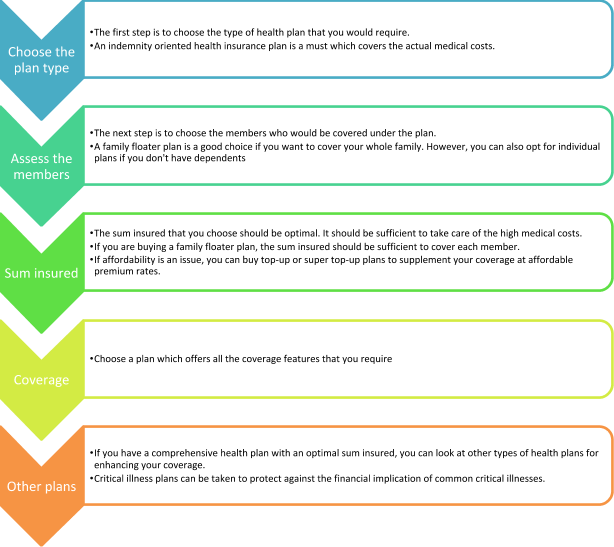
How to choose a health insurance plan?

Among the different varieties of health insurance policies available in the market, choosing the most suitable health plan might prove to be a challenge. So, here are some pointers on how you can choose the best health insurance plan for yourself and your family.

best health insurance plan for yourself and your family

Types of health insurance plans in India:

These top 10 health insurance companies in India offer different types of health insurance plans. Let’s find out the types of plans available and what exactly such plans cover – 

Indemnity Health Insurance Plans: This type of plan pays only for the expenses incurred during hospitalization.

  • Individual health insurance policies –
    Individual health insurance plans cover a single person. The plan has a single coverage amount or sum insured which can be utilised by the insured individual for his medical costs.
  • Family floater health insurance plans –
    These health plans cover the entire family under one sum insured. Family members include you, your spouse, dependent children and dependent parents. Moreover, there are family floater plans which allow coverage for your extended family members too like your uncle, aunt, siblings, etc. Under family floater health insurance plans, a single health insurance plan is issued and the policy covers all family members. Every covered member would be covered for the full sum insured. However, if one member of the family makes a claim, the sum insured would be reduced. Subsequent claims in the same policy year would then be covered up to the reduced sum insured. Family floater health insurance plans have lower premiums compared to individual health insurance plans for different family members. As such, family floater health insurance plans are quite popular and the top ten health insurance companies offer one or more family floater health plans with comprehensive coverage.

  • Senior citizen health insurance plans –
    Normal health insurance plans might have a limit on the entry age. These plans usually allow the maximum entry age to 60 or 65 years. For older individuals, there are senior citizen health insurance plans.
    Senior Citizen health insurance plans are specially designed for providing coverage individuals who are senior citizens, i.e. aged 61 years and above. Senior citizen plans can be taken to cover a single individual or both the husband and wife on a family floater basis. The sum insured under these plans is limited and the premiums are affordable so that older individuals can afford coverage. Moreover, the coverage benefit under senior citizen health insurance plans are also designed keeping in mind the health needs of senior citizens.

  • Top-up and super top-up health insurance policies 
    Top-up and super top-up health insurance plans act as complementary health insurance plans to increase your existing health insurance coverage. Under these health plans, there is a fixed deductible limit and a sum insured. You can choose both the limit and the coverage amount. These plans cover the actual medical costs that you incur provided that the costs exceed the selected deductible. If the claim is below the deductible limit, nothing would be paid. However, if the claim exceeds the deductible limit, the excess would be covered by top-up and super top-up health plans. Thus, if you have an existing health insurance plan, the coverage of the plan can be chosen as a deductible under a top-up or super top-up plan. Claims up to the deductible would be paid by your existing health insurance plan. Excess, if any, would be paid by the top-up or super top-up health insurance plans. Thus, you can get coverage for high sum insured levels at affordable premiums because top-up and super top-up plans have low premiums. Moreover, if you choose top-up and super top-up plans offered by the 10 best health insurance companies, you would also get a comprehensive scope of coverage which covers a range of medical expenses which you might incur. 
  • Disease specific health insurance policies –
    Under disease specific health insurance policies, one or more specific illnesses are covered. Such illnesses are not considered pre-existing illnesses and you get coverage within a short time after buying the policy. Thereafter, if you suffer any medical complications due to the covered illnesses, the plans would pay the medical costs that you incur. Common illness or disease specific health insurance plans include diabetes care plans, cardiac care plans, dengue plans, etc. The 10 best health insurance companies offer unique disease specific health insurance plans for a comprehensive coverage against some of the most dreaded illnesses.

Types of Fixed benefit health insurance policies in India:

These types of plans pay a fixed amount of money on diagnosis of the listed ailment, irrespective of the amount spent on hospitalization. 

Under fixed benefit health insurance plans, the following types of plans can be found – 

  • Critical illness health plan –
    Critical illness health insurance plans cover specified critical illnesses and medical procedures. If during the term of the policy, you are diagnosed with any of the covered illness or you undergo any of the covered medical procedures, the plan pays the entire coverage amount in a lump sum. Common critical illnesses which are covered include cancer, first heart attack, open chest CABG, Coma, kidney failure where regular dialysis is required, etc. When you choose critical illness plans offered by the top ten health insurance companies, you can get coverage against an exhaustive list of critical illnesses.
  • Hospital cash plan –
    Hospital cash plan is also a fixed benefit health plan. Under this plan, if you are hospitalised for 24 hours or more, a fixed lump sum benefit would be paid daily for each day of hospitalisation. Moreover, there is a fixed daily benefit if you are admitted to the ICU. In case of ICU admission, the hospital daily benefit payable usually doubles. The fixed daily benefit is paid up to a specified number of days per instance of claim.
  • Personal accident plans 
    Under personal accident plans, accidental death and disablements are covered. If, in an accident, you suffer accidental death or total/partial permanent disablement, a lump sum benefit would be paid. The benefit depends on the contingency suffered. In case of accidental death and accidental total and permanent disability, 100% of the sum insured is paid. For partial disabilities, 25% to 75% of the sum insured is paid depending on the disability suffered. Personal accident plans also allow optional coverage benefits for loss of job, funeral expenses, fractures, children’s education fund, etc.

A list of all the top 10 health insurance companies are mentioned on this page from where you can take your pick of a health insurance product from the above-mentioned insurers and be assured that you would get the best health insurance coverage. Turtlemint provides you with a comprehensive overview of all the health insurance plans offered by the top 10 health insurance companies so that you can enjoy comprehensive coverage with some of the best features and the premiums would also be affordable. Moreover, with the wide network of tied-up hospitals which then top 10 health insurance companies have, your claims would be settled on a cashless basis and that too within the shortest possible time. So, choose these top 10 health insurance companies from Turtlemint and enjoy good health insurance coverage.

LIC vs Postal Life Insurance – Compare benefits, features & plans

Which one to buy and why?

The Life Insurance Corporation of India (LIC) is a leading life insurance provider which enjoys the immense trust of its customers. It is owned by the Government of India and it offers a range of life insurance plans for its customers. Another Government-owned entity offering life insurance policies is the Post Office. The Post Office offers a range of life insurance plans under the category Postal Life Insurance (PLI). With both LIC and PLI offering a range of life insurance policies, many of you might be confused in choosing the best insurer for your life insurance needs.

So, here is a comparative analysis of life insurance plans offered by PLI and LIC for your knowledge –

Life Insurance Plans offered by LIC:

LIC offers the following types of life insurance plans –

Types of plansPlan names
Term insuranceLIC’s Jeevan Amar

LIC’s Anmol Jeevan II

Whole life insuranceLIC’s Jeevan Umang
Endowment insuranceLIC’s Jeevan Pragati

LIC’s Jeevan Labh

LIC’s Single Premium Endowment Plan

LIC’s New Endowment Plan

LIC’s New Jeevan Anand

LIC’s Jeevan Rakshak

LIC’s Limited Premium Endowment Plan

LIC’s Jeevan Lakshya

LIC’s Aadhar Shila

LIC’s Aadhar Stambh

Money-back insuranceLIC’s Bima Shree

LIC’s Jeevan Shiromani

LIC’s New Money Back Plan – 20 years

LIC’s New Money Back Plan – 25 years

LIC’s New Bima Bachat

LIC’s New Children’s Money Back Plan

LIC’s Jeevan Tarun

Unit Linked insuranceLIC’s New Endowment Plus
Pension plansPradhan Mantri Vaya Vandana Yojana

LIC’s New Jeevan Nidhi

List of Plans offered by the Postal Life Insurance:

PLI, on the other hand, offers the following types of plans –

Types of plansPlan names
Whole life insuranceSuraksha

Suvidha (convertible whole life plan)

Endowment insuranceSantosh
Money-back insuranceSumangal
Child insuranceBal Jeevan Bima
Joint life insuranceYugal Suraksha

Top #9 Differences between the plans offered by Postal Life Insurance and LIC of India:

Now that you know the plans offered by both, here is a comparative analysis between PLI and LIC and the plans that they offer –

  1. Types of policies offered:
PLIPLI offers only traditional life insurance plans which promise guaranteed benefits. Market-linked plans are not available. Moreover, PLI does not offer term insurance or retirement-oriented plans which are also essential in an individual’s financial portfolio.
LICLIC offers all types of life insurance plans, both traditional and market-linked.
  1. Health insurance coverage:
PLIThere is no plan offered by PLI which covers medical costs incurred by an individual in a medical emergency.
LICLIC offers two specialised health insurance policies – LIC’s Jeevan Arogya and LIC’s Cancer Cover. Both these plans cover major illnesses and provide the policyholder with financial assistance if the covered illnesses strike.
  1. Option to enhance the coverage:
PLIThe coverage under the plans offered by PLI cannot be customised or enhanced for your wider coverage needs.
LICLIC offers a range of optional riders which help you in enhancing and customising the coverage of your life insurance policy. The riders offered by LIC include the following –

  • LIC’s Linked Accidental Death Benefit Rider
  • LIC’s Accidental Death and Disability Benefit Rider
  • LIC’s Accidental Benefit Rider
  • LIC’s New Critical Illness Benefit Rider
  • LIC’s New Term Assurance Rider
  1. Available coverage limit:
PLIPlans offered by PLI limit the maximum available sum assured to INR 50 lakhs
LICUnder many LIC plans, there is no limit to the maximum sum assured. You can choose any level of sum assured that you want as per your coverage requirements.
  1. Eligibility to buy the plan:
PLIPLI policies are available only to individuals employed in Government organisations, defence, local bodies, educational institutions, financial institutions, listed companies, professionals, etc.
LICLIC policies are open to all. Any Indian citizen and even NRIs can buy life insurance plans from LIC.
  1. Buying the policy:
PLIPLI policies can be bought only from the post office.
LICLIC policies can be bought by agents, by visiting the company and also online. In fact, buying online is the easiest way to invest in a LIC policy.
  1. Premiums:
PLIPremiums of PLI plans are very low and affordable.
LICIn terms of premiums, LIC has a higher rate of a premium compared to PLI.
  1. Bonus:
PLIMany PLI plans offer a bonus which is quite high.
LICMany LIC plans also offer bonus. However, the bonus rate is low compared to PLI plans.
  1. Maximum age:
PLIPLI policies cover individuals only up to 55 years.
LICLIC plans have a higher coverage age limit. Coverage is allowed even up to 75 years.

Which is better – LIC or PIL?

The question of which option is better entirely rests on your requirements. If you are looking to invest in a traditional endowment plan, PLI is a better alternative as it offers the plan at a very low premium rate. Moreover, endowment plans offered by PLI earn higher bonus rates compared to the plans offered by LIC. So, for traditional endowment plans, PLI is a good choice if you are satisfied with the coverage of up to INR 50 lakhs.

If, on the other hand, you are looking to invest in ULIPs or term insurance plans, LIC is the only solution as these plans are not offered by PLI. Given the fact that a term insurance policy is a must, you should choose LIC for buying a suitable term insurance plan. Moreover, if you want to plan for your retirement or need a health insurance plan, you have to choose LIC since PLI does not offer these plans. Lastly, LIC scores over PLI in terms of its coverage level. If a higher coverage level is on your mind you should go with LIC as PLI limits the coverage available under its plans.

So, assess your insurance needs and make a choice. Both options allow you different types of life insurance plans and the choice of the better option depends entirely on what you require.

FAQs:

  1. Can a loan be taken in a PLI policy?

Yes, PLI plans allow the facility of loans. Loans are available if the policy has run for a minimum period of 3 years and has acquired a minimum surrender value of INR 1000.

  1. Are there tax benefits in LIC and PIL policies?

Yes, both LIC and PLI policies allow tax benefits. The premiums paid are allowed as a deduction under Section 80C up to INR 1.5 lakhs. The benefits received from the policy are also tax-free in your hands under Section 10 (10D).

  1. Can I buy insurance policies from both LIC and PLI?

Yes, you can buy multiple insurance policies from both LIC and PLI.

  1. How to buy LIC policy online?

You can buy LIC policies online through Turtlemint. Turtlemint is an online aggregator which lets you compare life insurance policies of multiple companies and select the best plan. You can visit Turtlemint at www.turtlemint.com and select the type of policy that you want to buy. You can then compare the available plans and buy the best policy for your requirements.

Know everything about UTI unit linked insurance plan

The Unit Trust of India is one of the oldest Asset Management Companies in India which was established in the year 1964. UTI provides different types of mutual fund schemes for investors. The company not only offers mutual funds but other services too like portfolio management services, venture funds, retirement solutions, etc. The company is one of the leading Asset Management Companies in the market with a presence across 150 branches in India and having investor accounts or more than 1 crore individuals.

Besides the different types of mutual fund schemes offered, UTI also offers a unit-linked insurance plan which combines the benefit of insurance cover and investment returns under one.

Let’s understand the plan in details –

What is a unit-linked insurance plan?

A unit-linked insurance plan is a plan which provides insurance coverage as well as market-linked returns. The investments made under a unit-linked plan are invested in market securities. Thereafter, as the securities perform, the investment grows. There is also an insurance cover which pays a lump sum benefit if the investor dies during the term of the plan. Thus, unit-linked insurance plans give you the benefit of mutual funds like investments and also provide financial security through insurance coverage in case of untimely demise.

UTI Unit Linked Insurance Plan:

UTI launched is a unit-linked insurance plan on 1st October 1971. Thereafter, the fund has attracted many investors and the Assets under Management as on 31st July 2019 stands at INR 4182.03 crores. Here are the salient features of the plan –

  • The plan comes in two variants of Direct and Regular. Direct plans can be bought directly from UTI while Regular plans can be bought through mutual fund brokers.
  • The fund invests in debt and equity instruments in the ratio of 60%:40%. Since debt exposure is high, returns are more stable. While equity investments promise attractive returns, debt investments bring stability to the fund portfolio.
  • No pre-entrance medical check-ups are required to buy the plan.
  • You can invest the premium in a lump sum or through SIPs.
  • There is no entry load on your investments. This means that the entire premium paid is utilised for investment promising higher returns.
  • You can opt for Systematic Transfer Investment Plan (STRIP) and choose to invest in UTI ULIP in a systematic manner. Under the STRIP option, the investment would be done from another plan to UTI ULIP at regular intervals.

The investment objective of the UTI Unit-Linked Insurance Plan:

The scheme aims to maximize wealth over a long-term period by investment in equity and debt instruments. It also aims to provide life insurance coverage to investors during the plan tenure so that they can secure themselves financially.

Plan parameters of the UTI Unit-Linked Insurance Plan:

Here are some of the important parameters of the plan

Who can buy?Resident individuals and NRIs. The plan can also be bought in the name of the spouse or dependent children
Duration of the plan10 years or 15 years
Entry agePlan term 10 years – 12 to 55.5 years

Plan term 15 years – 12 to 50.5 years

Minimum investment into the schemeINR 15,000
Maximum investment into the schemeINR 15 lakhs
Life insurance coverINR 15 lakhs
Life insurance cover for non-earning femalesUp to INR 5 lakhs
Exit load2% if withdrawal is done before the completion of the tenure
Total Expense RatioDirect plan – 1.17%

Regular plan – 1.81%

Benchmark indexCRISIL Short Term Debt Hybrid 60+40 Fund Index

Plan benefits of the UTI Unit-Linked Insurance Plan:

The plan offers the following benefits –

  • Life insurance cover:

A life insurance cover of up to INR 15 lakhs is available under the plan. You can choose to avail the cover in the following two options –

  • Declining Term Insurance Cover wherein the coverage amount would reduce every year
  • Fixed Term Cover wherein the coverage amount would remain the same throughout the term of the plan.

In case of premature death of the insured, the applicable coverage amount would be paid.

There is also an inbuilt personal accident insurance cover under the plan. The cover is allowed for up to INR 50,000. If the insured dies in an accident, the additional coverage of INR 50,000 would be paid along with the sum assured.

  • Bonus

Despite the fact that the investments earn attractive market-linked returns, UTI’s unit-linked insurance plan also offers guaranteed bonus to investors. Bonus is paid once the duration of the scheme comes to an end. The bonus payable under the 10-year scheme is 5% and for the 15-year scheme is 7.5%. Moreover, if you continue your investments in the scheme even after the duration is over, you would get a 0.5% additional bonus on the target amount. This is called post maturity bonus and the bonus is paid for each additional year after maturity till you remain invested in the scheme.

  • Maturity benefit

Once the chosen duration of the plan comes to an end, you can withdraw the accumulated corpus in full. There would be no exit load charged on such withdrawal. Once a withdrawal is done, the plan would be terminated.

  • Premature withdrawals

You can withdraw from the scheme completely or partially any time that you want before the chosen term comes to an end. However, for each premature withdrawal, an exit load of 2% would be applicable.

The investment portfolio of the scheme:

As mentioned earlier, UTI Unit Linked Insurance Plan invests in equity and debt in the ratio 40:60. The exact asset allocation of the fund is as follows –

asset allocation

The top 5 sectors into which the fund invests are as follows –

fund invests

The performance of the fund, in terms of absolute returns, as compared to its benchmark index and CRISIL 10-year Gilt Index over different periods is as follows –
performance

NAV of the UTI Unit Linked Insurance Plan scheme:

The current Net Asset Value of UTI ULIP stands as follows –

Type of schemeNet Asset Value as on 30th August 2019
RegularINR 23.8954
DirectINR 24.6981

(Source:https://www.moneycontrol.com/mutual-funds/nav/uti-unit-linked-insurance-plan/MUT018 and https://www.moneycontrol.com/mutual-funds/nav/uti-unit-linked-insurance-plan-ulip-direct-plan/MUT663)

Why buy UTI ULIP?

  1. You get a free insurance cover to provide financial security for your family in case of your untimely demise.
  2. There is an added accidental cover which pays an enhanced benefit in case of accidental death.
  3. You can enjoy attractive returns at low volatility because of the composition of the fund and its asset allocation.
  4. You can avail easy liquidity by withdrawing from the scheme whenever you want.
  5. The premium that you pay would be eligible for tax deductions under Section 80C of the Income Tax Act. You can claim deductions of up to INR 1.5 lakhs through investing in the scheme.
  6. The plan can be easily bought since there are no medical check-ups which you need to undergo for buying the policy.

UTI ULIP, therefore, gives you many benefits including insurance. You can trust the expertise of the oldest Asset Management Company (UTI) to provide you with the best returns on your investments. So, invest in UTI’s unit-linked plan and enjoy the benefit of investment as well as insurance.

FAQs

  1. What is the mode of investing in the scheme?

You can invest annually, half-yearly or through SIPs.

  1. What is the tax implication on capital gains earned from the scheme?

When the plan matures after the selected tenure, the capital gains that you earn would be subject to taxation. Since the plan invests predominantly in debt instruments, the capital gains would be taxed @20% with indexation benefit.

  1. What is the tax implication of the death benefit?

The death benefit would be a tax-free income in the hands of the nominee under Section 10 (10D).

  1. Can investments of more than INR 15 lakhs be made towards the scheme?

Yes, you can invest more than INR 15 lakhs but the target amount of investment and the insurance coverage would be available only up to INR 15 lakhs.